

Home
Class 12
PHYSICS
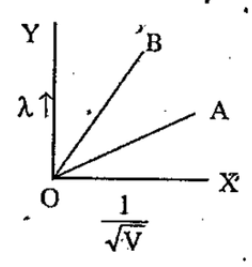
The two lines A and B shown in the graph...

The two lines A and B shown in the graph plot the de Broglie wavelength `(lambda)` as a function of `1/sqrtV` (V is the accelerating potential) for two particles having the same charge which of the two represents the particle for heavier mass? Write down Eienstein’s equation in photoelectrie effect.

Promotional Banner

Topper's Solved these Questions

  • MODEL PAPER SET-04

    UNITED BOOK HOUSE|Exercise EXERCISE|39 Videos
  • MODEL PAPER SET-06

    UNITED BOOK HOUSE|Exercise EXERCISE|45 Videos

Similar Questions

Explore conceptually related problems

Consider two particles of different masses. In which of the following situations the heavier of the two particles will have smaller de Broglie wavelength?

Write the expression for the de Broglie wavelength associated with a charged particle having charge q and mass , when it is accelerated by a potential V.

In which of the following situations the heavier of the two particles has smaller de Broglie wavelength? The two particles

Show that the de Broglie wavelength of charged particles accelerated through a potential of V volt is given by lamda = h//sqrt(2mqV) . Hence show that the de-Broglie wavelength of electron is (12.27)/(sqrtV)Å .

Einstein established the idea of photons on the basis of Planck's quantum theory. According to his idea, the light of frequency f or wavelength lamda is infact a stream of photons. The rest mass of each photon is zero and velocity is equal to the velocity of light (c) = 3 xx 10^(8) m.s^(-1) . Energy, E = hf, where h = Planck's constant = 6.625 xx 10^(-34)J.s . Each photon has a momentum p = (hf)/(c) , although its rest mass is zero. The number of photons increase when the intensity of incident light increases and vice-versa. On the other hand, according to de Broglie any stream of moving particles may be represented by progressive waves. The wavelength of the wave (de Broglie wavelength) is lamda = (h)/(p) , where p is the momentum of the particle. When a particle having charge e is accelerated with a potential difference of V, the kinetic energy gained by the particle is K= eV. Thus as the applied potential difference is increased, the kinetic energy of the particle and hence the momentum increase resulting in a decrease in the de Broglie wavelength. Given, charge of electron, e = 1.6 xx 10^(-19)C and mass = 9.1 xx 10^(-31) kg . The number of photons emitted per second from a light source of power 40 W and wavelength 5893 Å

Einstein established the idea of photons on the basis of Planck's quantum theory. According to his idea, the light of frequency f or wavelength lamda is infact a stream of photons. The rest mass of each photon is zero and velocity is equal to the velocity of light (c) = 3 xx 10^(8) m.s^(-1) . Energy, E = hf, where h = Planck's constant = 6.625 xx 10^(-34)J.s . Each photon has a momentum p = (hf)/(c) , although its rest mass is zero. The number of photons increase when the intensity of incident light increases and vice-versa. On the other hand, according to de Broglie any stream of moving particles may be represented by progressive waves. The wavelength of the wave (de Broglie wavelength) is lamda = (h)/(p) , where p is the momentum of the particle. When a particle having charge e is accelerated with a potential difference of V, the kinetic energy gained by the particle is K= eV. Thus as the applied potential difference is increased, the kinetic energy of the particle and hence the momentum increase resulting in a decrease in the de Broglie wavelength. Given, charge of electron, e = 1.6 xx 10^(-19)C and mass = 9.1 xx 10^(-31) kg . Two stationary electrons are accelerated with potential difference V_(1) and V_(2) respectively such that V_(1) : V_(2) = n . The ratio of their de Broglie wavelength

Einstein established the idea of photons on the basis of Planck's quantum theory. According to his idea, the light of frequency f or wavelength lamda is infact a stream of photons. The rest mass of each photon is zero and velocity is equal to the velocity of light (c) = 3 xx 10^(8) m.s^(-1) . Energy, E = hf, where h = Planck's constant = 6.625 xx 10^(-34)J.s . Each photon has a momentum p = (hf)/(c) , although its rest mass is zero. The number of photons increase when the intensity of incident light increases and vice-versa. On the other hand, according to de Broglie any stream of moving particles may be represented by progressive waves. The wavelength of the wave (de Broglie wavelength) is lamda = (h)/(p) , where p is the momentum of the particle. When a particle having charge e is accelerated with a potential difference of V, the kinetic energy gained by the particle is K= eV. Thus as the applied potential difference is increased, the kinetic energy of the particle and hence the momentum increase resulting in a decrease in the de Broglie wavelength. Given, charge of electron, e = 1.6 xx 10^(-19)C and mass = 9.1 xx 10^(-31) kg . The number of photons emitted per second by a source of light of power 30 W is 10^(20) , the momentum of each photon (in kg.m.s^(-1) )

An LCR circuit is equivalent to a damped pendulam. In an LCR circuit the capacitor is charged to Q_0 and then connected to the L and R as shown below: If the students plots graphs of the square of maximum charge (Q_(max)^2) on the capacitor with time (t) for two different values L_1 and L_2(L_1gtL_2) of L then which of the following represents this graph correctly?(plots are schematice are not drawn to scale)

A proton and an alpha particle are accelerated through the same potential difference. Which one of the two has greater de Broglie wavelength,

UNITED BOOK HOUSE-MODEL PAPER SET-05-EXERCISE
  1. State Biot Savart’s law.

    Text Solution

    |

  2. A ray of lilght is incident at a small angle theta on a rectangular gl...

    Text Solution

    |

  3. Write down the expression of angle of deviation by thin prism. A ray o...

    Text Solution

    |

  4. X-rays of wavelength lambda fall on photosensitive-surface emitting el...

    Text Solution

    |

  5. The two lines A and B shown in the graph plot the de Broglie wavelengt...

    Text Solution

    |

  6. What kind of diode is used as a voltage regulator? .draw the v-i char...

    Text Solution

    |

  7. How is the p-n junction, used as a half wave rectifier and draw the in...

    Text Solution

    |

  8. Write Kirchhoff’s 2nd law.

    Text Solution

    |

  9. For the network of conductors forming an electrical circuit as shown ...

    Text Solution

    |

  10. What is the nature of temperature coefficient of resistance of a semic...

    Text Solution

    |

  11. Group of N cells whose e.m.f. varies directly with the internal resist...

    Text Solution

    |

  12. Show that if n identical conductors are joined in series, the combined...

    Text Solution

    |

  13. It is said that the induced current has no direction of its own. DO yo...

    Text Solution

    |

  14. A closed circular coils of average radius 10 xx 10^-2 m is placed no...

    Text Solution

    |

  15. Show that in the C R circuit, the phase angle is tan^-1(1/(omegaCR))

    Text Solution

    |

  16. In an L-C-R circuit with all components connected in series,the e.m.f....

    Text Solution

    |

  17. In an L-C-R circuit with all components connected in series,the e.m.f....

    Text Solution

    |

  18. In an L-C-R circuit with all components connected in series,the e.m.f....

    Text Solution

    |

  19. In Young’s double slit experiment the distance between two slits is 0....

    Text Solution

    |

  20. In Young’s double slit experiment the distance between two slits is 0....

    Text Solution

    |