Home
Class 12
PHYSICS
A particle moving with velocity vecV is ...

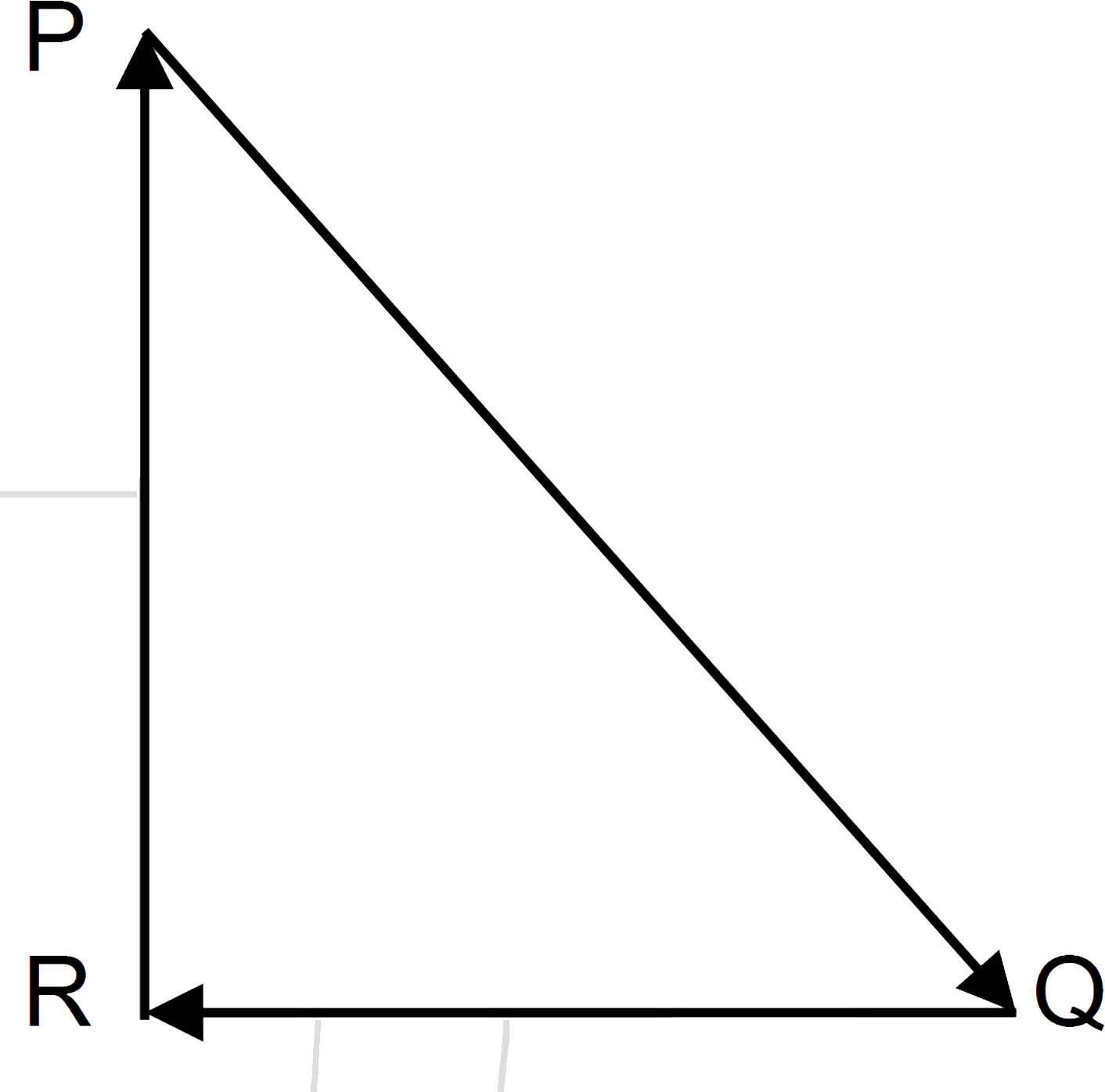
A particle moving with velocity `vecV` is acted by the three forces shown by the vector triangle PQR. The velocity of the particle will :

A

change according to the smallest force `vecQR`

B

increase

C

decrease

D

remain constant

Text Solution

Verified by Experts

The correct Answer is:

D

Net force on the particle is zero
`therefore veca-0`
`vecv` = remains constant
Promotional Banner

Similar Questions

Explore conceptually related problems

The acceleration-displacement graph of a particle moving in a straight line is as shown in figure, initial velocity of particle is zero. Find the velocity of the particle when displacement of the particle is s=12 m .

A graph between the square of the velocity of a particle and the distance s moved by the particle is shown in the figure. The acceleration of the particle is

Acceleration (a) -displacement (s) graph of a particle moving in a straight line is as shown in the figure. The initial velocity of the particle is zero. The v-s graph of the particle would be

Three forces start acting simultaneously on a particle moving with velocity, vecv . These forces are respresented in magnitude and direction by the three sides of a triangle ABC. The particle will now move with velocity

A charged is moving with constant velocity parallel to a horizontal current carrying long wire. The direction of velocity of that particle and the current are same. If the force acting on the particle are only magnetic force due to wire and gravitational force due to earth, then the particle :

Acceleration (a)-displacement(s) graph of a particle moving in a straight line is shown here. The initial velocity of the particle is zero. The v-s graph of the particle would be

The velocity - time graph is shown in the figure, for a particle. The acceleration of particle is

Three forces start acting simultaneously on a particle moving with velocity vec(v) . These forces are represented in magnitude and direction by the three sides os a triangle ABC (as shown). The particle will now move with velocity.

A particle of mass 2kg is moving in free space with velocity vecv_0=(2hati-3hatj+hatk)m//s is acted upon by force vecF=(2hati+hatj-2hatk)N . Find velocity vector of the particle 3s after the force starts acting.

The magnitude of force acting on a particle moving along x-axis varies with time (t) as shown in figure. If at t = 0 the velocity of particle is v_(0) , then its velocity at t=T_(0) will be
