Home
Class 12
CHEMISTRY
An alkene "A" on reaction with O3 and Zn...

An alkene "A" on reaction with `O_3` and Zn gives propanone and acetaldehyde in equimolar Addition of HCl to alkene "A" gives "B" as the product. The structure of product "B" is:

A

`H_(3)C-underset(Cl)underset(|)(CH)-underset(CH_(3))underset(|)overset(CH_(3))overset(|)(CH)`

B

`Cl-CH_(2)-CH_(2)-underset(CH_3)underset(|)overset(CH_(3))overset(|)(CH)`

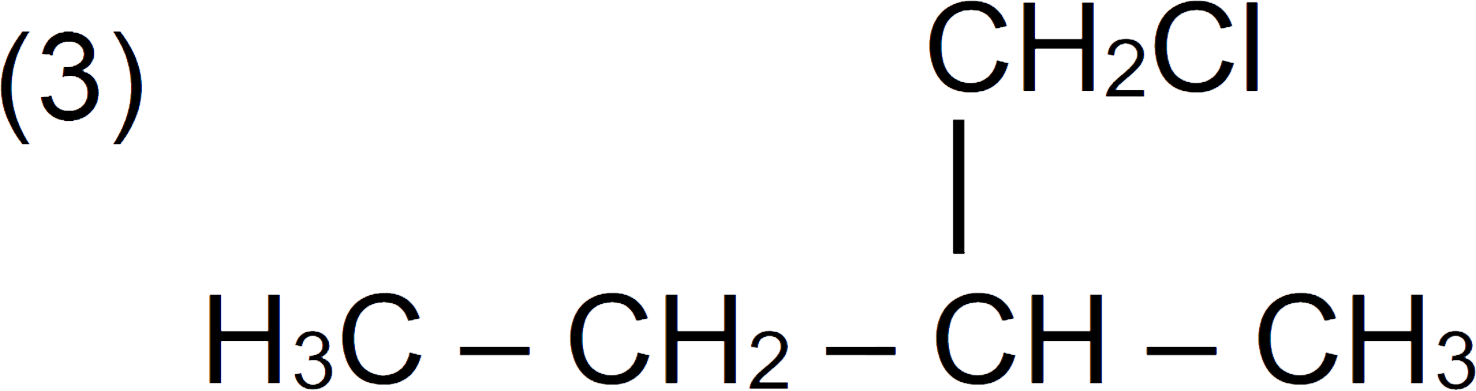
C

D

`H_(3)C-CH_(2)-underset(Cl)underset(|)overset(CH_(3))overset(|)(C)-CH_(3)`

Text Solution

AI Generated Solution

The correct Answer is:

To solve the problem, we need to follow these steps: ### Step 1: Identify the alkene "A" The question states that alkene "A" reacts with ozone (O₃) and zinc (Zn) to produce propanone (acetone) and acetaldehyde in equimolar amounts. The ozonolysis reaction breaks the double bond of the alkene and forms carbonyl compounds. - **Propanone (acetone)** has the structure: \[ \text{CH}_3\text{C(=O)}\text{CH}_3 \] - **Acetaldehyde** has the structure: \[ \text{CH}_3\text{C(=O)}\text{H} \] From these products, we can deduce the structure of alkene "A". The ozonolysis reaction suggests that alkene "A" must have a double bond between two carbon atoms that can lead to these products. ### Step 2: Construct alkene "A" To find alkene "A", we can combine the carbon skeletons of the products. The two carbonyl compounds suggest that the alkene must have the following structure: \[ \text{CH}_3\text{C}=\text{C}\text{H}\text{CH}_3 \] This structure corresponds to 2-butene (or its isomer). ### Step 3: Addition of HCl to alkene "A" Now, we need to consider the addition of HCl to alkene "A". According to Markovnikov's rule, when HCl adds to an unsymmetrical alkene, the hydrogen (H⁺) will attach to the carbon with the greater number of hydrogen atoms, while the chloride ion (Cl⁻) will attach to the carbon with fewer hydrogen atoms. 1. The double bond in 2-butene can be represented as: \[ \text{CH}_3\text{C}=\text{C}\text{H}\text{CH}_3 \] 2. When HCl is added: - The H⁺ will attach to the carbon that has more hydrogen atoms (the left carbon). - The Cl⁻ will attach to the carbon that has fewer hydrogen atoms (the right carbon). ### Step 4: Determine the structure of product "B" After the addition of HCl, we will get: \[ \text{CH}_3\text{C(Cl)}\text{H}\text{CH}_3 \] This structure corresponds to 2-chloro-2-methylbutane. ### Final Answer The structure of product "B" is: \[ \text{2-chloro-2-methylbutane} \]

To solve the problem, we need to follow these steps: ### Step 1: Identify the alkene "A" The question states that alkene "A" reacts with ozone (O₃) and zinc (Zn) to produce propanone (acetone) and acetaldehyde in equimolar amounts. The ozonolysis reaction breaks the double bond of the alkene and forms carbonyl compounds. - **Propanone (acetone)** has the structure: \[ \text{CH}_3\text{C(=O)}\text{CH}_3 \] ...
Promotional Banner

Similar Questions

Explore conceptually related problems

Alkenes on treating with O_3 and then the product on reduction may give

An alkene on ozonolysis gives methanal as one of the product. Its structure is :

(B) on treatment with Zn//HCl gives :

In the following reaction sequence, the products (B) to ( E) are formed. . The structure of product (B) is :

In the following reaction sequence, the products (B) to ( E) are formed. . The structure of product ( C) is :

In the following sequence of reactions, products A to D are formed: The structure of product (B) is:

In the following reaction sequence, the products (B) to ( E) are formed. . The structure of product ( E) is :

In the following reaction sequence, the products (B) to ( E) are formed. . The structure of product (F) is :

In the following reaction sequence, the products (B) to ( E) are formed. . The structure of product (D) is :

In the following sequence of reactions, products B to E are formed: The structure of product (E) is:
