Home
Class 12
PHYSICS
Six vectors, vec(a) through vec(f) have ...

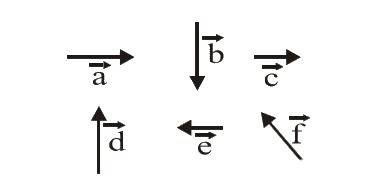
Six vectors, `vec(a)` through `vec(f)` have the magnitudes and directions indicated in the figure. Which of the following statements is true?

A

b +c =f

B

d + c =f

C

d +e =f

D

b + e =f

Text Solution

Verified by Experts

The correct Answer is:

c
Promotional Banner

Similar Questions

Explore conceptually related problems

Six vector vec(a) through vec(f) have the magnitudes and direction indicated in the figure. Which of the following statements is true?

Six vector vec(a) through vec(f) have the magnitudes and direction indicated in the figure. Which of the following statements is true?

Six vectors hata to hati have the magnitude and directions indicated in the figure . Which of the following statement is true ?

If vec(P) xx vec(Q) =vec(R ) , then which of the following statements is not true?

A particle performs SHM along a straight line and its position is vec(R ) , acceleration is vec(a) , velocity is vec(v) is and force on particle is vec(f) . Then which of the following statement are true? (i) vec(v). vec(a) is always + ve (ii) vec(v).vec(R ) may be -ve (iii) vec(f).vec(R ) is always -ve (iv) vec(v) is parallel to vec(f) sometimes

Three coplanar vectrors vec(A), vec(B) and vec(C) have magnitudes 4, 3 and 2 respectively. If the angle any two vector is 120^(@) then which of the following vector may be equal to (3vec(A))/4+vec(B)/3+vec(C)/2

vec(A) is a vector with magnitude A, then the unit vector hat(A) in the direction vec(A) is

Statement 1: If | vec a+ vec b|=| vec a- vec b| , then vec a and vec b are perpendicular to each other. Statement 2: If the diagonal of a parallelogram are equal magnitude, then the parallelogram is a rectangle. Which of the following Statements is/are correct ?

If vec r is a vector of magnitude 21 and has direction ratios 2,-3a n d6, then find vec rdot

The resultant and dot product of two vectors vec(a) and vec(b) is equal to the magnitude of vec(a) . Show that when the vector vec(a) is doubled , the new resultant is perpendicular to vec(b) .
