Home
Class 12
PHYSICS
Two pith balls carrying equal charges ar...

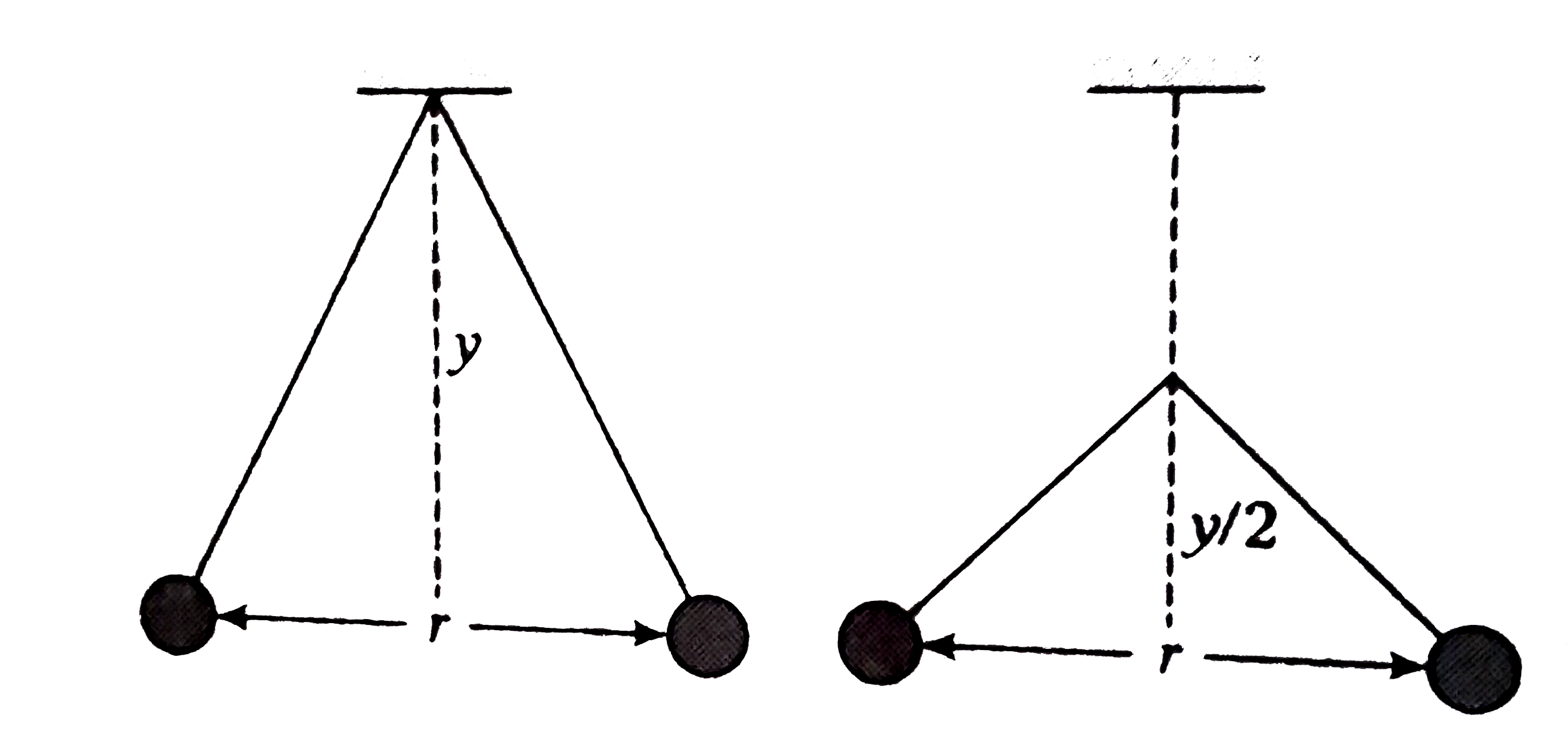
Two pith balls carrying equal charges are suspended from a common point strings of equal length, the equilibrium separation between them is r. Now, the strings are rigidly clamped at half the height. The equilibrium separation between the balls now becomes

A

`((1)/(sqrt(2)))^(2)`

B

`((r))/(sqrt(2)))`

C

`((2r)/(sqrt(3)))`

D

`((2r)/(3))`

Text Solution

Verified by Experts

The correct Answer is:

B
Promotional Banner

Similar Questions

Explore conceptually related problems

Two pitch balls carrying equal charges are suspended from a common point by strings of equal length, the equilibrium separation between them is r. Now the strings are rigidly clamped at half the height. The equilibrium separation between the balls now become

Two path balls carrying equal charges are suspended from a common point by strings of equal length, the strings are rightly clamped at half the height. The equilibrium separation between the balls, now becomes :

Two identical pith balls, each carrying charge q, are suspended from a common point by two strings of equal length l. Find the mass of each ball if the angle between the strings is 2theta in equilibrium.

Two indentical pith balls, each carrying charge q, are suspended from a common point by two strings of equal length l. Find the mass of each ball if the angle between the strings is 2theta in equilibrium.

Two identical pith balls are charged by rubbing against each other. They are suspended from a horizontal rod through two strings of length 20 cm each, the separation between the suspension points being 5 cm. in equilibrium, the separation between the balls in 3 cm. Find the mass of each ball and the tension in the strings. the charge on each ball gas a magnitude 2.0 xx 10^(-8) C.

Assertion : Two identical balls are charged by q. They are suspended from a common point by two insulating threads l each. In equilibrium, the angle between the tension in the threads is 180^(@) . (Ignore gravity). Reason : In equilibrium tension in the spring is T=1/(4pi epsi_(0)) (q.q)/l^(2)

Two identical balls each having a density rho are suspended from as common point by two insulating strings of equal length. Both the balls have equal mass and charge. In equilibrium each string makes an angle theta with vertical. Now, both the balls are immersed in a liquid. As a result the angle theta does not change. The density of the liquid is sigma . Find the dielectric constant of the liquid.

Two identical balls each having a density rho are suspended from as common point by two insulating strings of equal length. Both the balls have equal mass and charge. In equilibrium each string makes an angle theta with vertical. Now, both the balls are immersed in a liquid. As a result the angle theta does not change. The density of the liquid is sigma . Find the dielectric constant of the liquid.

Two similar balls having equal positive charge q are suspanded by two insulating stings of equal length. What would be the effect on the force when a plastic sheet is inserted between the two ?

Two identical balls , each having a charge q and mass m , are suspended from a common point by two insultating strings each of length L . The balls are held at a separation x and then released. Find (a) the electric force on each ball (b) the component of the resultant force on a ball along and perpendicular to string (c ) the tension in the string (d) the acceleration of one of the balls. Consider the situation only for the instant just after the release.
