Home
Class 12
CHEMISTRY
Acetone is treated with excess of ethano...

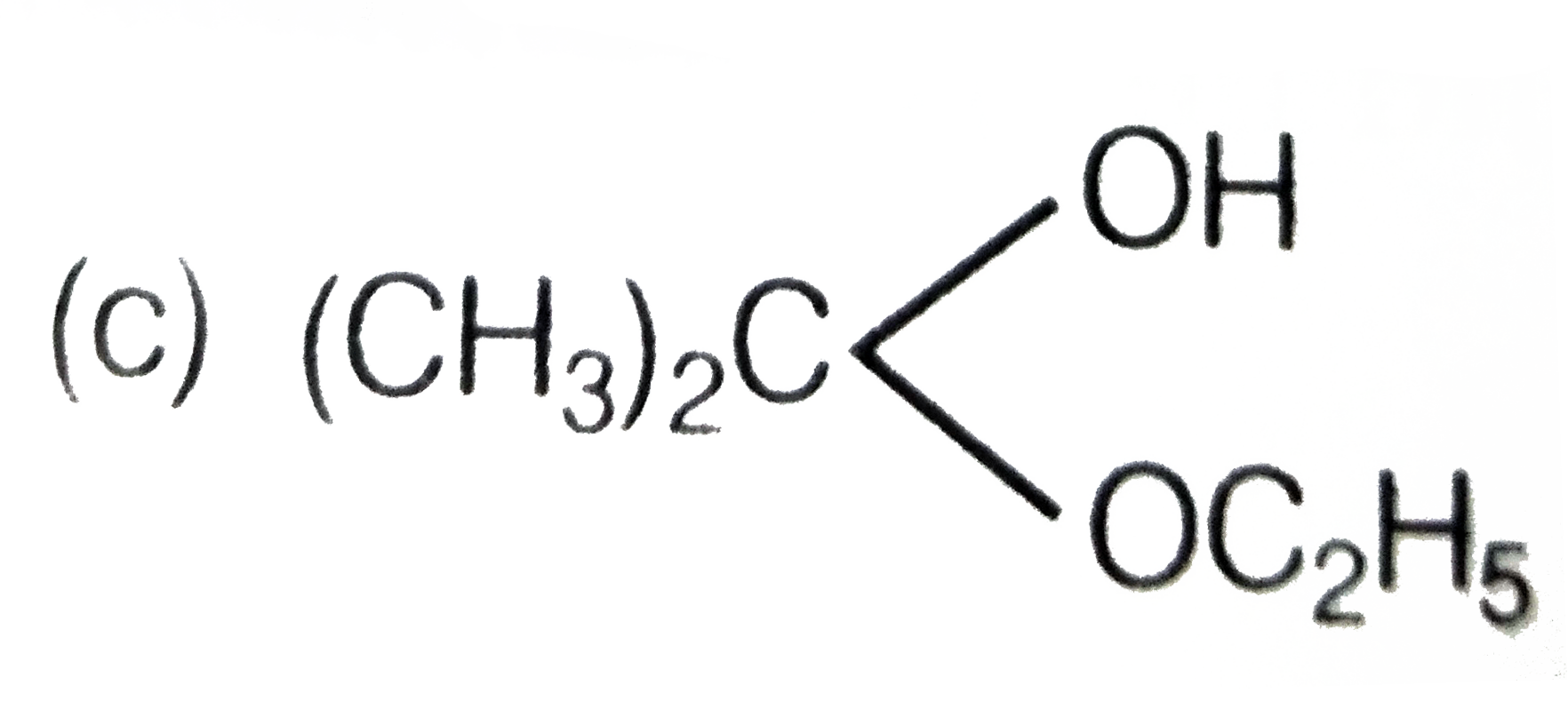
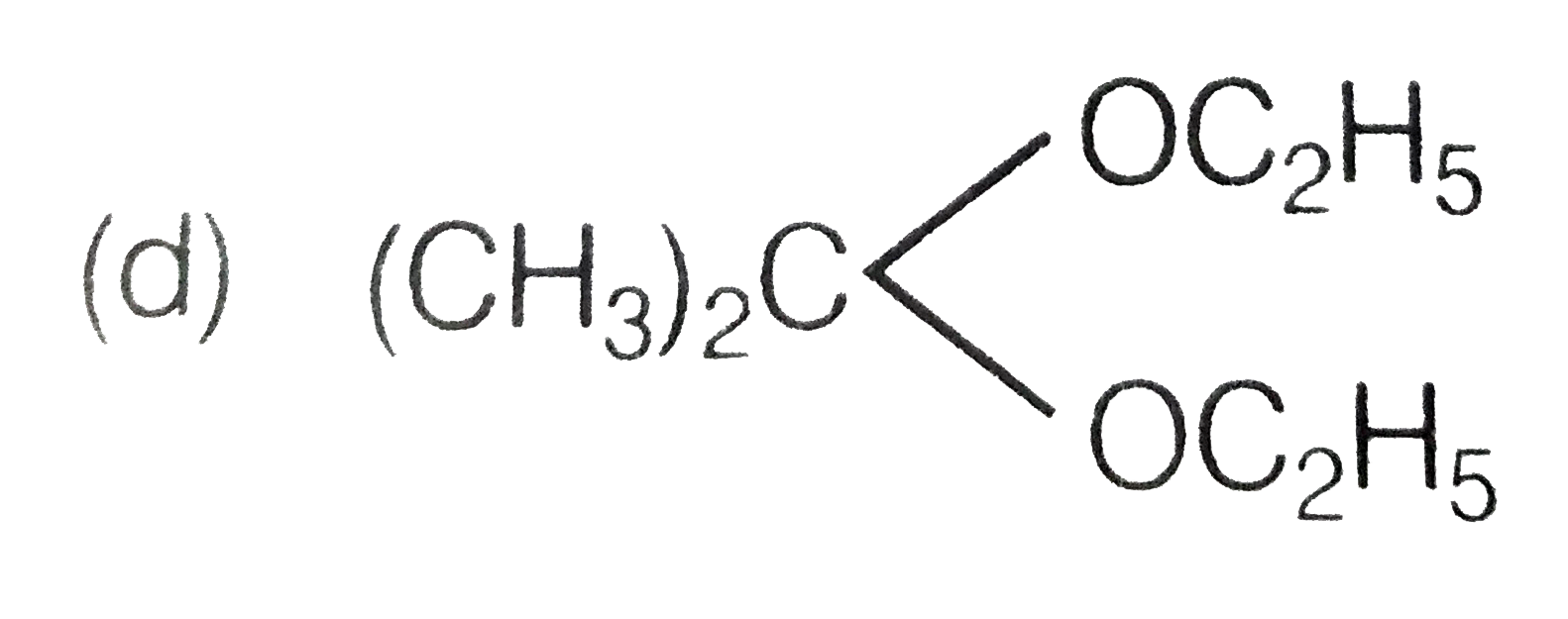
Acetone is treated with excess of ethanol in the presence of hydrochloric acid. The product obtained is

A

`CH_(3)CH_(2)CH_(2)-overset(O)overset(||)(C)-CH_(3)`

B

`CH_(3)CH_(2)CH_(2)-overset(O)overset(||)(C)-CH_(2)CH_(2)CH_(3)`

C

D

Text Solution

AI Generated Solution

The correct Answer is:

To solve the question regarding the treatment of acetone with excess ethanol in the presence of hydrochloric acid, we can follow these steps: ### Step-by-Step Solution: 1. **Identify the Reactants**: - The reactants in this reaction are acetone (a ketone) and ethanol (an alcohol). The chemical structure of acetone is \( CH_3COCH_3 \) and that of ethanol is \( C_2H_5OH \). 2. **Understanding the Reaction Conditions**: - The presence of hydrochloric acid (HCl) acts as a catalyst in this reaction, facilitating the formation of hemiacetals or hemiketals. 3. **Formation of Hemiketal**: - When acetone reacts with ethanol, the carbonyl group (C=O) of acetone reacts with the hydroxyl group (OH) of ethanol. This leads to the formation of a hemiketal. - The reaction can be represented as: \[ CH_3COCH_3 + C_2H_5OH \xrightarrow{HCl} CH_3C(OH)(C_2H_5)CH_3 \] - This product is known as a hemiketal because it contains one alkoxy group (from ethanol) and one hydroxyl group. 4. **Conversion to Ketal**: - Since the question states that there is an excess of ethanol, the hemiketal can further react with another molecule of ethanol. The hydroxyl group (OH) from the hemiketal is eliminated, and a new bond is formed with another ethanol molecule. - The reaction can be represented as: \[ CH_3C(OH)(C_2H_5)CH_3 + C_2H_5OH \rightarrow CH_3C(O C_2H_5)(O C_2H_5)CH_3 \] - The final product is a ketal, which is a fully substituted ether derived from the ketone. 5. **Final Product**: - The final product can be represented as: \[ CH_3C(O C_2H_5)(O C_2H_5)CH_3 \] - This compound is known as a ketal, specifically diethyl ketal of acetone. 6. **Conclusion**: - Therefore, the product obtained when acetone is treated with excess ethanol in the presence of hydrochloric acid is a ketal. ### Final Answer: The product obtained is **diethyl ketal of acetone**. ---

To solve the question regarding the treatment of acetone with excess ethanol in the presence of hydrochloric acid, we can follow these steps: ### Step-by-Step Solution: 1. **Identify the Reactants**: - The reactants in this reaction are acetone (a ketone) and ethanol (an alcohol). The chemical structure of acetone is \( CH_3COCH_3 \) and that of ethanol is \( C_2H_5OH \). 2. **Understanding the Reaction Conditions**: ...
Promotional Banner

Similar Questions

Explore conceptually related problems

When diethyl ether is treated with excess of CI_(2) in the presence of sum light, the product formed is :

The product formed by the reaction of acetaldehyde with excess of ethanol in the presence of sulphuric acid is:

Benzene is treated with methyl chloride in presence of anhydrous AlCl_3 and the product treated with excess of chlorine in presence of UV light. The final product is:

When chlorobenzene is treated with NH_(3) in presence of Cu_(2)O in xylene is 570 K. The product obtained is

Toluene is nitrated and the resulting product is reduced with tin and hydrochloric acid. The product so obtained is diazotised and then heated with cuprous bromide. The reaction mixture so formed contains

When mercury (II) chloride is treated with excess of stannous chloride, the products obtained are :

Aniline is reacted with bromine water and the resulting product is treated with an aqueous solution of sodium nitrite in presence of dilute hydrochloric acid. The compound so formed is converted into. The compound so formed is converted into a tetrafluoroborate which is subsequently heated. The final product is

The precipitation of second group sulphides qualitative analysis is carried out with hydrogen sulphide in the presence of hydrochloric acid but not with nitric acid .Explain.

If acetylene is reacted with an excess of sodium metal in hexane and the reaction product is treated with 1-bromopropane , the final product will be

Assetion : Permanganate titrations is not carried out in presence of hydrochloric acid. Reason : Hydrochloric acid is oxidised to chlorine.
