Home
Class 12
PHYSICS
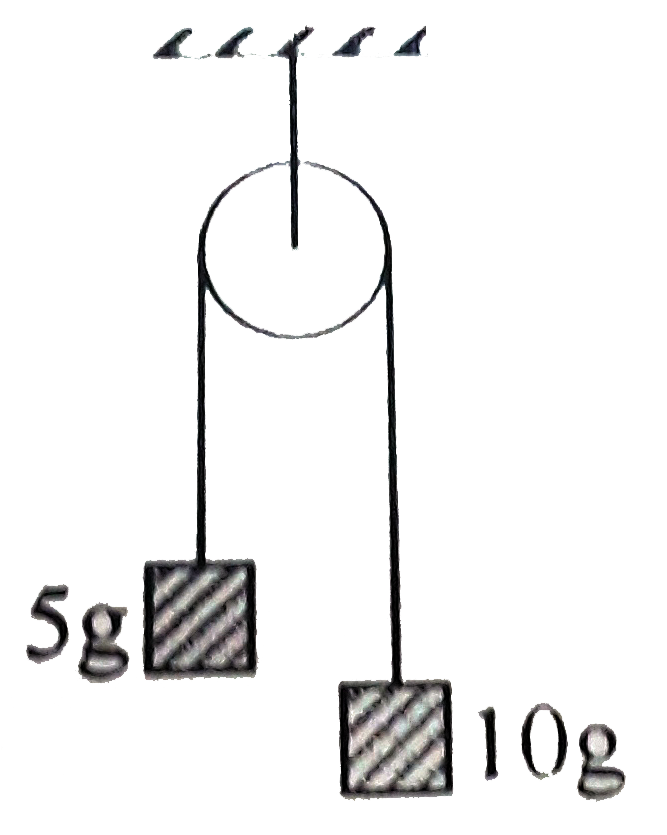
Two masses as shown are suspended from a...

Two masses as shown are suspended from a massless pulley. Calculate the acceleration of the system when masses aere left free:

A

2g/3

B

g/3

C

g/9

D

g/7

Text Solution

Verified by Experts

The correct Answer is:
B

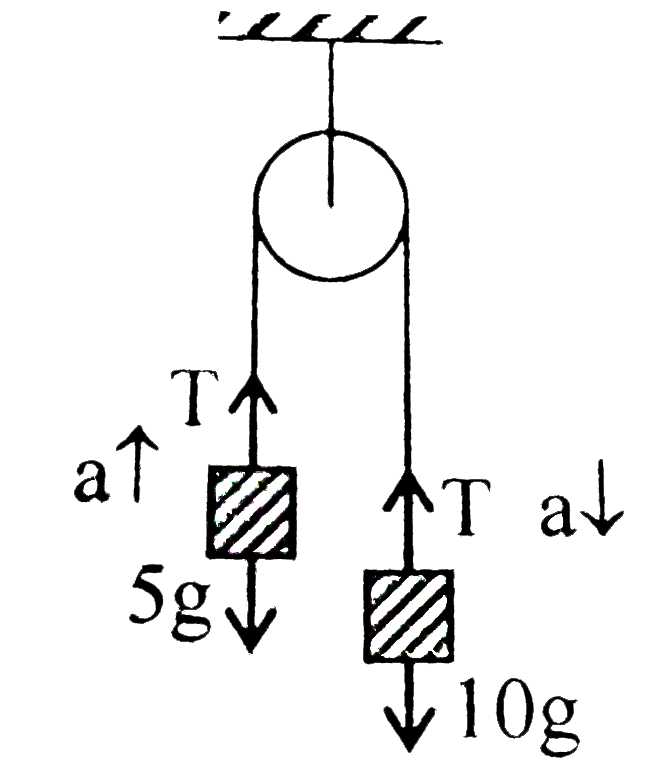
`10g - T = 10a`
`T - 5g = 5a`
`5g = 15a`
`a = (g)/(3)`
Promotional Banner

Similar Questions

Explore conceptually related problems

Two masses as shown are suspended from a massless pulley. Calculate the acceleration of the system when masses are left free.

Two masses as shown are suspended from a massless pulley. Calculate the acceleration of the 10 kg mass when masses are left free

Two masses m_1=5kg and m_2=4.8kg tied to a string are hanging over a light frictionless pulley. What is the acceleration of the masses when left free to move?

In the figure shown neglecting friction and mass of pulley, what is the acceleration of mass B ?

USS 150) Two masses of 5 kg and 10 kg are connected to a pulley as shown. What will be the acceleration of the system (g= acceleration due to gravity)

Two blocks of masses 6 kg and 4 kg are attached to the two ends of a massless string passing over a smooth fixed pulley. if the system is released, the acceleration of the centre of mass of the system will be

Two masses m 1 and m 2 are suspended together by a massless spring of constant K . When the masses are in equilibrium, m 1 is removed without disturbing the system. The amplitude of oscillations is

Two masses m_(1)and M_(2) are suspended together by a massless spring of constant k. When the masses are in equilibrium, m_(1) is removed without disturbing the system. Then the angular frequency of oscillation of m_(2) is

Two masses M and m are suspended together by massless spring of force constant -k. When the masses are in equilibrium, M is removed without disturbing the system. The amplitude of oscillations.

Two masses m_(1) and m_(2) are suspended together by a massless spring of constant k. When the masses are in equilibrium, m_(1) is removed without disturbing the system. Then the angular frequency of oscillation of m_(2) is

