Home
Class 12
PHYSICS
Two sound sources emitting sound each of...

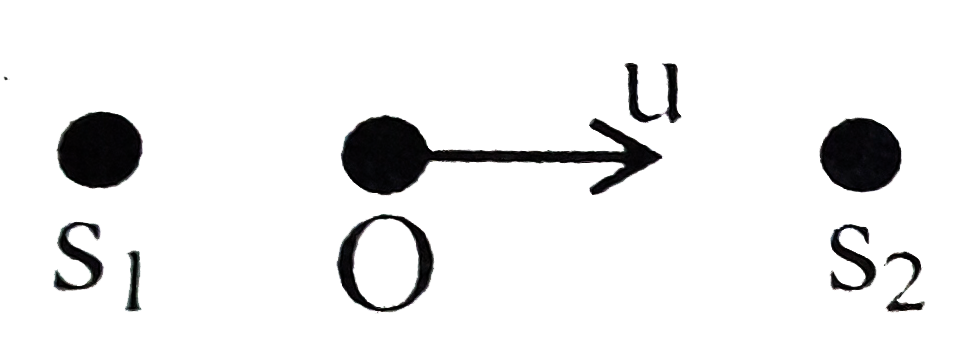
Two sound sources emitting sound each of wavelength `lambda` are fixed at a given distance apart. A listener moves with a velocity `u` along the line joining the two sources. The number of beats heard by him per second is

A

`(2u)/(lambda)`

B

`(u)/(lambda)`

C

`sqrt(u lambda)`

D

`(u)/(2 lambda)`

Text Solution

Verified by Experts

The correct Answer is:
A


For first source
`n_(1) = n ((v - u)/(v)) = (1 - (u)/(v))n`
for Iind source
`n_(2) = n ((v + u)/(v)) = (1 + (n)/(v)) n`
Beat freq. `= [n_(1) - n_(2)] = n + (nu)/(v) - n + (nu)/(v)`
`= (2nu)/(v) = 2 (u)/(lambda) [:' v = n lambda :. (1)/(lambda) = (n)/(v)]`
Promotional Banner

Similar Questions

Explore conceptually related problems

A and B are two identical sound sources cachemitting a note of frequency 1000 Hz. A person moves from A to B along the line joining the two sources. How fast should be move to that he has 7 beats per second. velocity of sound 330 m/s ?

Two coherent sound sources A and B produce a sound of wavelength lambda. If at t=0 a detector starts moving with constant velocity v_(0) from point O along y - direction, then the minimum time, after which it detects the sound of maximum intensity, is (D gt gt lambda)

two piano keys are stuck simultaneously. the notes emitted by them have a frequencies 250 Hz and 253 Hz. the number of Beats heard per second is

Two coherent light sources, each of wavelength lambda , are separated by a distance 3 lambda , The maximum number of minima formed on line AB, which funs from -oo to +oo , is

Two sound waves of wavelengths 98cm and 100cm arrive at the same point,from two different source.The number of beats heard (per second) is (speed of sound is 392m/s)

Two identical source moving parallel to each other at seperation 'd' are producing sounds of frequency 'f' and are moving with constant velocity v_(0) . A stationary .observer 'O' is on the line of motion of one of the sources. Then the variation of beat frequency heard by O with time is best represented by: (as they come from large distance and go to a large distance)

A sound source emits two sinusoidal sound waves, both of wavelength lambda , along paths A and B as shown in figure.The sound travelling along path B is reflected from five surfaces as shown and then merges at point Q, producing minimum intensity at that point.The minimum value of d in terms of lambda is :

Two coherent sources separated by distance d are radiating in phase having wavelength lambda . A detector moves in a big circle around the two sources in the plane of the two sources. The angular position of n=4 interference maxima is given as

Two stationary sources of sound, S_(1) and S_(2) having an equal frequency are fixed some distance apart. The position A is left of S_(1) , position B in the middle of the two sources and positionC is to the right of S_(2) . An observer starts moving with velocity V_(0) from position A towards S_(1) , then

Two coherent sources emit light of wavelength lambda . Separation between them, d = 4 lambda . If a detector moves along the y-axis, what is the maximum number of minima observed?

