Home
Class 12
CHEMISTRY
CH(2)OHCH(2)OH on heating with periodic ...

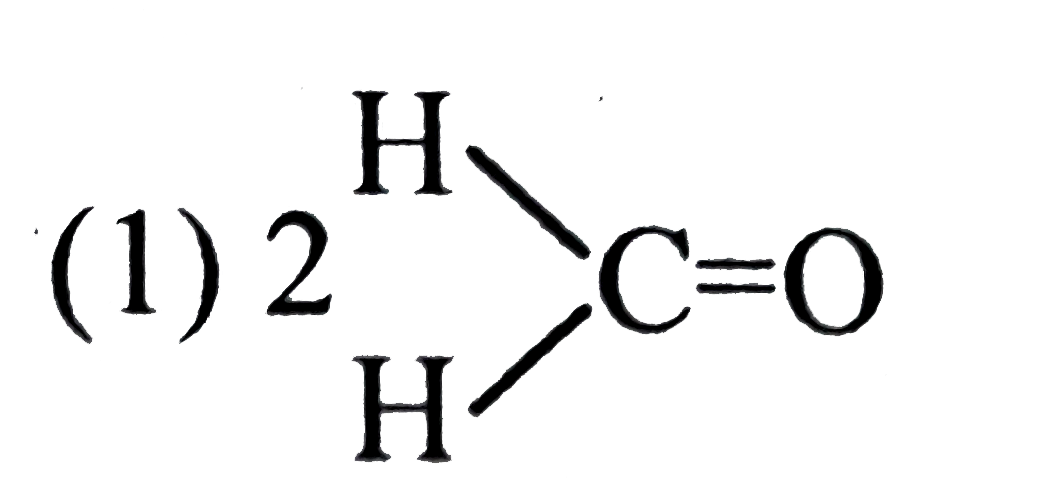
`CH_(2)OHCH_(2)OH` on heating with periodic acid gives

A

B

`2CO_(2)`

C

`2HCOOH`

D

`{:(CHO),(|),(CHO):}`

Text Solution

AI Generated Solution

The correct Answer is:

To solve the problem of what product is formed when ethylene glycol (CH₂OH-CH₂OH) is heated with periodic acid (HIO₄), we can follow these steps: ### Step-by-Step Solution: 1. **Identify the Reactants**: - The compound given is ethylene glycol, which has the formula CH₂OH-CH₂OH. - The reagent used is periodic acid, represented as HIO₄. 2. **Understand the Reaction**: - Periodic acid is known to oxidize glycols. In this case, it will cleave the carbon-carbon bond in ethylene glycol and oxidize the hydroxyl groups. 3. **Reaction Mechanism**: - When ethylene glycol reacts with periodic acid, it undergoes oxidative cleavage. The two hydroxyl (-OH) groups are oxidized, and the carbon-carbon bond between the two carbon atoms is broken. - This results in the formation of two molecules of formaldehyde (HCHO). 4. **Write the Balanced Equation**: - The reaction can be summarized as: \[ \text{CH}_2\text{OH-CH}_2\text{OH} + \text{HIO}_4 \rightarrow 2 \text{HCHO} + \text{HIO}_3 + \text{H}_2\text{O} \] - Here, two moles of formaldehyde (HCHO) are produced, along with iodic acid (HIO₃) and water (H₂O). 5. **Identify the Products**: - From the balanced equation, we see that the primary product formed is formaldehyde (HCHO). - Therefore, the answer to the question is that ethylene glycol on heating with periodic acid gives formaldehyde. ### Final Answer: The product formed when CH₂OH-CH₂OH is heated with periodic acid is **formaldehyde (HCHO)**. ---

To solve the problem of what product is formed when ethylene glycol (CH₂OH-CH₂OH) is heated with periodic acid (HIO₄), we can follow these steps: ### Step-by-Step Solution: 1. **Identify the Reactants**: - The compound given is ethylene glycol, which has the formula CH₂OH-CH₂OH. - The reagent used is periodic acid, represented as HIO₄. ...
Promotional Banner

Similar Questions

Explore conceptually related problems

Of the two alcohols, (a) CH_(2)=CH-CH_(2)OH and (b) CH_(2)=CH-CH_(2)-CH_(2)OH , which one will react more easily with conc. HCl in the presence of ZnCl_(2) ?

How many acidic H - atoms are present in the compound CH_3CH(OH)CH_(2)CH_2NH_2 that can react with overset(Theta)R of R - MgX to give alkane.

CH_(2)OHCH_(2)CH_(2)COCH_(3)overset("Reagent")rarr CH_(2)OHCH_(2)CH_(2)CH_(2)CH_(3) Suitable reagent for above reaction is :-

An alcohol on oxidation is found to give CH_(3)COOH and CH_(3)CH(OH)CH_(2)CH_(2)CH_(3) The structure of the alcohol is :

(a) What happens when CH_(3) - O - CH_(3) is heated with HI ? (b) Explain mechanism for hydration of acid catalyzed ethene : CH_(2)=CH_(2)+H_(2)Ooverset(H^(+))rarrCH_(3)-CH_(2)-OH

Which of the following compound will not give positive test with NaHCO_(3) .? {:("Phenol"",",CH_(3)COOH",",CH_(3)CH_(2)SO_(3)H",",CH_(3)C-=CH",",CH_(3)CH_(2)OH","),("Phthalic acid" ,"Salicylic acid" ",","Cinammic acid","Lactice acid",P-"Cresol"):}

The dehydration of malonic acid CH_(2) (COOH)_(2) with P_(4)O_(10) and heat give

The dehydration of malonic acid CH_(2) (COOH)_(2) with P_(4)O_(10) and heat give

Arrange the following in decreasing order of their acidic strength and give reason for your answer. CH_(3)CH_(2)OH, CH_(3)COOH, ClCH_(2)COOH, FCH_(2)COOH, C_(6)H_(5)CH_(2)COOH

Heating of [CH_3 CH_2 CH_2CH(CH_3 )N^(+)(CH_3)_3 OH ^- gives the major product :
