Home
Class 12
PHYSICS
The kinetic energies of a planet in an e...

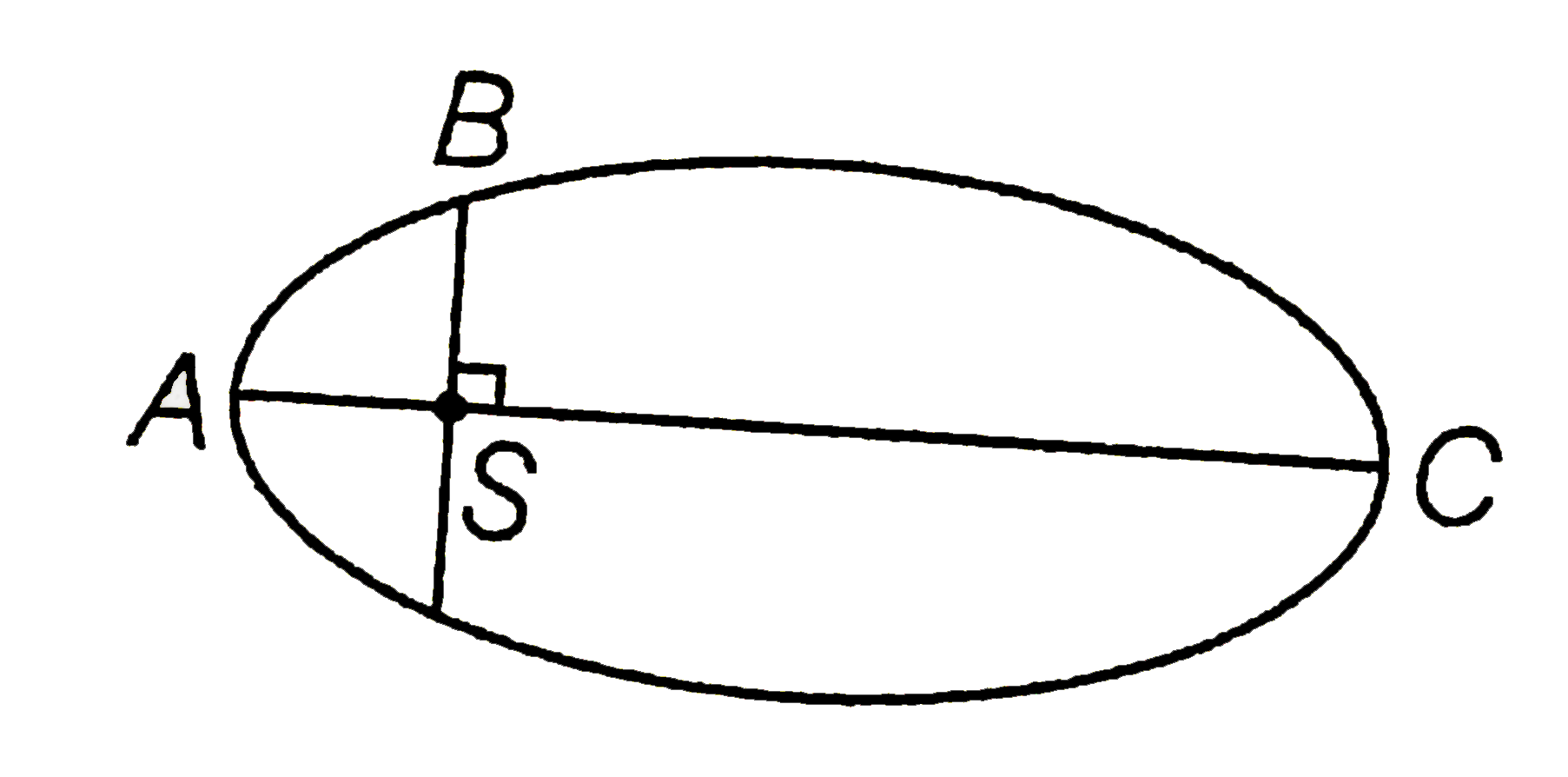
The kinetic energies of a planet in an elliptical orbit about the sun, at positions A,B and C are `K_(A),K_(B)and K_(C)` repectively.AC is the major axis and SB is perpendicular to AC at the position of the Sun S as shown in the figure .Then

A

`K_(B) lt K_(A) lt K_(C)`

B

`K_(A) gt K_(B) gt K_(C)`

C

`K_(A) lt K_(B) lt K_(C)`

D

`K_(B) gt K_(A) gt K_(C)`

Text Solution

Verified by Experts

The correct Answer is:
B


Point A is perihelion and C is aphelion.
So, `V_(B) gt V_(B) gt V_(C)`
So, `K_(A) gt K_(B) gt K_(C)`
Promotional Banner

Similar Questions

Explore conceptually related problems

The kinetic energies of a planet in an elliptical orbit about the Sun, at positions A,B and C are K_(A),K_(B) and K_(C) respectively. AC is the major axis and SB is perpendicular to AC at the position of the sun as shown in the figure. Then

In the figure shown a planet moves in an elliptical orbit around the sun. Compare the speeds, linear and angular momenta at the points A and B .

Figure shows a planet in an elliptical orbit around the Sun S . Where is the kinetic energy of the planet maximum?

A planet is moving in an elliptical path around the sun as shown in figure. Speed of planet in positions P and Q are V_(1) and V_(2) respectively with SP=r_(1) and SQ=r_(2) , then v_(1)//v_(2) is equal to

If veca & vecb are the position vectors of A & B respectively and C is a point on AB produced such that AC=3AB then the position vector of C is:

A planet is revolving round the sun in an elliptical orbit as shown in figure. Select correct alternative(s)

The kinetic energy K of a particle moving along x - axis varies with its position (x) as shown in figure The magnitude of force acting on particle at x = 9 mis

Figure shows the motion of a planet around the Sun S in an elliptical orbit with the Sun at the focus. The shaded areas A and B are also shown in the figure which can be assumed to be equal. If t_(1) and t_(2) represent the time taken for the planet to move from a to b and c to d , respectively then

Figure shows the motion of a planet around the Sun S in an elliptical orbit with the Sun at the focus. The shaded areas A and B are also shown in the figure which can be assumed to be equal. If t_(1) and t_(2) represent the time taken for the planet to move from a to b and c to d , respectively then

A planet is revolving round the sun is elliptical orbit. Velocity at perigee position ( nearest) is v_(1) and at apogee position ( farthest) is v_(2) . Both these velocities are perpendicular to the line joining centre of sun and planet. r_(1) is the minimum distance and r_(2) the maximum distance. When the planet is at perigee position, it wants to revolve in a circular orbit by itselff. For this, value of G

