Home
Class 12
MATHS
Let A,B,C,D,E represent vertices of a re...

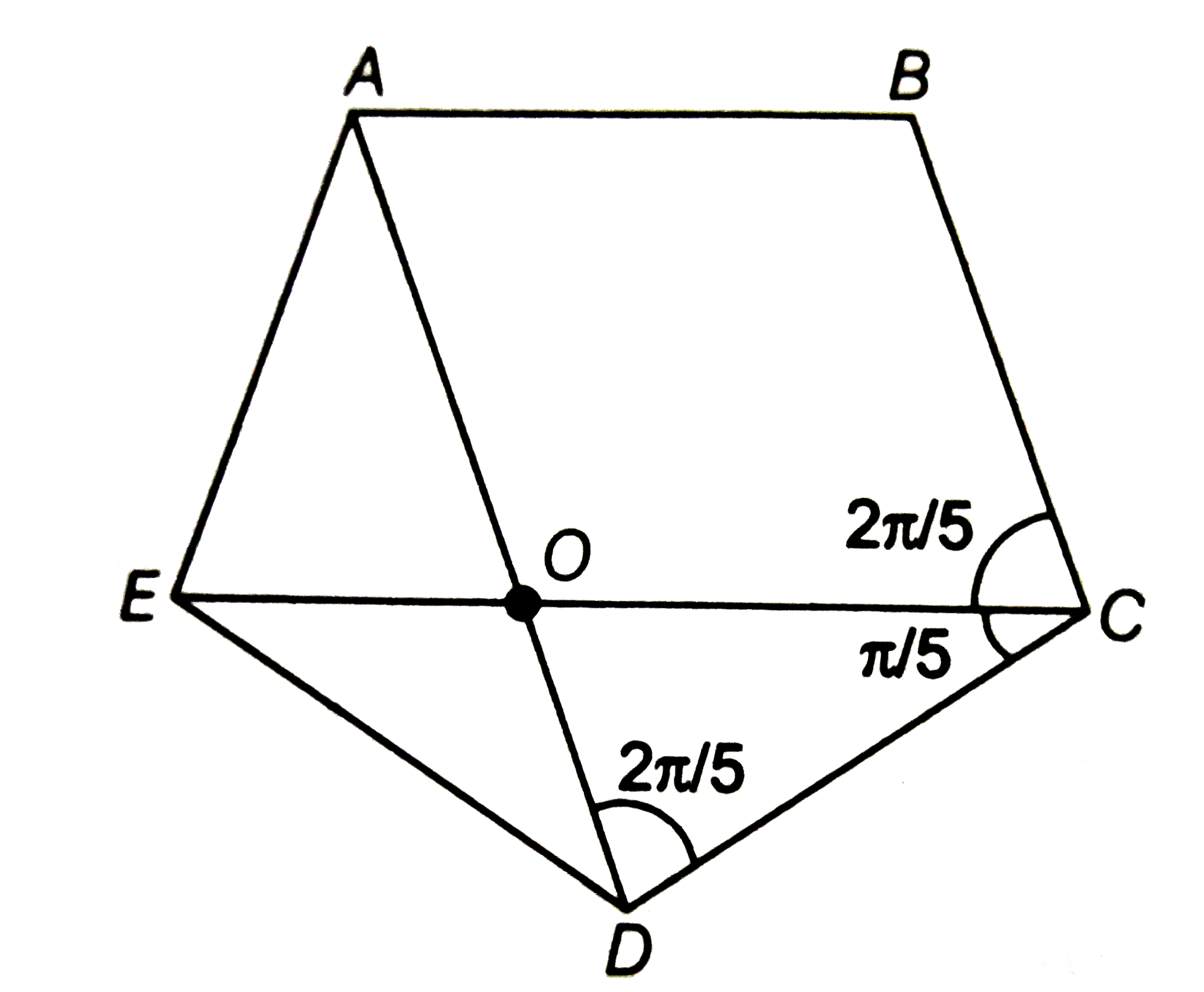
Let A,B,C,D,E represent vertices of a regular pentangon ABCDE. Given the position vector of these vertices be a,a+b,b,`lamda a` and `lamdab` respectively.
Q. AD divides EC in the ratio

A

`1-"cos"(3pi)/(5):"cos"(3pi)/(5)`

B

`1+2"cos"(2pi)/(5):"cos"(pi)/(5)`

C

`1+2"cos"(pi)/(5):2"cos"(pi)/(5)`

D

none of these

Text Solution

Verified by Experts

The correct Answer is:
C

Given ABCDE is a regular pentagon

Let position vector point A and C be a and b, respectively. AD is parallel to BC and AB is parallel to EC.
Therefore,
AOCB is a parallelogram annd position vector of B is a+b.
The position vectors of E annd D are `lamdab and lamda a` respectively.
Also, `OA=BC=AB=OC=1` (let)
therefore, `AOCB` is rhombus.
`angleABC=angleAOC=(3pi)/(5)`
and `angleOAB=angleBCO=pi-(3pi)/(5)=(2pi)/(5)`
further, `OA=AE=1 and OC=CD=1`
Thus, `DeltaEAO and DeltaOCD` are isosceles.
In `DeltaOCD`, using sine rule we get,
`(OC)/("sin"(2pi)/(5))=(OD)/("sin"(pi)/(5))`
`implies OD=(1)/(2"cos"(pi)/(5))=OE`
`implies AD=OA+OD=1+(1)/(2"cos"(pi)/(5))`
`(AD)/(BC)=1+(1)/(2"cos"(pi)/(5))=(1+2"cos"(pi)/(5))/(2"cos"(pi)/(5))`
Promotional Banner

Topper's Solved these Questions

  • VECTOR ALGEBRA

    ARIHANT MATHS ENGLISH|Exercise Exercise For Session 1|7 Videos
  • VECTOR ALGEBRA

    ARIHANT MATHS ENGLISH|Exercise Exercise For Session 2|17 Videos
  • TRIGONOMETRIC FUNCTIONS AND IDENTITIES

    ARIHANT MATHS ENGLISH|Exercise Exercise (Questions Asked In Previous 13 Years Exam)|19 Videos

Similar Questions

Explore conceptually related problems

If the position vectors of the points A,B and C be a,b and 3a-2b respectively, then prove that the points A,B and C are collinear.

veca,vecb,vecc are the position vectors of vertices A, B, C respectively of a paralleloram, ABCD, ifnd the position vector of D.

If a,b and c are the position vectors of the vertices A,B and C of the DeltaABC , then the centroid of DeltaABC is

Let A,B,C be vertices of a triangle ABC in which B is taken as origin of reference and position vectors of A and C are veca and vecc respectively. A line AR parallel to BC is drawn from A PR (P is the mid point of AB) meets AC and Q and area of triangle ACR is 2 times area of triangle ABC Positon vector of Q for position vector of R in (1) is (A) (2veca+3vecc)/5 (B) (3veca+2vecc)/5 (C) (veca+2vecc)/5 (D) none of these

Let A, B, C respresent the vertices of a triangle, where A is the origin and B and C have position b and c respectively. Points M, N and P are taken on sides AB, BC and CA respectively, such that (AM)/(AB)=(BN)/(BC)=(CP)/(CA)=alpha Q. AN+BP+CM is

Let A,B,C be vertices of a triangle ABC in which B is taken as origin of reference and position vectors of A and C are veca and vecc respectively. A line AR parallel to BC is drawn from A PR (P is the mid point of AB) meets AC and Q and area of triangle ACR is 2 times area of triangle ABC Position vector of R in terms veca and vecc is (A) veca+2vecc (B) veca+3vecc (C) veca+vecc (D) veca+4vecc

If vec a ,\ vec b ,\ vec c are position vectors of the vertices A ,\ B\ a n d\ C respectively, of a triangle A B C ,\ write the value of vec A B+ vec B C+ vec C Adot

A (-1, 0), B (1, 3) and D (3, 5) are the vertices of a parallelogram ABCD. Find the co-ordinates of vertex C.

In the pelvic girdle of man A,B,C,D and E respectively represent

If veca , vecb, vecc are the position vectors of the vertices. A,B,C of a triangle ABC. Then the area of triangle ABC is

