Home
Class 12
MATHS
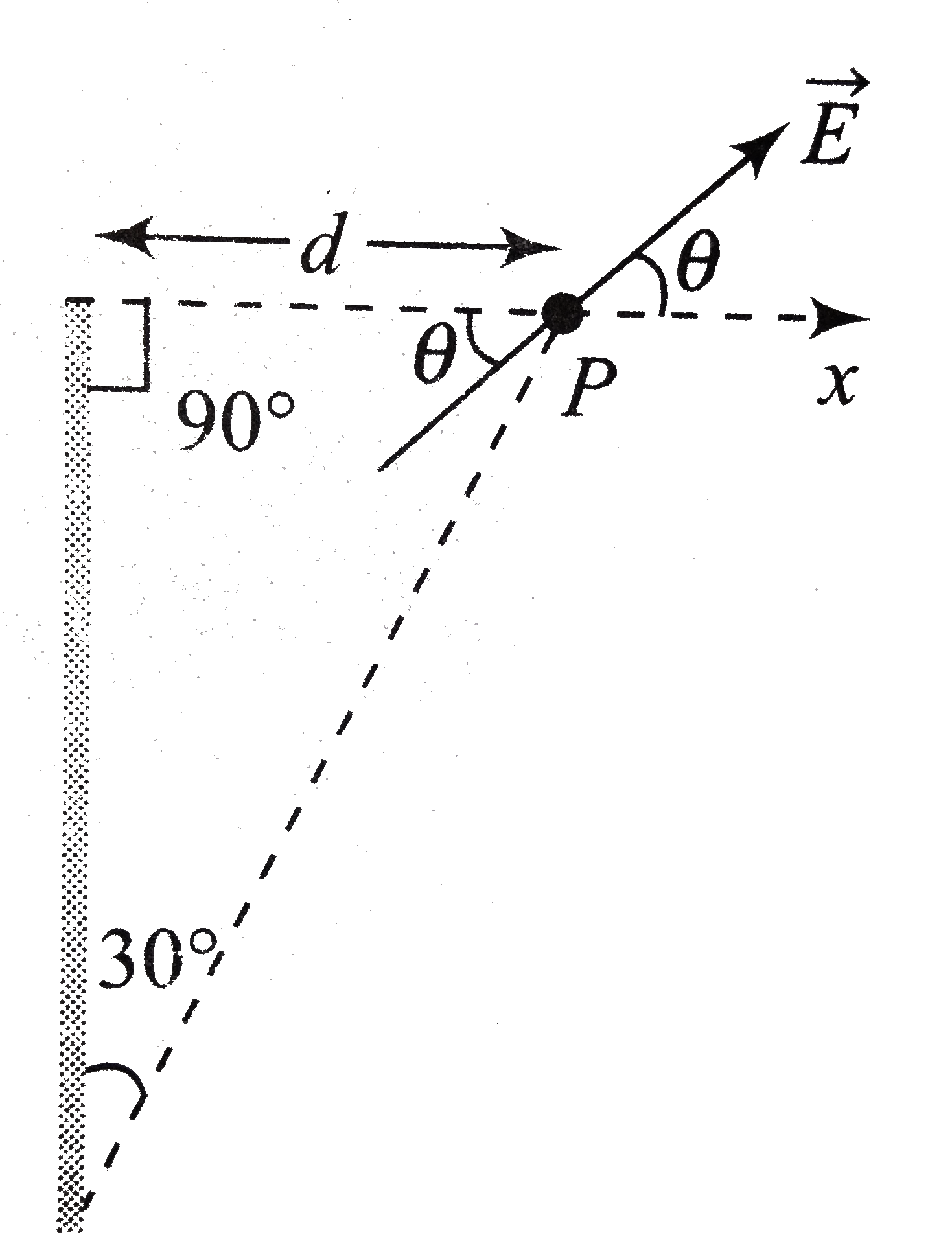
The direction (theta) of vec(E) at point...

The direction `(theta)` of `vec(E)` at point P due to uniformly charged finite rod will be

Text Solution

Verified by Experts

The correct Answer is:
A, B, C, D

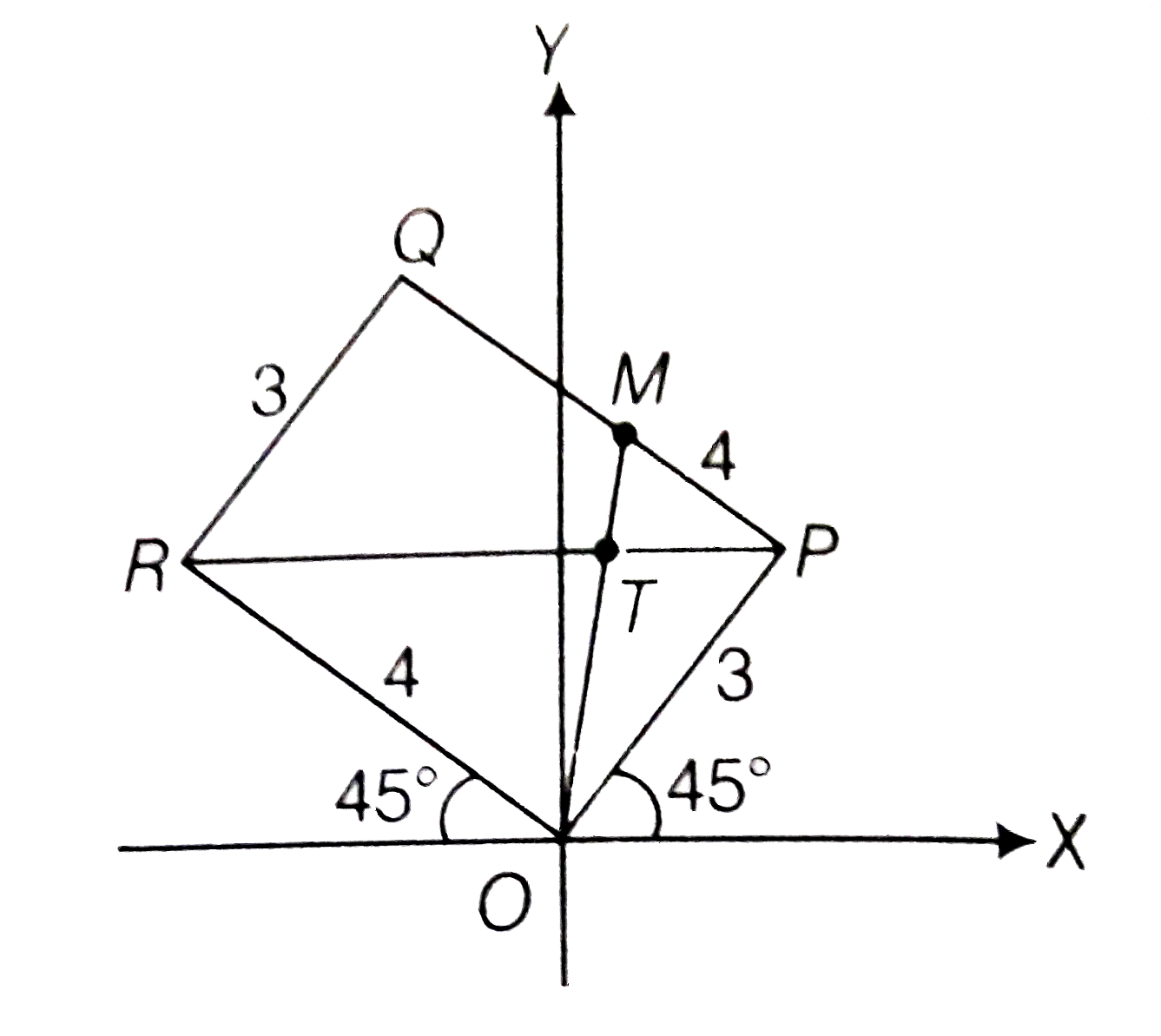
(A) Let `hati and hatj` be the unit vectors along OX and OY respectively.
Now, OP=3 and `anngleXOP=45^(@)` implies that
`OP=(3cos45^(@))hati+(3sin45^(@))hatj=(3)/(sqrt(2))(hati+hatj)`
(B) Again `angleXOR=135^(@) and OR=4` implies that
`OR=(4)/(sqrt(2))(-hati+hatj)=2sqrt(2)(-hati+hatj)`
(C) the position vector of Q is given by
`OP+PQ=OP+OR=(1)/(sqrt(2))(-hati+7hatj)`

`thereforeOM=(((3)/(sqrt(2)))(hati+hatj)+((1)/(sqrt(2)))(-hati+7hatj))/(2)`
`=(2hati+10hatj)/(2sqrt(2))=(hati+5hatj)/(sqrt(2))`
(D) Now, `PT:RT=1:2`
thereofore, `OT=(1(OR)+2(OP))/(3)`
`=(((4)/(sqrt(2)))(-hati+hatj)+2[((3)/(sqrt(2)))(hati+hatj)])/(3)`
`=(sqrt(2))/(3)(hati+5hatj)`
Promotional Banner

Topper's Solved these Questions

  • VECTOR ALGEBRA

    ARIHANT MATHS ENGLISH|Exercise Exercise For Session 1|7 Videos
  • VECTOR ALGEBRA

    ARIHANT MATHS ENGLISH|Exercise Exercise For Session 2|17 Videos
  • TRIGONOMETRIC FUNCTIONS AND IDENTITIES

    ARIHANT MATHS ENGLISH|Exercise Exercise (Questions Asked In Previous 13 Years Exam)|19 Videos

Similar Questions

Explore conceptually related problems

The direction (q) of vec(E ) at point p due to uniformly charged rod will be

(a) Define electric flux. Write its S.I. units. (b) Using Gauss's law, prove that the electric field at a point due to a uniformly charged infinite plane sheet is independent of the distance from it. (c ) How is the field directed if (i) the sheet is positively charged, (ii) negatively charged ?

The maximum electric field at a point on the axis of a uniformly charged ring is E_(0) . At how many points on the axis will the magnitude of the electric field be E_(0)//2 .

Find the electric field at a point P on the perpendicular bisector of a uniformly charged rod. The lengthof the rod is L, the charge on it is Q and the distance of P from the centre of the rod is a.

Find the electric field at a point P on the perpendicular bisector of a uniformly charged rod. The length of the rod is L, the charge on it is Q and the distance of P from the centre of the rod is a.

STATEMENT-1 : Electric field at a point due to an infinite sheet of uniformly distributed charge is independent of distance between the point from the sheet. STATEMENT-2 : Electric field at a pont due to an uniformly distributed long charged rod is inversity proportional to distance between the point and rod. STATEMENT-3 : Electric field at a point due to an electric dipole is inversely proportional to the cube of distance between point and centre of dipole.

The electric potential due to uniformly charged sphere of radius R ,having volume charge density rho having a spherical cavity of radius R/2 as shown as in figure at point p is

The net field vecE due to the uniformly charged rod at P makes angles theta_(1) and theta_(2) with AP and BP respectively. Then find the value of theta_(1)//theta_(2)

Find the electric field intensity at a point P which is at a distance R (point lying on the perpendicular drawn to the wire at one of its end) from a semi-infinite uniformly charged wire. (Linear charge density = lambda ).

An electric dipole is kept on the axis of a uniformly charged ring at distance from the centre of the ring. The direction of the dipole moment is along the axis. The dipole moment is p , charge of the ring is Q & radius of the ring is R . The force on the dipole is

