Home
Class 9
MATHS
In the given figure, ABCD is a rhombus w...

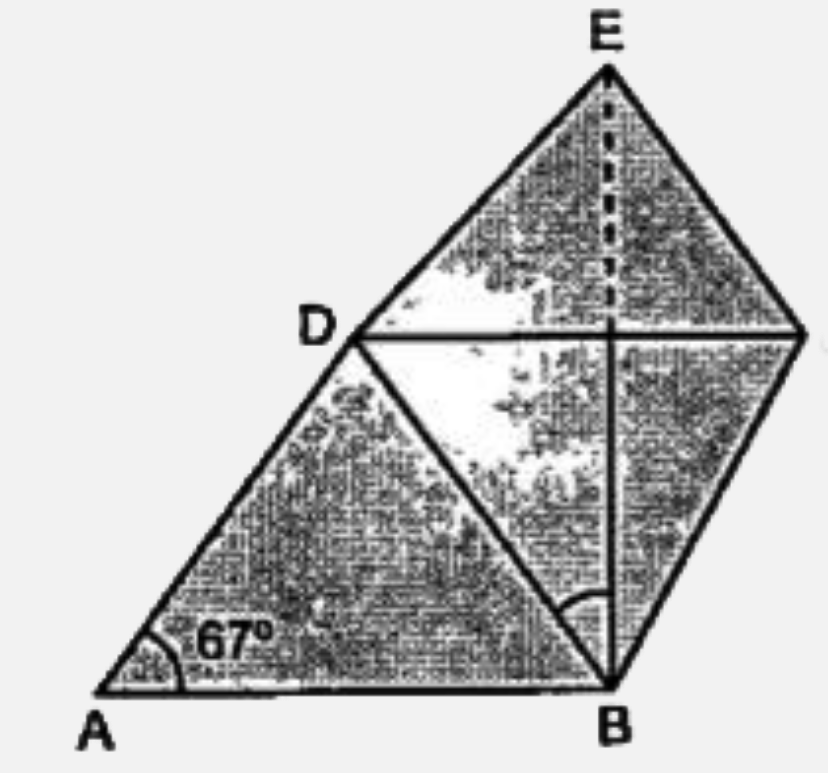
In the given figure, ABCD is a rhombus with angle A = `67^(@)`.

If DEC is an equilateral triangle. Calculate :
(i) `angleCBE" (ii) "angleDBE`

Text Solution

Verified by Experts

The correct Answer is:

(i) `26*5^(@)" (ii) "30^(@)`
Promotional Banner

Topper's Solved these Questions

  • RECTILINEAR FIGURES

    ICSE|Exercise QUADRILATERALS AND ITS PROPERTIES - 3 MARKS QUESTIONS|8 Videos
  • RATIONAL AND IRRATIONAL NUMBERS

    ICSE|Exercise EXERCISE 1 (D)|21 Videos
  • SIMULTANEOUS EQUATIONS

    ICSE|Exercise EXERCISE 6 (G)|13 Videos

Similar Questions

Explore conceptually related problems

In the given figure, ABCD is a rhombus with angle A= 67^(@) If DEC is an equilateral triangle, calculate: angleDBE

In the given figure, ABCD is a rhombus with angle A= 67^(@) If DEC is an equilateral triangle, calculate: angleCBE

In the given figure, ABCD is a rohombus with A=67^(@). If DEC is an equilateral triangle, calculate (i) angleCBE (ii) angleDBE

In the adjoining figure, ABCD is a rhombus and ABE is an equilateral triangle. If angleBCD=70^(@), find (a)angleADE" "(b)angleBDE" "(c)angleBED

The given figure shows a rhombus ABCD. Find x and y

ABCD is a rectangle. If angleBPC=124^(@) . Calculate: (i) angleBAP (ii) angleADP .

The given figure shows a square ABCD and an equilateral triangle ABP. Calculate : (i) angleAOB (ii) angleBPC (iii) anglePCD (iv) reflex angleAPC

In the given figure, ABCD is a trapezium with angle C = 120^(@), DC = 28 cm and BC = 40 cm. Find : (i) AB

The given figure shows a square ABCD and an equilateral triangle ABP. Calculate: anglePCD

The given figure shows a square ABCD and an equilateral triangle ABP. Calculate: angleBPC
