Home
Class 12
PHYSICS
A ray of light incident on the face AB o...

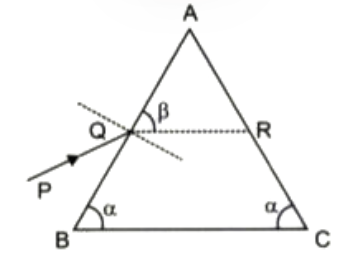
A ray of light incident on the face AB of an isosceles triangular prism makes an angle of incidence i and deviates by an angle `beta` on shown in figure. Show that in the position of minimum deviation `anglebeta=anglealpha`. Also find out the condition when the refracted ray QR suffers total internal reflection.

Text Solution

Verified by Experts

For minimum deviation, the refracted ray inside the prism is parallel to the base of the prism.
Promotional Banner

Similar Questions

Explore conceptually related problems

A ray of light in air is incident on a glass plate at polarising angle of incidence. It suffers a deviations of 22^(@) on entering glass. The angle of polarisation is

A ray of light is incident normally on one of the faces of a prism of apex angle 30 degree and refractive index sqrt2 . The angle of deviation of the ray in degrees is

The relation between angle of incidence i , angle of prism A and angle of minimum deviation for a triangular prism is.

A ray of light is incident normally on one face of an equilateral prism of refractive index 1.5 . The angle of deviation is: (Given sin^-1.(2)/(3)=42^@ )

The angle between the incident ray and the refracted ray of a prism is called angle of deviation.

A ray of light is incident on a rectangular plate at an angle of incidence 60^(@) . The light ray suffers a deviation which is 25% of the angle of incidence. The refractive index of the glass will be

A beam of monochromatic light is incident at i= 50^(@) on one face of an equilateral prism, the angle of emergence is 40^(@) , then the angle of minimum deviation is :

A ray of light is incident on a prism ABC of refractive index sqrt3 as shown in the figure. The angle by which the second identical prism must be rotated so that the final ray suffers net minimum deviation is

A ray of light passes through the equilateral prism such that angle of incidence is equal to the angle of emergence if the angle of incidence is 45^(@) . The angle of deviation will be

A ray of light is incident normally on a plane glass slab. What will be (i) the angle of refraction, and (ii) the angle of deviation for the ray ?
