

Home
Class 12
PHYSICS
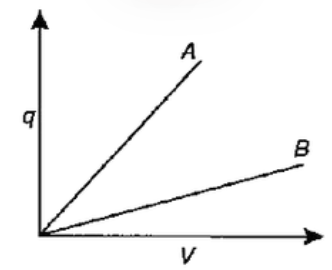
The given graph shows variation of charg...

The given graph shows variation of charge .q. versus potential difference .V. for two capacitors

`C_(1)andC_(2)`. Both the capacitors have same plate separation but plate area of `C_(2)` is greater than that of `C_(1)`. Which line (A or B) corresponds to `C_(1)` and why?

Promotional Banner

Similar Questions

Explore conceptually related problems

Shows these variation of charge q for two capacitors C_(1) and C_(2) The two capacitors have the same plate separation. But the plate area of C_(2) is double than that of C_(1) . Which of the lines in the figure corresponds to C_(1) and C_(2) and why? .

Two capacitors C_(1) and C_(2) are charged to same potential V , but with opposite polarity as shown in the figure. The switches S_(1) and S_(2) are then closed

Given that C denotes capacitance of a capacitor and V is the potential difference across its plates. Then the dimensions of CV^(2) are same as that of

The circuit shows two capacitors, C_(1) and C_(2) charged so as to have respectively charges q_(1) and q_(2) . The switch is closed . Which of the following choices are incorrect ?

Two identical capacitor C_(1) and C_(2) are connected in series with a battery. They are fully charged. Now a dielectric slab is inserted between the plates of C_(2) . The potential across C_(1) will :

A 10V battery is connected to two capacitors C_1 and C_2 and a resistor R. When the capacitors are fully charged, then the potential difference across the resistor will be

At which of the two points, 1 or 2 , of a charged capacitor with nonparallel plates is the surface charge density greater?

The potentials of the two plates of capacitor are +10V and -10 V . The charge on one of the plate is 40 C . The capacitance of the capacitor is

Two parallel-plate capacitors with different distances between the plates are connected in parallel to a voltage source. A point positive charge is moved from a point A , that is exactly in the middle between the plates of a capacitor C_(1) to a point B (or a capacitor C_(2) that lies at a distance from the negative plate of C_(2) equal to half the distance between the plates of C_(1) ) During this process of moving the charge. .

Find potential difference across the plates AB if capacitance between the plates is C and area of each plate is equal and Q_(1), Q_(2) (lt Q_1) are charges given to the plates