

Home
Class 12
PHYSICS
A ray of light falls on a right angled p...

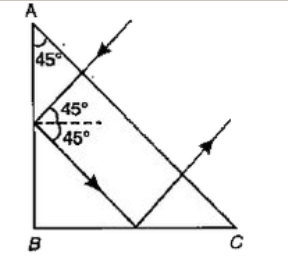
A ray of light falls on a right angled prism ABC (AB=BC) and travels as shown in figure. What is the refractive index of material of the prism ?

Promotional Banner

Similar Questions

Explore conceptually related problems

A ray falls on a prism ABC(AB=BC) and travels as shown in adjoining figure.The minimum refraction index of the prism material should be -

A ray of light incident normally on an isosceles right angled prism travels as shown in the figure. The least value of the refractive index of the prism must be

A ray of light falls on an equilateral prism ABC as shown. Face AC of the prism is polished. What is the refractive index mu of the material of the prims so that when the ray falls on face BC (after reflecting from AC) it makes an angle 60^(@) with it.?

A ray of light is incident normally on one face of a prism as shown in figure. The refractive index of the material of the prism is (5)/(3) and the prism is immersed in water of refractive index (4)/(3) , then

A ray LM of monochromatic light incident normally on one refracting surface AB of a regular glass prism ABC emerges in air from the adjacent surface C as shown in figure. Calculate the refractive index of the material of the prism.

A ray of light is incident on the hypotenuse of a right-angled prism after travelling parallel to the base inside the prism. If mu is the refractive index of the material of the prism, the maximum value of the base angle for which light is totally reflected from the hypotenuse is

A ray of light LM incident normally on the surface AC of an isosceles right angled prism ABC (where AB=BC) emerges along PQ, parallel to LM, as shown in given figure. What can you say about refractive index mu of the material of the prism ?

A light ray is incident normally on the face AB of a right-angled prism ABC (mu==1.50) as shown in figure. What is the largest angle phi for which the light ray is totally reflected at the surface AC ?

A ray of light LM incident normally on the surface AC of an isosceles right angled prism ABC (where AB = BC) emerges along PQ, parallel to LM, as shown in given figure. What can you say about refractive index fe of the material of the prism?

A ray of light PQ is incident normally on the hypotenuse of a right angled prism ABC as shown in the diagram given below: What is the value of the angle of deviation of the ray ?