

Home
Class 12
PHYSICS
A symmetric biconvex lens of radius of c...

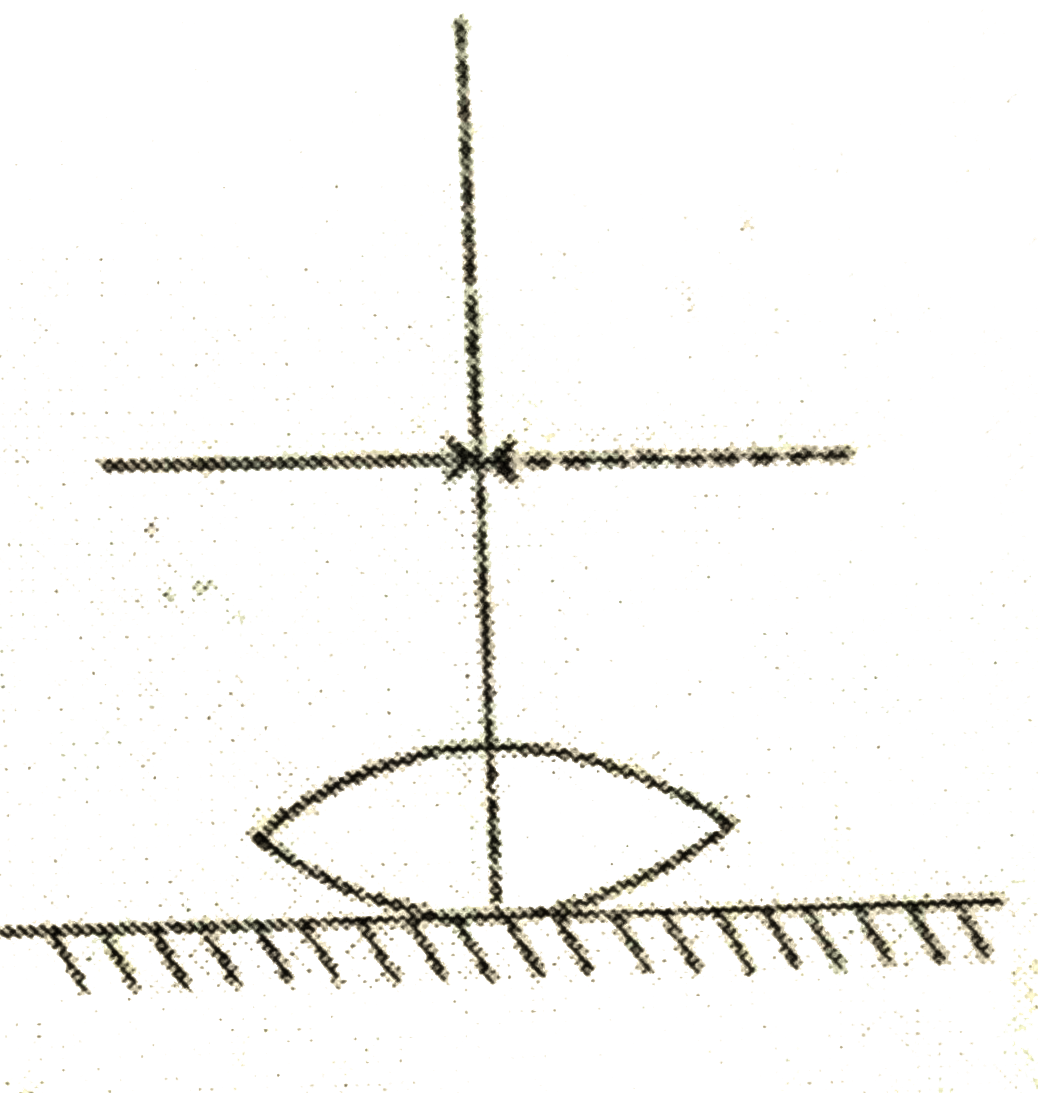
A symmetric biconvex lens of radius of curvature R and made of glass of refractive index 1.5, is placed on a layer of liquid placed on top of a plane mirror as shown in the figure. An optical needle with its tip on the principal axis of the lens is moved along the axis until its real, inverted image coincides with the needle itself. The distance of the needle from the lens is measured to be x. On removing the liquid layer and repeating the experiment, the distance is found to be y. Obtain the expression for the refractive index of the liquid in terms of x and y.

Promotional Banner

Similar Questions

Explore conceptually related problems

A synunetdc bionvex fens of radius of curvature Rand made of glass of refractive index 1.5, is placed on a placed on top of a plane mirror as shown in the figure.An optical needle with with its tip on the principal axis of the lens is moved along the axis until its real, inverted images conicides with the needle itself. The distance from the lens in measured to be x. On removing the liquid layer and repeating the experiment, the distance is found to be y . Obtain the expression for the refractive index of the liquid in terms of x and y.

An equiconvex lens, with redii of curvature of magnitude 10 cm each, is put over a liquid layer poured on top of a plane mirror. A small needle, with its tip on the principal axis of the lens, is moved along the axis until its inverted real image coincides with the needle itself. The distance of the needle, from the lens, is measured to be 15 cm . On removing the liquid layer, and repeating the experiment the distance is measured to be 10 cm . Given that the two values of the distance measured represent the force length values in the two cases, calculate the refractive index of the liqiud.

Fig. shows an equiconvex lens (of refractive index 1.5 ) in contact with a liquid layer on top of a plane mirror. A small needle with its tip on the principal axis is moved along the axis until its inverted image is found at the position of the needle. The distance of the needle from the lens is measured to be 45.0 cm . The liquid is removed and the experiment is repeated. The new distance is measured to be 30.0 cm . What is the refractive index of the liquid ?

A slab of glass, of thickness 6 cm and refractive index mu =1.5 is placed in front of a concave mirror as shown in the figure. If the radius of curvature of the mirror is 40 cm and the reflected image coincides with the object, then the distance of the object from the mirror is

A plano convex lens is made of glass of refractive index 1.5. The radius of curvature of its convex surface is R. Its focal length is

A glass lens of refractive index 1.5 is placed in a trough of liquid. What must be the refractive index of the liquid in order to mark the lens disappear?

A plane convex lens has a focal length 12cm and is made up of glass with refractive index 1.5. Find the radius of curvature of its curved side.

A thin bi-convex lens made out of a material of refractive index mu_(1) is place in a medium of refractive index mu_(2) . A paraxial beam of light, parallel to the principal axis of the lens, is shown in the figure. Based on the ray diagram, we can conclude that

A thin equiconvex lens of refractive index 3//2 is placed on a horizontal plane mirror as shown in figure. The space between the lens and the mirror is filled with a liquid of refractive index 4//3 . It is found that when a point object is placed 15 cm above the lens on its priincipal axis, the object coincides with its own image. Q. If another liquid is filled instead of water, the object and the image coincide at a distance 25 cm from the lens. Calculate the refractive index of the liquid.

A biconvex thin lens of radius of curvature R is made up of variable refractive index mu=2(1+r/d) . Assume 2d lt lt R . There are infinite images of the point O, which is placed at a distance R on the principal axis from the lens as shown in the figure. The image is spread along the pricipal axis in a length of (r is the radial distance from P measured perpendicular to principal axis)