

Home
Class 12
PHYSICS
A potentiometer circuit is shown in Figu...

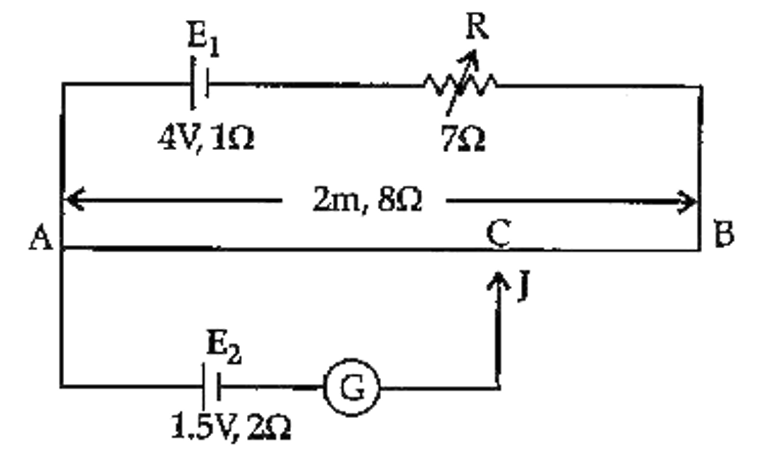
A potentiometer circuit is shown in Figure 3. AB is a uniform metallic wire having length of 2 m and resistance of `8Omega`. The batteries `E_(1) and E_(2)` have emfs of 4V and 1.5 V and their internal resistance are `1Omega" and "2Omega` respectively.

If the jockey J is made to touch the wire AB at a point C such that the galvanometer (G) shows no defection. Calculate the length AC.

Promotional Banner

Similar Questions

Explore conceptually related problems

A potentiometer circuit is shown in Figure 3 below. AB is a uniform metallic wire having length of 2m and resistance of 8Omega . The batteries E_(1) and E_(2) have emfs of 4V and 1.5V and their internal resistances are 1Omega and 2Omega respectively. Now the jockey J is made to touch the wire AB at a point C such that the galvanometer (G) shows no deflection. Calculate the length AC.

A potentiometer circuit is shown in Figure 3 below. AB is a uniform metallic wire having length of 2m and resistance of 8Omega . The batteries E_(1) and E_(2) have emfs of 4V and 1.5V and their internal resistances are 1Omega and 2Omega respectively. When the jockey J does not touch the wire AB, calculate: the current flowing through the potentiometer wire AB.

A potentiometer circuit is shown in Figure 3 below. AB is a uniform metallic wire having length of 2m and resistance of 8Omega . The batteries E_(1) and E_(2) have emfs of 4V and 1.5V and their internal resistances are 1Omega and 2Omega respectively. When the jockey J does not touch the wire AB, calculate: the potential gradient across the wire AB

A potentiometer circuit is shown in Figure 3. AB is a uniform metallic wire having length of 2 m and resistance of 8Omega . The batteries E_(1) and E_(2) have emfs of 4V and 1.5 V and their internal resistance are 1Omega" and "2Omega respectively. When the jockey J does not touch the wire AB, calculate : (a) the current flowing through the potentiometer wire AB. (b) the potential gradient across the wire AB.

In the ciruit the cells E_1 and E_2 have emfs of 4V and 8V and internal resistance 0.5 Omega and 1.0 Omega, respectively. Calculate the current through 6 Omega resistance.

In the circuit shown E, F, G and H are cells of emf 2V, 1V, 3V and 1V respectively and their internal resistance are 2Omega, 1Omega, 3Omega and 1Omega respectively.

In the circuit shown E, F, G and H are cells of emf 2V, 1V, 3V and 1V respectively and their internal resistance are 2Omega, 1Omega, 3Omega and 1Omega respectively.

E_(1) and E_(2) are two batteries having emfs of 3V and 4V and internal resistances of 2Omega and 1Omega respectively. They are connected as shown in Figure 2 below. Using Kirchhoff.s Laws of electrical circuits, calculate the currents I_(1) and I_(2) .

E_(1) and E_(2) are two batteries having emfs of 3V and 4V and internal resistances of 2Omega" and "1Omega respectively. They are connected as shown in Figure 2. Using Kirchhoff.s Laws of electrical circuits, calculate the current I_(1) and I_(2) .

A battery of EMF E produces currents 4 A and 3 A when connected to external resistance 1 Omega and 2 Omega respectively. The internal resistance of the battery is