Home
Class 12
PHYSICS
Following figure shows the positions of ...

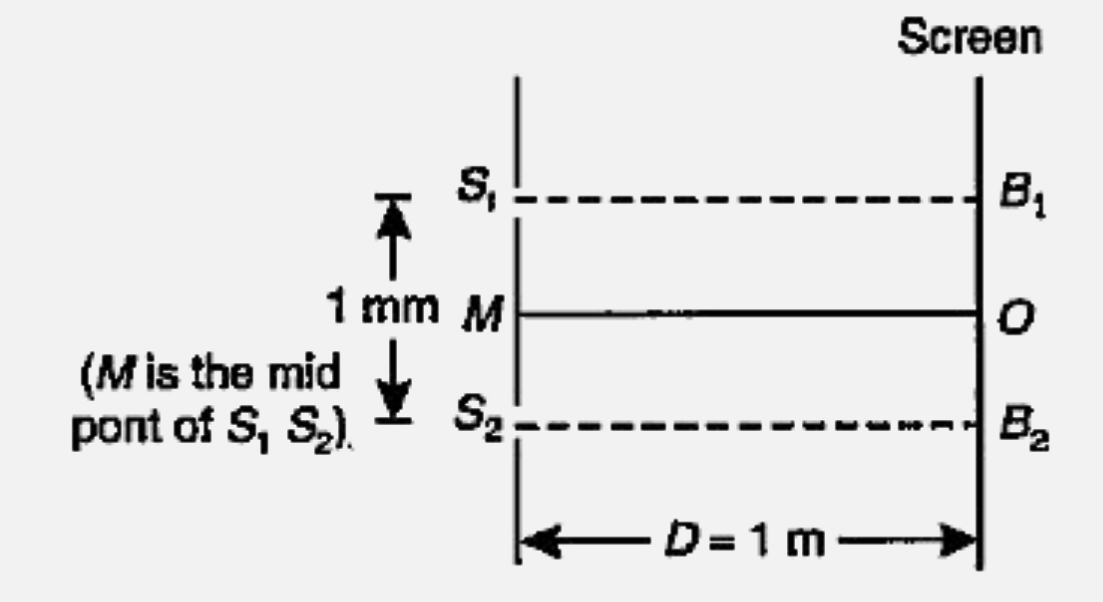
Following figure shows the positions of the first bright fringes `B_(1)andB_(2)` on either side of the central bright fringe O in Young.s double slit experiment. Find the wavelength of monochromatic light used.

Text Solution

Verified by Experts

Given, `D=1m`
`d=1xx10^(-3)m`
`OB_(1)=beta=0.5mm,D=1m,d=1mm=1xx10^(-3)m`
`beta=(Dlambda)/(d)`
`lambda=(betad)/(D)`
`=((0.5xx10^(-3))xx(1xx10^(-3)))/(1m)`
`=5xx10^(-7)m=5000Å`
`=5xx10^(-7)m=5000Å`.
Promotional Banner

Similar Questions

Explore conceptually related problems

Alternative bright and bark fringes appear in Young.s double slit experiment due to the pheno-menon of

In the figure is shown Young's double slit experiment. Q is the position of the first bright fringe on the right side of O. P is the 11^(th) bright fringe on the other side, as measured from Q. If the wavelength of the light used is 600 nm . Then S_(1)B will be equal to

As shown in the figure Q, above point O is the position of first bright fringe. On the other side of O, D is the position of 11th bright fringe with respect to Q. If the wavelength of light used is 6000A^(0) then the value of S_(1)B will be

The figure shows the interfernece pattern obtained in double slit experiment using light of wavelength 600 nm. Q. The third order bright fringe is

The line-width of a bright fringe is sometimes defined as the separation between the points on the two sides of the central line where the intensity falls to half the maximum. Find the line-width of a bright fringe in a Young's double slit experiment in terms of lamda , d and D where the symbols have their usual meanings

Find the angular fringe width in Young's double slit experiment using a monochromatic light of wavelength 500 nm when the slits are separated by 2.5 mm.

A beam of light consisting of two wavelengths 650 nm and 520 nm is used to obtain interference fringes in a Young's double slit experiment. (a) Find the distance of the third bright fringe on the screen from the central maximum for the wavelength 650 nm . (b) What is the least distance from the central maximum where the bright fringes due to both the wavelengths coincide? The distance between the slits is 2 mm and the distance between the plane of the slits and screen is 120 cm .

Find the angular separation between the consecutive bright fringes in a Young's double slit experiment with blue-green light of wavelength 500 nm. The separation between the slits is 2.0 xx 10^ -3 m.

Find the angular separation between the consecutive bright fringes in a Young's double slit experiment with blue-green light of wavelength 500 nm. The separation between the slits is 2.0 x 10^ -3 m.

A beam of light consisting of two wavelength, 650 nm and 520 nm, is used to obtain interference fringes in a Young's double - slit experiment. Find the distance of the third bright fringe on the screen from the central maximum for wavelengths 650 nm.
