Home
Class 11
PHYSICS
A block A of mass 4 kg is placed on anot...

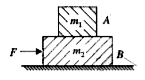
A block A of mass 4 kg is placed on another block B of mass 5 kg and the block rests on a smooth horizontal table. For sliding the block A on B, a horizontal force of 12 N is required to be applied on it. The maximum horizontal force that can be applied on B so that both A and B move together and the acceleration produced by this force is

A

25 N, 5 `m//s^(2)`

B

27 N, 3 `m//s^(2)`

C

30 N, 8 `m//s^(2)`

D

cannot be calculated from the given data.

Text Solution

Verified by Experts

The correct Answer is:

b

`F_(K) = mu_(K)m_(1)g = 12, mu_(K) = 3//g`
`F = mu_(k) (m_(1) + m_(2)) g = (3//g) (4 + 5) g = 27` N
`a = F//(m_(1) + m_(2)) = 27//(4 + 5) = 3ms^(-2)`
Promotional Banner

Topper's Solved these Questions

  • COMPETITION CARE UNIT

    ICSE|Exercise MOTION IN FLUIDS |25 Videos
  • COMPETITION CARE UNIT

    ICSE|Exercise UNIFORM CIRCULAR MOTION |25 Videos
  • COMPETITION CARE UNIT

    ICSE|Exercise Dynamics ( WORK POWER ENERGY )|35 Videos
  • CIRCULAR MOTION

    ICSE|Exercise MODULE 2 (FROM ROTATIONAL KINETIC ENERGY , WORK ,POWER)|24 Videos
  • DIMENSIONS

    ICSE|Exercise SELECTED PROBLEMS (FROM CONVERSIONS OF ONE SYSTEMS OF UNITS INTO ANOTHER)|9 Videos

Similar Questions

Explore conceptually related problems

A block A of mass 4 kg is placed on another block B of mass 5 kg , and the block B rests on a smooth horizontal table . For sliding block A on B , a horizontal force of 12 N is required to be applied on A How much maximum force can be applied on B so that both A and B move togrther ? Also find out acceleration produced by this force .

A block A of mass 4 kg is placed on another block B of mass 5 kg , and the block B rests on a smooth horizontal table . For sliding block A on B , a horizontal force of 12 N is required to be applied on A How much maximum force can be applied on B so that both A and B move togrther ? Also find out acceleration produced by this force .

12N of force required to be applied on A to slip on B. Find the maximum horizontal force F to be applied on B so that A and B moves together.

A 4 kg block A is placed on the top of 8 kg block B which rests on a smooth table. A just slips on B when a force of 12 N is applied on A. Then the maximum horizontal force F applied on B to make both A and B move together, is

Two block A and B of masses 5 kg. and 3 kg. respectively rest on smooth horizontal surface with B over A. The coefficient of friction between A and B. 0.5 the maximum horizontal force that can be applied to A so that there will be motion of A and B without separation is :-

A block A of mass 2 kg is placed over smooth block B of mass 4 kg which is placed over a smooth horizontal floor The coefficient of friction between A and B is 0.4 when a horizontal forces of magnitude 10 N is applied on A the acceleration of block of A and B are

A 4.0 kg block is put on top of a 5.0kg block. In order to cause the top block to slip on the bottom one, a horizontal force of 12N must be applied to the top block. Assuming a friction less table the maximum horizontal force F which can be applied to the lower block so that the blocks, will move together should be

Two block (A) 2kg and (B) 5kg rest one over the other on a smooth horizontal plane. The cofficient of static and dynamic friction between (A) and (B) is the sae and equal to 0.60. The maximum horizontal force that can be applied to (B) in order that both (A) and (B) do not have any relative motion:

A block of mass m is placed on another block of mass M lying on a smooth horizontal surface as shown in the figure. The co-efficient of friction between the blocks is mu . Find the maximum horizontal force F (in Newton) that can be applied to the block M so that the blocks together with same acceleration? (M=3kg, m=2kg, mu=0.1, g=10m//s^(2))

A block A of mass 2 kg rests on another block B of mass 8 kg which rests on a horizontal floor. The coefficient of friction between A and B is 0.2 while that between B and floor is 0.5 .When a horizontal floor F of 25 N is applied on the block B the force of friction between A and B is

ICSE-COMPETITION CARE UNIT-FRICTION
  1. While walking on ice, one should take small steps to avoid sliping. Th...

    Text Solution

    |

  2. Two masses A and B of 10 kg and 5 kg respectively are connected with a...

    Text Solution

    |

  3. A 40kg slab rest on a frictionless floor as shown in . A 10kg blocks r...

    Text Solution

    |

  4. Consider, a car moving along a straight horizontal road with a speed o...

    Text Solution

    |

  5. A body of mass 100 g is sliding from an inclined plane of inclination ...

    Text Solution

    |

  6. If a block moving up at theta = 30^(@) with a velocity 5m/s, stops aft...

    Text Solution

    |

  7. A 20 kg block is initially at rest. A 75 N force is required to set th...

    Text Solution

    |

  8. A block A of mass 4 kg is placed on another block B of mass 5 kg and t...

    Text Solution

    |

  9. Starting from rest, a body slides down a 45^(@) inclined plane in twic...

    Text Solution

    |

  10. If a cyclist moving with a speed of 4.9 m/s on a level can take a shar...

    Text Solution

    |

  11. A heavy uniform chain lies on horizontal table top. If the coefficient...

    Text Solution

    |

  12. A block slides with a velocity of 10 m/sec. on a rough horizontal surf...

    Text Solution

    |

  13. A block of mass 2 kg is placed on the floor. The coefficient of static...

    Text Solution

    |

  14. A block of mass m lying on a rough horizontal plane is acted upon by a...

    Text Solution

    |

  15. When two surfaces are coated with a lubricant, then they

    Text Solution

    |

  16. For a body on a horizontal surface, coefficients of static and kinetic...

    Text Solution

    |

  17. A cubical box of side L rests on a rough horizontal surface with coeff...

    Text Solution

    |

  18. A block of mass 3 kg rests on a rough inclined plane making an angle ...

    Text Solution

    |

  19. A cylinder rolls up an inclined plane, reaches some height and then ro...

    Text Solution

    |

  20. An insect crawls up a hemisherical surface very slowly .The coefficien...

    Text Solution

    |
