Home
Class 11
PHYSICS
A 10 kg mass is connected at one end of ...

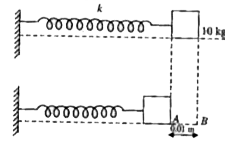
A 10 kg mass is connected at one end of a massless spring with force constant `k = 1000 N/m, keeping other end fixed in a horizontal plane as shown in the fig. 15.6
If the sytem is displaced by 0.01 m from its equilibrium position A to a point B, then the acceleration of the system is

A

`10ms^(-2)`

B

`1 ms^(-2)`

C

`-1ms^(-2)`

D

`-10ms^(-2)`

Text Solution

Verified by Experts

The correct Answer is:

B
Promotional Banner

Topper's Solved these Questions

  • COMPETITION CARE UNIT

    ICSE|Exercise NDA EXAM QUESTIONS|55 Videos
  • CIRCULAR MOTION

    ICSE|Exercise MODULE 2 (FROM ROTATIONAL KINETIC ENERGY , WORK ,POWER)|24 Videos
  • DIMENSIONS

    ICSE|Exercise SELECTED PROBLEMS (FROM CONVERSIONS OF ONE SYSTEMS OF UNITS INTO ANOTHER)|9 Videos

Similar Questions

Explore conceptually related problems

A particle of mass m is attached to one end of a mass-less spring of force constant k, lying on a frictionless horizontal plane. The other end of the spring is fixed. The particle starts moving horizontally from its equilibrium position at time t=0 with an initial velocity u_0 . when the speed of the particle is 0.5u_0 , it collides elastically with a rigid wall. After this collision

A particle of mass m is attached to one end of a mass-less spring of force constant k, lying on a frictionless horizontal plane. The other end of the spring is fixed. The particle starts moving horizontally from its equilibrium position at time t=0 with an initial velocity u_0 . when the speed of the particle is 0.5u_0 , it collides elastically with a rigid wall. After this collision

A mass of 1.5 kg is connected to two identical springs each of force constant 300 Nm^(-1) as shown in the figure. If the mass is displaced from its equilibrium position by 10cm, then the period of oscillation is

A mass of 0.2 kg is attached to the lower end of a massless spring of force constant 200(N)/(m) the other end of which is fixed to a rigid support. Study the following statements.

A mass of 1.5 kg is connected to two identical springs each of force constant 300 Nm^(-1) as shown in the figure. If the mass is displaced from its equilibrium position by 10 cm, then maximum speed of the trolley is

A 100 g block is connected to a horizontal massless spring of force constant 25.6(N)/(m) As shown in Fig. the block is free to oscillate on a horizontal frictionless surface. The block is displaced 3 cm from the equilibrium position and , at t=0 , it is released from rest at x=0 It executes simple harmonic motion with the postive x-direction indecated in Fig. The position time (x-t) graph of motion of the block is as shown in Fig. Q. When the block is at position B on the graph its.

A 100 g block is connected to a horizontal massless spring of force constant 25.6(N)/(m) As shown in Fig. the block is free to oscillate on a horizontal frictionless surface. The block is displaced 3 cm from the equilibrium position and , at t=0 , it is released from rest at x=0 It executes simple harmonic motion with the postive x-direction indecated in Fig. The position time (x-t) graph of motion of the block is as shown in Fig. Velocity of the block as a function of time can be expressed as

A ring of mass m and radius a is connected to an inextensible string which passes over a frictionless pulley. The other end of string is connected to upper end of a massless spring of spring constant k. The lower end of the spring is fixed. The ring can rotate in the vertical plane about hinge without any friction. If horizontal position of ring is equilibrium position then find time period of small in oscillations of the ring.

Four massless springs whose force constants are 2k, 2k, k and 2k respectively are attached to a mass M kept on a frictionless plane (as shown in figure). If the mass M is displaced in the horizontal direction.

A system consisting of a smooth movable wedge of angle alpha and a block A of mass m are connected together with a massless spring of spring constant k, as shown in the figure. The system is kept on a frictionless horizontal plane. If the block is displaced slighlly from equilibrium and left to oscillate, find the frequency of small oscillations.

ICSE-COMPETITION CARE UNIT-OBJECTIVE QUESTIONS FROM PREVIOUS IAS EXAMINATIONS
  1. A stone of mass M tied at the end of a string, is moving in a circular...

    Text Solution

    |

  2. An elastic collision conserves

    Text Solution

    |

  3. Two planets A and B have the same material density. If the radius of A...

    Text Solution

    |

  4. Water rises to a height 'h' in capillary tube. If the length of capill...

    Text Solution

    |

  5. An oil drop of diameter 4 xx 10^(-6) m falls through air. iF the densi...

    Text Solution

    |

  6. When a harmonic wave is proppagating through a medium, the displacemen...

    Text Solution

    |

  7. The displacement of a particle executing simple harmonic motion is giv...

    Text Solution

    |

  8. Which of the below figure (s) represent damped simple harmonic motion....

    Text Solution

    |

  9. A railway engine passes by the platform at a speed of 36 km/hr blowing...

    Text Solution

    |

  10. A string 1m long is drawn by a 300 Hz vibrator attached to its end. Th...

    Text Solution

    |

  11. The Farensheit and the centrigrade scales have the same numerical valu...

    Text Solution

    |

  12. van der Waal's equation of state of a gas takes into account

    Text Solution

    |

  13. A beat engine work on a Cannot cycle with the heat sink in the tempera...

    Text Solution

    |

  14. If the temperature of a black body is increased, then the maximum of t...

    Text Solution

    |

  15. A 10 kg mass is connected at one end of a massless spring with force c...

    Text Solution

    |

  16. A particle is projected at an elevation tan^(-1) ((4)/(3)) from a poi...

    Text Solution

    |

  17. The escape velocity of a particle of mass 'm'

    Text Solution

    |

  18. In an inelastic collision

    Text Solution

    |

  19. IF e is the coefficient of restitution then which one of the followi...

    Text Solution

    |

  20. Two soap bubbles A and B have radii r(1) and r(2) respectively. If r(1...

    Text Solution

    |
