Home
Class 12
MATHS
Which of the following graphs represent ...

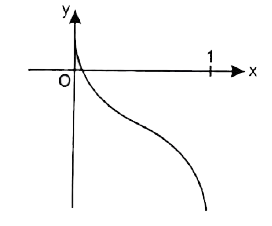
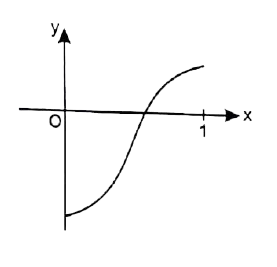
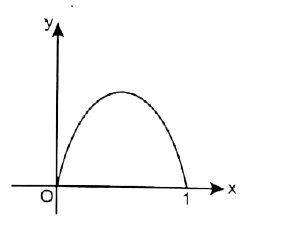
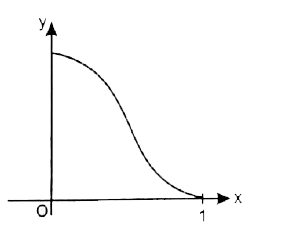
Which of the following graphs represent function whose derivatives have a maximum in the interval `(0,1)` ?

A

B

B

C

D

Text Solution

AI Generated Solution

The correct Answer is:

To determine which of the given graphs represents a function whose derivatives have a maximum in the interval (0, 1), we need to analyze the concavity of the function and its derivative. ### Step-by-Step Solution: 1. **Understanding the Problem**: - We need to find a function \( f(x) \) such that its derivative \( f'(x) \) has a maximum in the interval \( (0, 1) \). - This means that \( f'(x) \) should change its concavity in this interval. 2. **Concept of Concavity**: - If \( f'(x) \) has a maximum in the interval \( (0, 1) \), then the second derivative \( f''(x) \) must change sign in this interval. - Specifically, \( f''(x) \) should be positive before the maximum and negative after the maximum, indicating a change from concave up to concave down. 3. **Analyzing the Options**: - We will examine each option to see if the graph of the function \( f(x) \) shows a change in concavity in the interval \( (0, 1) \). 4. **Option 1**: - If the graph is concave up before \( x = 1 \) and concave down after \( x = 1 \), then \( f'(x) \) has a maximum in the interval \( (0, 1) \). - This option satisfies the condition. 5. **Option 2**: - Similar to Option 1, if the graph shows a change from concave up to concave down in the interval \( (0, 1) \), then this option also satisfies the condition. 6. **Option 3**: - If the graph does not show a change in concavity or remains either concave up or concave down throughout the interval, then this option does not satisfy the condition. 7. **Option 4**: - If the graph shows a change from concave up to concave down in the interval \( (0, 1) \), then this option satisfies the condition. 8. **Conclusion**: - Based on the analysis, Options 1, 2, and 4 represent functions whose derivatives have a maximum in the interval \( (0, 1) \). - Therefore, the final answer is: **Options 1, 2, and 4 are correct**.
Promotional Banner

Topper's Solved these Questions

  • APPLICATION OF DERIVATIVES

    VIKAS GUPTA (BLACK BOOK) ENGLISH|Exercise EXERCISE (COMPREHENSION TYPE PROBLEMS)|15 Videos
  • APPLICATION OF DERIVATIVES

    VIKAS GUPTA (BLACK BOOK) ENGLISH|Exercise EXERCISE (MATHCING TYPE PROBLEMS)|6 Videos
  • APPLICATION OF DERIVATIVES

    VIKAS GUPTA (BLACK BOOK) ENGLISH|Exercise EXERCISE (SUBJECTIVE TYPE PROBLEMS)|22 Videos
  • AREA UNDER CURVES

    VIKAS GUPTA (BLACK BOOK) ENGLISH|Exercise AXERCISE (SUBJECTIVE TYPE PROBLEMS)|8 Videos

Similar Questions

Explore conceptually related problems

Which of the following graphs is NOT a function ?

Which of the following graph represents uniform motion

Which of the following graph represents uniform motion

Which of the following represents functional isomerism ?

Which of the following graph represents Boyle's law ?

Does the following graph represent a function or a relation?

Which of the following graphs are graphs of a function?

Which one of the following graphs represent a function? (FIGURE)

Which of the following graphs represents exothoermic reaction?

Which of the following graphs represents exothermic reaction ?

VIKAS GUPTA (BLACK BOOK) ENGLISH-APPLICATION OF DERIVATIVES -EXERCISE (ONE OR MORE THAN ANSWER IS/ARE CORRECT )
  1. The function f (x) =1+ x ln (x+ sqrt(1+ x ^(2)))-sqrt(1- x^(2)) is:

    Text Solution

    |

  2. Let m and n be positive integers and x,y gt 0 and x+y =k, where k is c...

    Text Solution

    |

  3. Determine the equation of straight line which is tangent at one point ...

    Text Solution

    |

  4. A curve is such that the ratio of the subnomal at any point to the sum...

    Text Solution

    |

  5. Number of A parabola of the form y= ax^2 +bx+c with a>0 intersectio...

    Text Solution

    |

  6. Find the gradient of the line passing through the point (2,8) and touc...

    Text Solution

    |

  7. The equation x + cos x = a has exactly one positive root. Complete set...

    Text Solution

    |

  8. Given that f (x) is a non-constant linear function. Then the curves :

    Text Solution

    |

  9. f (x) = int (0) ^(x) e ^(t ^(3)) (t ^(2) -1) (t+1) ^(2011) dt (x gt ...

    Text Solution

    |

  10. Let f(x)=sinx+a x+bdot Then which of the following is/are true? (a) f(...

    Text Solution

    |

  11. Which of the following graphs represent function whose derivatives hav...

    Text Solution

    |

  12. Consider f (x)= sin ^(5) x-1, x in [0, (pi)/(2)], which of the followi...

    Text Solution

    |

  13. If f(x)=x^(alpha)log x and f(0)=0, then the value of 'alpha' for which...

    Text Solution

    |

  14. Which of the following is/are true for the function f(x)= int (0) ^(x)...

    Text Solution

    |

  15. Let F (x) = (f (x ))^(2) + (f' (x ))^(2), F (0) =6, whtere f (x) is a ...

    Text Solution

    |

  16. Let f (x) = {{:(x ^(3)+x^(2)-10x,,, -1 le x lt 0),( sin x ,,, 0 le x l...

    Text Solution

    |

  17. Minimum distance between the curves y ^(2) =x-1 and x ^(2) =y -1 is eq...

    Text Solution

    |

  18. For the equation (e ^(-x))/(1+x)= lamda which of the following stateme...

    Text Solution

    |

  19. If y = m x +5 is a tangent to the curve x ^(3) y ^(3) = ax ^(3) +by^(...

    Text Solution

    |

  20. If (f(x)-1) (x ^(2) + x+1)^(2) -(f (x)+1) (x^(4) +x ^(2) +1) =0 AA x...

    Text Solution

    |
