Home
Class 12
CHEMISTRY
Consider the following ionsisation react...

Consider the following ionsisation reaction `:`
`IE(KJ mol^(-1))" "IE(KJ mol^(-1))`
`A_((g))rarrA_((g))^(+)+e^(ө),A_(1)" "B_((g))rarrB_((g))^(+)+e^(ө),B_(1)`
`B_((g))^(+)rarrB_((g))^(+2)+e^(ө),B_(2)" "C_((g))rarrC_((g))^(+)+e^(ө),C_(1)`
`C_((g))^(+)rarrC_((g))^(+2)+e^(ө),C_(2)" "C_((g))^(+2)rarrC_((g))^(+3)+e^(ө),C_(3)`
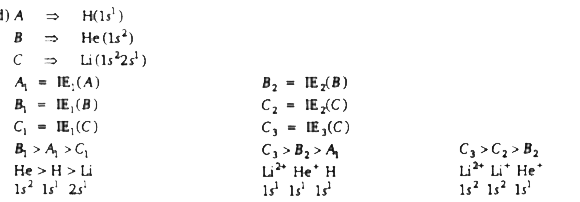
If monovalent positive ion of `A`, divalent positive ion of `B` and trivalent positive ion of `C` have zero electron. Then incorrect order of corresponding I.P. is `:`

A

`C_(3) gt B_(2) gt A_(1)`

B

`B_(1) gt A_(1) gt C_(1)`

C

`C_(3) gt C_(2) gt B_(2)`

D

`B_(2) gt C_(3) gt A_(1)`

Text Solution

Verified by Experts

The correct Answer is:
D

Promotional Banner

Topper's Solved these Questions

  • PERIODIC PROPERTIES

    VK JAISWAL ENGLISH|Exercise MATCH THE COLUMN|11 Videos
  • PERIODIC PROPERTIES

    VK JAISWAL ENGLISH|Exercise SUBJECTIVE PROBLEMS|22 Videos
  • p-BLOCK ELEMENTS

    VK JAISWAL ENGLISH|Exercise SUBJECTIVE PROBLEMS|35 Videos
  • QUALITATIVE INORGANIC ANALYSIS

    VK JAISWAL ENGLISH|Exercise SUBJECTIVE PROBLEMS|4 Videos

Similar Questions

Explore conceptually related problems

Consider the following changes :- M_((s)rarrM_((g))" ""....."(a) M_((s))rarrM_((g))^(+2)+2e^(ө)" ""....."(b) M_((g))rarrM^(+)+e^(ө)" ""....."(c) M_((g))^(+)rarrM_((g))^(+2)+e^(ө)" ""....."(d) M_((g))rarrM_((g))^(+2)+2e^(ө)" ""....."(e) The second ionisation energy of M_((g)) could be calculated from which of the above given reactions :

Consider the following changes :- M_((s)rarrM_((g))" ""....."(a) M_((s))rarrM_((g))^(+2)+2e^(ө)" ""....."(b) M_((g))rarrM^(+)+e^(ө)" ""....."(c) M_((g))^(+)rarrM_((g))^(+2)+e^(ө)" ""....."(d) M_((g))rarrM_((g))^(+2)+2e^(ө)" ""....."(e) The second ionisation energy of M_((g)) could be calculated from which of the above given reactions :

In which of the following process maximum energy is released A) S_((g))+e^(-) rarr S_((g))^(-) B) O_((g))^(-) +e^(-) rarr O_((g))^(-2) C) S_((g))^(-)+e^(-) rarr S_((g))^(-2)

O_((g))^(-)+e^(-)toO_((g))^(-2) /_\H_(1) O_((g))+e^(-)toO_((g))^(-) /_\H_(2) O_(2(g))toO_(2(g))^(+)+e^(-) /_\H_(3) O_((g))toO_(2(g))^(+)+e^(-) /_\H_(4) H_(2(g))toH_(2(g))^(+)+e^(-) /_\H_(5) O_((g))toH_((g))^(+)+e^(-) /_\H_(6) O_((g))+2e^(-)toO^(-2) /_\H_(7) Which of the following option (s) is/are correct?

{:(List - I("Reaction"), List -II((K_(p))/(K_(c)))),((A)A_(2)(g) + 3B_(2)(g) hArr 2AB_(3)(g),(P)(RT)^(-2)),((B) A_(2) (g)+ B_(2) (g) hArr 2 AB(g) ,(Q) (RT)^(@)),((C) A(s) + (3)/(2) B_(2) (g) hArr AB_(3)(g),(R) (RT)^(1//2)),((D) AB_(2) (g) hArr AB(g) +(1)/(2) B_(2)(g),(S) (RT)^(-1//2)):}

Classify the following redox reactions: a. N_(2)(g)+O_(2)(g)rarr 2NO(g) b. 2Pb(NO)_(3)(s)rarr2PbO(s)+2NO_(2)(g)+(1)/(2)O_(2)(g) c. NaH(s)H_(2)O(l)rarr NaOH(aq)+H_(2)(g) d. 2NO_(2)(g)+2overset(ө)OH(aq)rarrNO_(2)^(ө)(aq)+NO_(3)^(ө)(aq)+H_(2)O(l)

Write balanced net ionic equations for the following reactions in basic solution: (a) H_(2)O_(2)(aq)+ClO_(4)^(Ө)(aq) rarr ClO_(2)^(Ө)(aq)+O_(2)(g) (b) ( c) Cu(OH)_(2)(s) + N_(2)H_(4)(aq) rarr Cu(s)+N_(2)(g) (d) MnO_(4)^(Ө) + IO_(3)^(Ө)(aq)rarr MnO_(2)(s) + IO_(4)^(Ө)(aq)

Consider the following reversible chemical reactions : A_(2)(g)+B_(2)(g)overset(K_(1))(hArr)2AB(g)....(1) 6AB(g) overset(K_(2))(hArr)3A_(2)(g)+3B_(2)(g).....(2) The relation between K_(1) and K_(2) is :

K_(p) value for C_(2)H_(4(g))+H_(2(g))rArrC_(2)H_(6(g))is 5xx10^(18)" atm"^(-1)andK_(p)" for C_(2)H_(2)+H_(2(g))rArrC_(2)H_(4(g)) " is "5xx10^(26) " atm"^(-1) at 50^(@)C. Calculate K_(p) for the reaction 2H_(2(g))+C_(2)H_(2(g))rArrC_(2)H_(6(g))

Calculate in kJ for the following reaction : C(g) + O_(2)(g) rarr CO_(2)(g) Given that, H_(2)O(g) + C(g) + H_(2)(g) , Delta H = +131 kJ CO(g) + 1/2 O_(2)(g) rarr CO_(2)(g), " " Delta H = -242 kJ H_(2)(g) + 1/2 O_(2)(g) rarr H_(2)O(g), " "DeltaH = -242 kJ

VK JAISWAL ENGLISH-PERIODIC PROPERTIES-Level 2
  1. The correct values of ionization enthalpies(in KJ "mol"^(-1)) of Si, P...

    Text Solution

    |

  2. The third ionisation energy will be maximum for:

    Text Solution

    |

  3. Consider the following ionsisation reaction : IE(KJ mol^(-1))" "...

    Text Solution

    |

  4. The incorrect statement is:

    Text Solution

    |

  5. First three ionisation energies (in kJ/mol) of three representative el...

    Text Solution

    |

  6. Which of the following statement is correct regarding following proces...

    Text Solution

    |

  7. The correct order of increasing electron affinity of the following ele...

    Text Solution

    |

  8. The second electron gain enthalpies (in kJ mol^(-1)) of oxygen and sul...

    Text Solution

    |

  9. Which of the following statement is correct?

    Text Solution

    |

  10. Which of the following statements is incorrect?

    Text Solution

    |

  11. The formation of the oxide ion O(g)^(2-) requires first an exothermic ...

    Text Solution

    |

  12. In which of the following energy is abosrbed?

    Text Solution

    |

  13. The electron affinity of the following elements can be arranged:

    Text Solution

    |

  14. In which of the following arrangements , the order is not correct acco...

    Text Solution

    |

  15. Which of the following statements is/are wrong?

    Text Solution

    |

  16. Consider the following conversions: (i) O((g))+e^(-) to O((g))^(-),D...

    Text Solution

    |

  17. {:("Element","Electronegative value"),(W,2.7),(X,2.1),(Y,0.8),(Z,3.4):...

    Text Solution

    |

  18. In the compound M-O-H, the M-O bond will be broken if:

    Text Solution

    |

  19. Aqueous solution of two compounds M(1) - O - H and M(2) - O - H are pr...

    Text Solution

    |

  20. The ionisation potential and electron affinity of an element "X" are 2...

    Text Solution

    |

