Home
Class 12
CHEMISTRY
Which of the following leads to bonding...

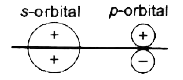
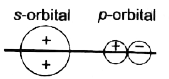
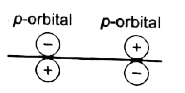
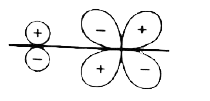
Which of the following leads to bonding?

A

B

C

D

Text Solution

AI Generated Solution

The correct Answer is:

To determine which of the given orbital interactions leads to bonding, we will analyze each option based on the type of overlap between the orbitals involved. ### Step-by-Step Solution: 1. **Identify the Orbitals**: - We have different combinations of S and P orbitals in the options provided. 2. **Analyze the First Option**: - The first option involves an S orbital and a P orbital. - The overlap is unsymmetrical, meaning it does not have a proper head-on or sideways overlap. - **Conclusion**: This does not lead to bonding. 3. **Analyze the Second Option**: - The second option also involves an S orbital and a P orbital. - Here, the P orbital overlaps with the S orbital in a head-on manner, and the phases of the orbitals are the same (both in the positive phase). - **Conclusion**: This symmetrical overlap leads to bonding. 4. **Analyze the Third Option**: - The third option consists of two P orbitals. - The overlap is between two P orbitals with different phases (one positive and one negative). - **Conclusion**: This results in a negative overlap, which does not lead to bonding. 5. **Analyze the Fourth Option**: - The fourth option involves an S orbital, a P orbital, and a D orbital. - Similar to the third option, the overlap is not symmetrical and involves different phases. - **Conclusion**: This negative overlap does not lead to bonding. 6. **Final Conclusion**: - After analyzing all options, the only combination that leads to bonding is the second option, where there is a head-on overlap between the S and P orbitals. ### Answer: The correct answer is **Option 2**. ---
Promotional Banner

Topper's Solved these Questions

  • CHEMICAL BONDING (BASIC)

    VK JAISWAL ENGLISH|Exercise Level 2|62 Videos
  • CHEMICAL BONDING (BASIC)

    VK JAISWAL ENGLISH|Exercise Level 3 (Passive 1)|6 Videos
  • CHEMICAL BONDING (ADVANCED)

    VK JAISWAL ENGLISH|Exercise SUBJECTIVE PROBLEMS|64 Videos
  • CO-ORDINATION COMPOUNDS

    VK JAISWAL ENGLISH|Exercise LEVEL 2|144 Videos

Similar Questions

Explore conceptually related problems

Which of the following leads to the formation of new species ?

Which of the following can lead to infertility in males

which of the following leads to redox reaction ?

Which of the following process lead to formation of isobars ?

Which of the following reaction leads to the formation of secondary alcohol?

Which of the following is most polar bond ?

In which of the following back - bonding is possible

In which of the following species the bond is nondirectional ?

Which of the following shows bond in silicone?

VK JAISWAL ENGLISH-CHEMICAL BONDING (BASIC)-SUBJECTIVE PROBLEMS
  1. Which of the following leads to bonding?

    Text Solution

    |

  2. Consider following compounds A to E : (A) XeF(n) " " (B) XeF((n+1)...

    Text Solution

    |

  3. Consider the following five group (According to modern periodic table)...

    Text Solution

    |

  4. Consider the following species and find out total number of species wh...

    Text Solution

    |

  5. Consider the following table regarding interhalogen compounds, XY(n) (...

    Text Solution

    |

  6. What is covalency of chlorine atom in second excited state ?

    Text Solution

    |

  7. Sum of sigma and pi bonds in NH(4)^(+) cation is ..

    Text Solution

    |

  8. Calculate the value of X-Y, for XeOF(4). (X=Number of sigma bond pair ...

    Text Solution

    |

  9. The molecule ABn is planar with six pairs of electrons around A in the...

    Text Solution

    |

  10. Calculate value of (X+Y+Z)/(10), here X is O-N-O bond angle in NO(3)^(...

    Text Solution

    |

  11. Calculate x+y+z for H(3)PO(3) acid, where x is no. of lone pairs, y is...

    Text Solution

    |

  12. How many right angle, bond angles are present in TeF(5)^(-) molecular ...

    Text Solution

    |

  13. How may possible angle FSeF bond angles are present in SeF(4) molecule...

    Text Solution

    |

  14. In IF(6)^(-) and TeF(5)^(-), sum of axial d-orbitals which are used in...

    Text Solution

    |

  15. Among the following, total no. of planar species is : (i) SF(4) " "...

    Text Solution

    |

  16. Calculate the value of " x+y-z" here x,y and z are total number of non...

    Text Solution

    |

  17. Consider the following table Then calculate value of "p+q+r-s-t".

    Text Solution

    |

  18. In phosphorus acid, if X is number of non bonding electron pairs. Y is...

    Text Solution

    |

  19. Calculate the number of p(pi)-d(pi) bond(s) present in SO(4)^(2-) :

    Text Solution

    |

  20. Sum of sigma and pi bonds in NH(4)^(+) cation is ..

    Text Solution

    |

  21. Consider the following orbitals (i)3p(x) (ii)4d(z^(2)) (iii)3d(x^(2)...

    Text Solution

    |
