Home
Class 12
CHEMISTRY
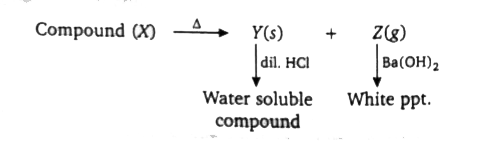
Q. Compound 'X' is:...


Q. Compound 'X' is:

A

`NaNO_(3)`

B

`Ag_(2)C_(2)O_(4)`

C

`PbSO_(4)`

D

`ZnCO_(3)`

Text Solution

Verified by Experts

The correct Answer is:
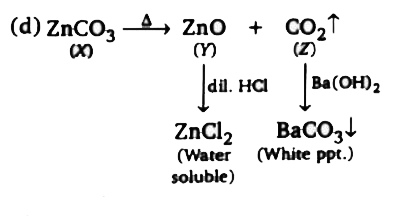
D

Promotional Banner

Topper's Solved these Questions

  • TYPES OF REACTIONS

    VK JAISWAL ENGLISH|Exercise ONE OR MORE ANSWERS IS/ARE CORRECT|40 Videos
  • TYPES OF REACTIONS

    VK JAISWAL ENGLISH|Exercise MATCH THE COLUMN|14 Videos
  • TYPES OF REACTIONS

    VK JAISWAL ENGLISH|Exercise LEVEL 2|196 Videos
  • s-BLOCK ELEMENTS

    VK JAISWAL ENGLISH|Exercise SUBJECTIVE PROBLEMS|2 Videos

Similar Questions

Explore conceptually related problems

Compound 'Q' is:

Compound 'Q' is :

The magnetic property, dipole moment, plane of symmetry, colour and absorption band cann be helpful in structure elucidation of complex compounds: Q. Compound 'x' has molecular formula CrCl_(2)Br*6H_(2)O can show type of isomerism. (i) hydrate isomerism (ii) ionization isomerism (iii) geometrical isomerism (iv) optical isomerism

(i) P+C("carbon")+Cl_(2) to Q+CO (ii) Q+H_(2)O to R+HCl (iii) BN+H_(2)O to R+NH_(3) uarr (iv) Q+LiAlH_(4) to S+LiCl+AlCl_(3) (v) S+H_(2) to R+H_(2) uarr (vi) S+NaH to T (P,Q,R,S annd T do not represent their chemical symbols) Q. Compound S is: (I) an odd e^(-) compound (II) (2c-3e^(-)) compound (III) a electron deficient compound (IV) a sp^(2) hybridized compound Choose the correct code:

The compound 'X' is

The compound X is

Compound X will be :

Three compound X, Y and Z were taken into three different laboratory vessels annd they are carried out by a chemist in his car. The car caught fire due to short circuit and the chemist came out of the car and noticed following observations: Q. Compound X changes into white substnace along with liberation of neutral oxide and then white substnace decomposed into three products among which two are acidic oxides. among these oxides non-polar oxide can undergo polar cyclic polymer on cooling. the compound X will be:

When an oxide of manganese (P) is fused with KOH in the presence of an oxidising agent and dissolved in water, it gives a dark green solution of compound (Q). Compound (Q) disproportionates in neutral or acidic solution to give purple compound ( R) oxidises potassium iodide solution to a compound (S) and compound (P) is also formed. Compounds P to S are

VK JAISWAL ENGLISH-TYPES OF REACTIONS-LEVEL 3
  1. Consider the following reactions and answer the following questions. ...

    Text Solution

    |

  2. Consider the following reactions and answer the following questions. ...

    Text Solution

    |

  3. Q. Compound 'X' is:

    Text Solution

    |

  4. Q. Incorrect statement 'Y' changes on heating:

    Text Solution

    |

  5. The unique behaviour of CU, having a positive E^(@) (reduction potenti...

    Text Solution

    |

  6. The unique behaviour of CU, having a positive E^(@) (reduction potenti...

    Text Solution

    |

  7. Q. When H(2)S gas was passed into filtrate (P), a coloured precipitate...

    Text Solution

    |

  8. Q. Precipitate (Q) was treated withdil. HCl and coloured solution was ...

    Text Solution

    |

  9. Q. Species P and S are respectively:

    Text Solution

    |

  10. Q. 'T' cannot be identify by:

    Text Solution

    |

  11. Consider three P, Q, R, salts among them P and Q salts have different ...

    Text Solution

    |

  12. Consider three P, Q, R, salts among them P and Q salts have different ...

    Text Solution

    |

  13. Consider three P, Q, R, salts among them P and Q salts have different ...

    Text Solution

    |

  14. Three compound X, Y and Z were taken into three different laboratory v...

    Text Solution

    |

  15. Three compound X, Y and Z were taken into three different laboratory v...

    Text Solution

    |

  16. Three compound X, Y and Z were taken into three different laboratory v...

    Text Solution

    |

  17. In salts of polyatomic anion, as polarising power of cation increase, ...

    Text Solution

    |

  18. In salts of polyatomic anion, as polarising power of cation increase, ...

    Text Solution

    |

  19. Dioxygen directly reacts with nearly all metals annd non-metals except...

    Text Solution

    |

  20. Dioxygen directly reacts with nearly all metals annd non-metals except...

    Text Solution

    |

