Home
Class 12
CHEMISTRY
which of the following graph is correct ...

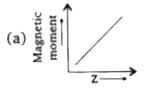
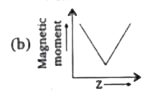
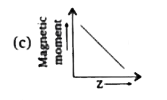
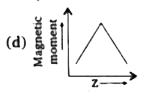
which of the following graph is correct representation between atomic number (Z) and magnetic moment of d-block elements? [outer electronic configuration: `(n-1)d^(x)ns^(1 or 2)`]

A

B

C

D

Text Solution

AI Generated Solution

The correct Answer is:

To solve the question regarding the correct representation of the relationship between atomic number (Z) and magnetic moment of d-block elements, we can follow these steps: ### Step 1: Understand the Concept of Magnetic Moment The magnetic moment (μ) of an atom is related to the number of unpaired electrons (n) in its d-orbitals. The formula for calculating the magnetic moment is given by: \[ \mu = \sqrt{n(n + 2)} \] where \( n \) is the number of unpaired electrons. ### Step 2: Analyze the Electron Configuration of d-block Elements The outer electronic configuration of d-block elements is given as \((n-1)d^x ns^{1 \text{ or } 2}\). This means that the d-block elements fill their d-orbitals after the s-orbitals of the previous shell. ### Step 3: Determine the Number of Unpaired Electrons For d-block elements: - When filling the d-orbitals, the first five electrons (d1 to d5) will each occupy a separate orbital, leading to an increase in the number of unpaired electrons (1 to 5). - As we continue to fill the d-orbitals (d6 to d10), pairing begins to occur, which decreases the number of unpaired electrons. ### Step 4: Observe the Trend - From \( d^1 \) to \( d^5 \), the number of unpaired electrons increases, and thus the magnetic moment increases. - From \( d^6 \) to \( d^{10} \), the number of unpaired electrons decreases, leading to a decrease in the magnetic moment. ### Step 5: Identify the Correct Graph Given the trend of increasing magnetic moment with increasing atomic number up to \( d^5 \) and then decreasing from \( d^6 \) to \( d^{10} \), the correct graph will show an initial rise followed by a fall. ### Conclusion The correct representation of the relationship between atomic number (Z) and magnetic moment for d-block elements is represented by option D, which shows an increase in magnetic moment with atomic number up to a certain point, followed by a decrease. ---

To solve the question regarding the correct representation of the relationship between atomic number (Z) and magnetic moment of d-block elements, we can follow these steps: ### Step 1: Understand the Concept of Magnetic Moment The magnetic moment (μ) of an atom is related to the number of unpaired electrons (n) in its d-orbitals. The formula for calculating the magnetic moment is given by: \[ \mu = \sqrt{n(n + 2)} \] where \( n \) is the number of unpaired electrons. ...
Promotional Banner

Topper's Solved these Questions

  • PERIODIC PROPERTIES

    VK JAISWAL ENGLISH|Exercise Level 3 (Passage Type)|89 Videos
  • PERIODIC PROPERTIES

    VK JAISWAL ENGLISH|Exercise ONE OR MORE ANSWERS IN/ARE CORRECT|98 Videos
  • p-BLOCK ELEMENTS

    VK JAISWAL ENGLISH|Exercise SUBJECTIVE PROBLEMS|35 Videos
  • QUALITATIVE INORGANIC ANALYSIS

    VK JAISWAL ENGLISH|Exercise SUBJECTIVE PROBLEMS|4 Videos

Similar Questions

Explore conceptually related problems

Which of the following electron configurations is correct for iron,(atomic number26)?

Which of the following electron configurations is correct for iron,(atomic number26)?

The element with the electronic configuration [Xe]^(54) 4f^(14)5d^(1)6s^(2) is a

The element with the electronic configuration [Xe]^(54) 4f^(14)5d^(1)6S^(2) is a

Which of the following electron configurations is correct for copper,(atomic number29)

Assign the position of the element having outer electronic configuration (n - 1) d^(2)ns^(2) for n = 4 in the periodic table.

(n-1)d^(10)ns^(2) is the electronic configuration of

The element having the lowest atomic number and a ground state electronic configuration of (n-1) d^(6)ns^(2) is placed in:

Predict the name and position of the element in the periodic table with the electronic configuration (n - 1) d^(8) n s^(2) for n = 5 .

Which block of the periodic table contains elements with the general electronic configuration (n-2)f^(1-14) (n-1)d^(0-1)ns^(2)?
