Home
Class 12
CHEMISTRY
Consider the following Borh-Habber's cyc...

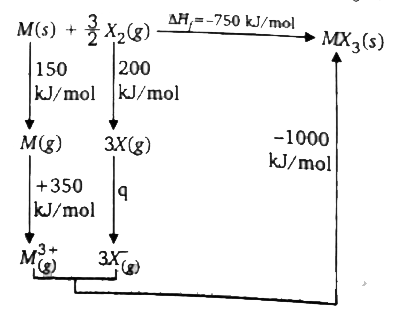
Consider the following Borh-Habber's cycle for formation of `MX_(3)(s)`.

Then calculate value `(q_(1))/(50)`, here `q_(1)` is electron affinity of X(g) in kJ/mol.

Text Solution

Verified by Experts

The correct Answer is:

4

`-750=150+(3)/(2)xx200+350+q-1000`
`q=3xxDeltaH_(BG)=-550,`
`q_(1)=(550)/(3)=183,(q_(1))/(50)=3.66~~4.0`
Promotional Banner

Topper's Solved these Questions

  • PERIODIC PROPERTIES

    VK JAISWAL ENGLISH|Exercise Level 2|102 Videos
  • PERIODIC PROPERTIES

    VK JAISWAL ENGLISH|Exercise MATCH THE COLUMN|11 Videos
  • PERIODIC PROPERTIES

    VK JAISWAL ENGLISH|Exercise ASSERTION-REASON TYPE QUESTIONS|36 Videos
  • p-BLOCK ELEMENTS

    VK JAISWAL ENGLISH|Exercise SUBJECTIVE PROBLEMS|35 Videos
  • QUALITATIVE INORGANIC ANALYSIS

    VK JAISWAL ENGLISH|Exercise SUBJECTIVE PROBLEMS|4 Videos

Similar Questions

Explore conceptually related problems

Consider the following table Then calculate value of "p+q+r-s-t".

Consider the following table Then calculate value of "p+q+r-s-t".

The DeltaH_(f)^(0)(KF,s) is -563 kJ mol^(-1) . The ionization enthalpy of K(g) is 419 kJ mol^(-1) . and the enthalpy of sublimation of potassium is 88 kJ mol^(-1) . The electron affinity of F(g) is 322 kJ mol^(-1) and F-F bond enthalpy is 158 kJ mol^(_1) . Calculate the lattice enthalpy of KF(s) . The given data are as follows: (i) K(s)+1//2F_(2)(g)rarrKF(s)" "DeltaH_(f)^(0)= -563 kJ mol^(-1) (ii) K(g)rarrK^(+)(g)+e^(-)" "Delta_("Ioniz")^(0)=419 kJ mol^(-1) (iii) K(s)rarrK(g)" "DeltaH_("sub")^(0)=88kJ mol^(-1) (iv) F(g)+e^(-)rarrF^(-)(g)" "DeltaH_(eg)^(0)= -322 kJ mol^(-1) (v) F_(2)(g)rarr2F(s)" "DeltaH_("diss")^(0)= 158 kJ mol^(-1) (vi) K^(+)(g)+F^(-)(g)rarrKF(s)" " DeltaH_(L)^(0)=?

For the reaction K(g)+F(g) +K^(o+)+F^(Theta) (separated ions DeltaH = 19 kcal mol^(-1) ), if the ionisation potential of K and the electron affinity of F^(Theta) have a geometric means of 3.88eV and IP gt EA , calculate the values fo ionisation potential and electron affinity.

Consider the following Calculate value of p+q , here p and q are total number of dpi-ppi bonds and total number of sp^(3) hybridised atoms respectively in given molecule.

Consider the following Calculate value of p+q , here p and q are total number of dpi-ppi bonds and total number of sp^(3) hybridised atoms respectively in given molecule.

The value of DeltaH^(@) for the reaction Cu^(+)(g)+I^(-)(g)toCuI(g) is -446kJ mol^(-1) . If the ionisation energy of Cu(g) is 745 kJ mol^(-1) and the electron affinity of I(g) is -295 kJ mol^(-1) , then the value of DeltaH^(@) for the formation of one mole of CuI(g) from Cu(g) and I(g) is:

the standard heat of formation of Fe2O3 (s) is 824.2kJ mol-1 Calculate heat change for the reaction. 4Fe(s) + 302 (g)= 2Fe2O3(s)

If the enthalpy of formation of H_2O(l) is -x kj/mol and enthalpy of neutralization of HCl and NaOH is -y kj/mol then enthalpy of formation of OH^-1 ion (in kJ/mol) is

Consider the following reactions. DeltaH^(@) values of the reactions hve been given as -x, -y and z kJ. Fe_(3)O_(4)(s) to 3Fe(s) + 2O_(2)(g), DeltaH^(@) = z kJ 2Fe(s) + O_(2)(g) to 2FeO(s), DeltaH^(@) =-x kJ 4Fe(s) + 3O_(2)(g) to 2Fe_(2)O_(3)(s), DeltaH^(@) =-y kJ In the given set of reaction, -x//2 kJ refers to

VK JAISWAL ENGLISH-PERIODIC PROPERTIES-SUBJECTIVE PROBLEMS
  1. If heat of solution for AB(s) is -0.95xx10^(x) kcal/mol and lattice en...

    Text Solution

    |

  2. Consider the following Borh-Habber's cycle for formation of MX(3)(s). ...

    Text Solution

    |

  3. Calculate value of -U/100, for AB(s), from following data of Born-Habe...

    Text Solution

    |

  4. Consider the following orders: (i) HF gt HCl gt HBr gt HI: Lewis bas...

    Text Solution

    |

  5. Find out total number of representative elements in the given element:...

    Text Solution

    |

  6. An element 'X' has its electronic configuration of 'K' shell is (n-5)s...

    Text Solution

    |

  7. if value of spin quantum number(s)=-1//2,0,+1//2 then calculate number...

    Text Solution

    |

  8. How many pairs are, in which first species has lower ionisation enegy ...

    Text Solution

    |

  9. Total number of element(s) which have only single oxidation state (oth...

    Text Solution

    |

  10. The number of electrons for Zn^(2+) cation that have the value of azim...

    Text Solution

    |

  11. Calculate the electronegativity of silicon atom using Allred-rochow's ...

    Text Solution

    |

  12. If heat of solution for AB(s) is -0.95xx10^(x) kcal/mol and lattice en...

    Text Solution

    |

  13. Consider the following Borh-Habber's cycle for formation of MX(3)(s). ...

    Text Solution

    |

  14. Calculate value of -U/100, for AB(s), from following data of Born-Habe...

    Text Solution

    |

  15. Consider the following orders: (i) HF gt HCl gt HBr gt HI: Lewis bas...

    Text Solution

    |

  16. Find out total number of representative elements in the given element:...

    Text Solution

    |

  17. An element 'X' has its electronic configuration of 'K' shell is (n-5)s...

    Text Solution

    |

  18. if value of spin quantum number(s)=-1//2,0,+1//2 then calculate number...

    Text Solution

    |

  19. How many pairs are, in which first species has lower ionisation enegy ...

    Text Solution

    |

  20. Total number of element(s) which have only single oxidation state (oth...

    Text Solution

    |
