Home
Class 12
CHEMISTRY
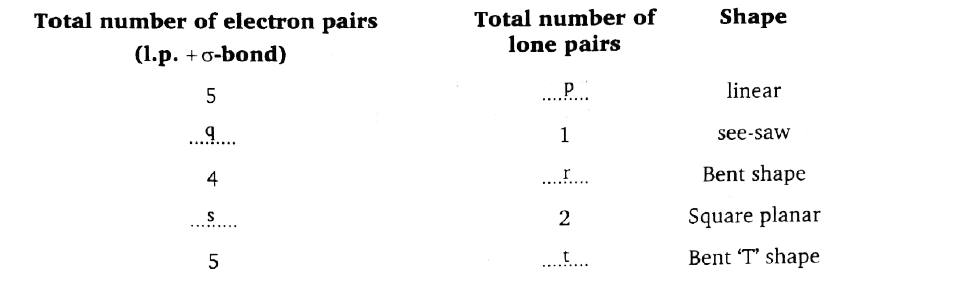
Consider the following table Then c...

Consider the following table

Then calculate value of "p+q+r-s-t".

Text Solution

Verified by Experts

The correct Answer is:

2

p=3, q=5, r=2
s=6, t=2
`3+5+2-6-2 implies 2`
Promotional Banner

Topper's Solved these Questions

  • CHEMICAL BONDING (BASIC)

    VK JAISWAL ENGLISH|Exercise ASSERTION-REASON TYPE QUESTIONS|23 Videos
  • CHEMICAL BONDING (ADVANCED)

    VK JAISWAL ENGLISH|Exercise SUBJECTIVE PROBLEMS|64 Videos
  • CO-ORDINATION COMPOUNDS

    VK JAISWAL ENGLISH|Exercise LEVEL 2|144 Videos

Similar Questions

Explore conceptually related problems

The v-t graph for two particles P and Q are given in the figure. Consider the following statements(s). Then, which of the following statement(s) is/are True:

Consider the following statements. p : Hari is clever. q: shyam is fool. r: Shyam is honest. The negation of statement Hari is clever & Shyam is dishonest if and only if shyam is fool is expressed. As.... (1) ~p^^(q⇔~ r) (2) ~(q ⇔(p^^~r)) (3) ~ q ⇔(~ p^^r ) (4) ~(p^^~ r) (5) ~(p^^r)

Consider the following representation based on long form of periodic table. Here P, Q< R and S are up, right down the left elements with respect to the central element 'X' respectively. According to above representation the correct mathc is/are

Observe the following statements I : The dual of [ ~p ^^ q)] vv [ p ^^ {~(q vv ~s)}] is [~(p vv q)] ^^ [p vv{~(q ^^ ~s)}] II : The dual of ~p ^^ [(~q) ^^ (p vv q) ^^ ~r] is ~p vv[~q) vv(p ^^ q) vv ~r] The true statements in the above is/are :

Consider the following chemical reactions,Compound P,Q, and R respectively are

If t_n denotes the nth term of an A.P. and t_p= 1/q, t_q= 1/p then which one of the following is necessarily a root of the equation (p+2q-3r)x^2+(q+2r-3p)x+(r+2p-3q)=0 (A) t_p (B) t_q (C) t_(pq) (D) t_(p+q)

If p,q are roots of the quadratic equation x^(2)-10rx -11s =0 and r,s are roots of x^(2)-10px -11q=0 then find the value of p+q +r+s.

If p,q,r be three distinct real numbers, then the value of (p+q)(q+r)(r+p), is

If number of aldose, ketose, furanose and pyranose units present in maitose are p, q, r, s respectively. Find the value of p+q+r+s

In Fig.83, P Q || R S Find the value of xdot

VK JAISWAL ENGLISH-CHEMICAL BONDING (BASIC)-SUBJECTIVE PROBLEMS
  1. The molecule ML(x) is planar with 6 electron pairs around M in the val...

    Text Solution

    |

  2. Calculate value of (X+Y+Z)/(10), here X is O-N-O bond angle in NO(3)^(...

    Text Solution

    |

  3. Calculate x+y+z for H(3)PO(3) acid, where x is no. of lone pairs, y is...

    Text Solution

    |

  4. How many right angle, bond angles are present in TeF(5)^(-) molecular ...

    Text Solution

    |

  5. How may possible angle FSeF bond angles are present in SeF(4) molecule...

    Text Solution

    |

  6. In IF(6)^(-) and TeF(5)^(-), sum of axial d-orbitals which are used in...

    Text Solution

    |

  7. Among the following, total no. of planar species is : (i) SF(4) " "...

    Text Solution

    |

  8. Calculate the value of " x+y-z" here x,y and z are total number of non...

    Text Solution

    |

  9. Consider the following table Then calculate value of "p+q+r-s-t".

    Text Solution

    |

  10. In phosphorus acid, if X is number of non bonding electron pairs. Y is...

    Text Solution

    |

  11. Calculate the number of p(pi)-d(pi) bond(s) present in SO(4)^(2-) :

    Text Solution

    |

  12. Sum of sigma and pi bonds in NH(4)^(+) cation is ..

    Text Solution

    |

  13. Consider the following orbitals (i)3p(x) (ii)4d(z^(2)) (iii)3d(x^(2)...

    Text Solution

    |

  14. Calculate value of |x-y|, here x and y are the total number of bonds i...

    Text Solution

    |

  15. Consider the following compounds : (i) IF(5) " " (ii) ClI(4)^(-) "...

    Text Solution

    |

  16. Total number of species which used all three p-orbitals in hybridisati...

    Text Solution

    |

  17. Consider the following species NO(3)^(-), SO(4)^(2-), ClO(3)^(-),SO(3)...

    Text Solution

    |

  18. Consider the following orbitals 3s, 2p(x), 4d(xy),4d(z^(2)), 3d(x^(2)-...

    Text Solution

    |

  19. For the following molecules : PCl(5), BrF(3), IC l(2)^(-), XeF(5)^(-...

    Text Solution

    |

  20. Find out number of transformation among following which involves the c...

    Text Solution

    |
