Home
Class 12
CHEMISTRY
If P to T are second period p-block elem...

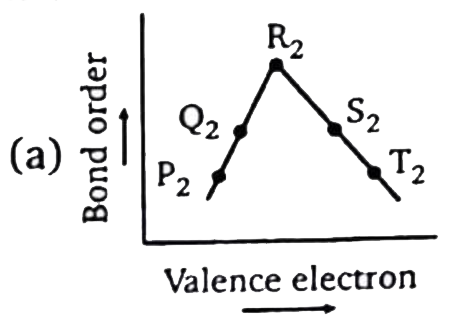
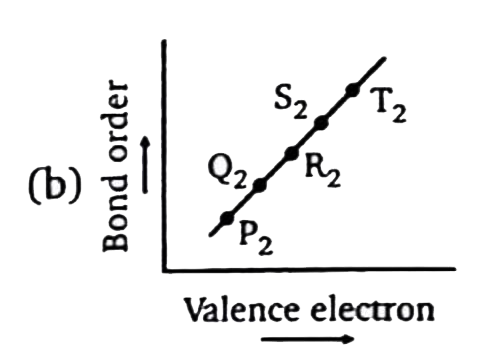
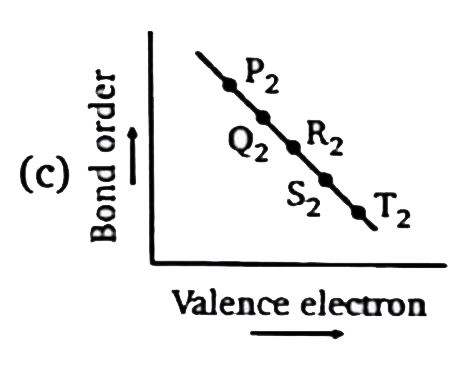
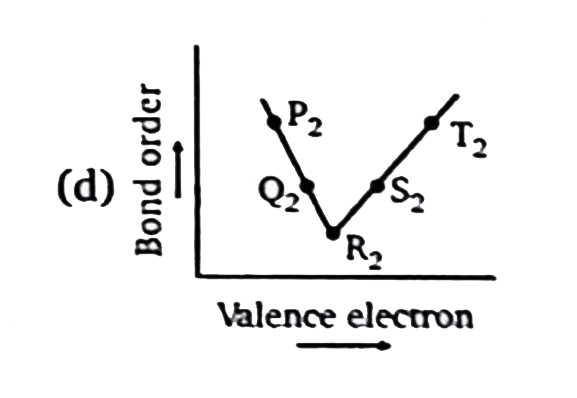
If P to T are second period p-block elements then which of the following graph show corrrect relation between valence electrons in `P_(2) to T_(2)`

A

B

C

D

Text Solution

AI Generated Solution

The correct Answer is:

To solve the problem, we will analyze the relationship between the number of valence electrons in the second period p-block elements (B, C, N, O, F, Ne) and their corresponding bond orders. ### Step-by-Step Solution: 1. **Identify the Second Period p-Block Elements:** The second period p-block elements are: - Boron (B) - Carbon (C) - Nitrogen (N) - Oxygen (O) - Fluorine (F) - Neon (Ne) 2. **Determine the Number of Valence Electrons:** Each of these elements has the following number of valence electrons: - Boron (B): 3 valence electrons - Carbon (C): 4 valence electrons - Nitrogen (N): 5 valence electrons - Oxygen (O): 6 valence electrons - Fluorine (F): 7 valence electrons - Neon (Ne): 8 valence electrons 3. **Determine the Bond Order for Diatomic Molecules:** The bond orders for the diatomic molecules formed by these elements are: - B₂: Bond order = 1 - C₂: Bond order = 2 - N₂: Bond order = 3 - O₂: Bond order = 2 - F₂: Bond order = 1 - Ne₂: Bond order = 0 (Noble gas, no bond) 4. **Plot the Relationship:** Now, we can plot the relationship between the number of valence electrons and bond order: - For 3 valence electrons (B): Bond order = 1 - For 4 valence electrons (C): Bond order = 2 - For 5 valence electrons (N): Bond order = 3 - For 6 valence electrons (O): Bond order = 2 - For 7 valence electrons (F): Bond order = 1 - For 8 valence electrons (Ne): Bond order = 0 5. **Analyze the Graph:** From the data, we see that as we move from Boron to Nitrogen, the bond order increases, reaching a maximum at Nitrogen. After that, as we move to Oxygen and Fluorine, the bond order decreases. This indicates a peak in bond order at Nitrogen. 6. **Select the Correct Graph:** The correct graph will show an initial increase in bond order as the number of valence electrons increases, followed by a decrease after reaching the peak at Nitrogen. Therefore, the correct option is the one that illustrates this trend. ### Conclusion: The correct answer is option number one, which shows the bond order first increasing and then decreasing as the number of valence electrons increases from B to Ne.

To solve the problem, we will analyze the relationship between the number of valence electrons in the second period p-block elements (B, C, N, O, F, Ne) and their corresponding bond orders. ### Step-by-Step Solution: 1. **Identify the Second Period p-Block Elements:** The second period p-block elements are: - Boron (B) - Carbon (C) ...
Promotional Banner

Topper's Solved these Questions

  • CHEMICAL BONDING (ADVANCED)

    VK JAISWAL ENGLISH|Exercise Level 3|77 Videos
  • CHEMICAL BONDING (ADVANCED)

    VK JAISWAL ENGLISH|Exercise ONE OR MORE ANSWER IS/ARE CORRECT|78 Videos
  • CHEMICAL BONDING (ADVANCED)

    VK JAISWAL ENGLISH|Exercise SUBJECTIVE PROBLEMS|64 Videos
  • CHEMICAL BONDING (BASIC)

    VK JAISWAL ENGLISH|Exercise SUBJECTIVE PROBLEMS|54 Videos

Similar Questions

Explore conceptually related problems

Which of the following is most electronegative in p -block elements

Which of the following is completely absorbed in P.C.T. ?

The element which belong with p-block is/are

In the given (V-T) diagram, what is the relation between pressure P_(1) and P_(2) ?

In the given (V-T) diagram, what is the relation between pressure P_(1) and P_(2) ?

In the given (V-T) diagram, what is the relation between pressure P_(1) and P_(2) ?

What are p -block elements? Give their general electronic configuration.

If P.T would have contained 10 periods, maximum elements in that P.T. would be :-

In s - and p -block elements the OS . changes in 2 units, but in transition elements it changes it chnages in units of one.(T/F)

p block elements of 6^(th) period are represented as :-

VK JAISWAL ENGLISH-CHEMICAL BONDING (ADVANCED)-Level 2
  1. The geometry with respect to the central atom of the following molecul...

    Text Solution

    |

  2. Incorrect statement regarding BF(3)NH(3) molecule is :

    Text Solution

    |

  3. In which of the following molecules mu(oberved) is found to be greater...

    Text Solution

    |

  4. Among the following, the molecule with the highest dipole moment is :

    Text Solution

    |

  5. Which of the following is wheat fruit?

    Text Solution

    |

  6. Which of the following is wheat fruit?

    Text Solution

    |

  7. The bond having the minimum bond energy is :

    Text Solution

    |

  8. The correct increasing order of extent of hydrolysis is

    Text Solution

    |

  9. Inorganic benzene reacts with HCl to form a compounds B(3)N(3)H(9)Cl(...

    Text Solution

    |

  10. Select the correct statements about hydrolysis of BCl(3) and NCl(3):

    Text Solution

    |

  11. The incorrect statement regarding molecular orbital (s) is :

    Text Solution

    |

  12. Which of the following species absorb maximum energy in its HOMO-LUMO ...

    Text Solution

    |

  13. If P to T are second period p-block elements then which of the followi...

    Text Solution

    |

  14. Which of the following facts given is not correct? (I) Bond length o...

    Text Solution

    |

  15. N(2) and O(2) are converted to monocations N(2)^(+) and O(2)^(+) respe...

    Text Solution

    |

  16. In which of the following transformations, the bond order has increase...

    Text Solution

    |

  17. H.O.M.O (Highest Occupied Molecular Orbital ) of CO molecular is :

    Text Solution

    |

  18. The structure of B(3)N(3)H(6) is as follows: How may derivations...

    Text Solution

    |

  19. Correctly match is:

    Text Solution

    |

  20. Select correct statement (s) :

    Text Solution

    |
