Home
Class 12
CHEMISTRY
Crystal field theory provides correct el...

Crystal field theory provides correct electronic distribution of central metal under surrounding ligannd field, hence it clearly explains magnetic moment, colour of a complex.
Q. In which of the following complex transition of electron occurs from one shell to other shell of central metal.

A

`[Fe(H_(2)O)_(5)(NO)]^(2+)`

B

`[Co(H_(2)O)_(6)]^(2+)`

C

`[Rh(NH_(3))_(6)]^(2+)`

D

`[Ni(CN)_(6)]^(4-)`

Text Solution

Verified by Experts

The correct Answer is:
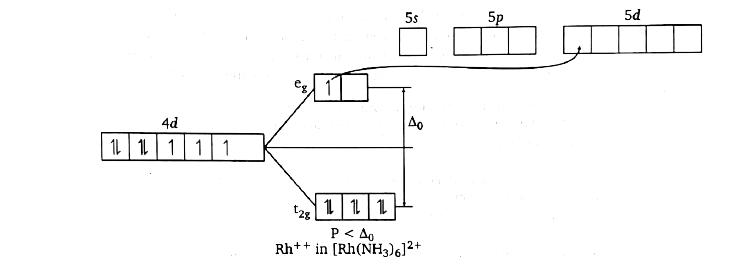
C

Promotional Banner

Topper's Solved these Questions

  • CO-ORDINATION COMPOUNDS

    VK JAISWAL ENGLISH|Exercise ONE OR MORE ANSWERS IS/ARE CORRECT|71 Videos
  • CO-ORDINATION COMPOUNDS

    VK JAISWAL ENGLISH|Exercise MATCH THE COLUMN|36 Videos
  • CO-ORDINATION COMPOUNDS

    VK JAISWAL ENGLISH|Exercise LEVEL 2|144 Videos
  • CHEMICAL BONDING (BASIC)

    VK JAISWAL ENGLISH|Exercise SUBJECTIVE PROBLEMS|54 Videos
  • d-BLOCK ELEMENTS

    VK JAISWAL ENGLISH|Exercise ASSERTION-REASON TYPE QUESTIONS|32 Videos

Similar Questions

Explore conceptually related problems

Crystal field theory provides correct electronic distribution of central metal under surrounding ligannd field, hence it clearly explains magnetic moment, colour of a complex. Q. Which of the following complex is high spin?

Crystal field theory provides correct electronic distribution of central metal under surrounding ligannd field, hence it clearly explains magnetic moment, colour of a complex. Q. Which of the following hydrated complex ion has high intensity colour in aqueous solution.

The crystal field theory assumes interaction between metal ion and the ligands as a purely electrostatic and ligands are supposed to be point charges. Q. Amongst the following complexes which has square planar geometry?

The crystal field theory assumes interaction between metal ion and the ligands as a purely electrostatic and ligands are supposed to be point charges. Q. Amongst the following complexes which has square planar geometry?

a) Give the electronic configuration of the d-orbitals of Ti in [Ti(H_2O)_6]^(3+) ion in the octahedral crystal field. b) Why is this complex coloured ? Explain on the basis of distribution of electrons in d-orbitals.

Which of the following statements is correct with regard to complex ion ? . (a) complex ion consists of a central ion bonded to two or more donor ions or molecules usually does not dissociate into simple ions or molecules even in a solution and exhibits properties different from its constituent ions or molecules (b) The donor ions and molecues which coordinate with the central atom or ion a complex are called ligands The sum of the number of electrons pressent in the central metal ion or atom and those donated by the ligands is called the effective atomic number of the central metal aton and this number is usually the same as the atomic number of the next higher noble gas (d) All of these .

Figure shows two concentric shells of radii a and b uniformly distributed charges q and -q. Which of the following graphs gives correct variation of electric field intensity E with the distance r from the centre?

Crystal field theory with its assumptions of completely electrostatic metal-ligand interactions, does not appear to retionalize the spectrochemical series particularly well. To explain the order of ligands in the series we must admit some covalent contribution to the metal ligand bond, both sigma and pi. Sigma bonds are formed by ligands using their p orbitals (e.g. Cl^(-) ) or by hybrid orbitals (e.g. sp^(3) ) by (H_(2)O ) since all ligands are capable of such sigma interaction, this is not very useful in rationalizing spectrochemical series. The pi bonding ability of ligands partially justifies their position in spectrochemical series. pi-acid ligands. which can accept electron density from filled metal orbital into their empty orbital via pi interation appear towards stronger/higher and of the series e.g. CN^(-).PR_(3) etc. While sigma-donor ligands are typically weak field ligands e.g. Cl^(-),O^(2-) etc. Q. Which of the following d orbitals of the central atom is useful for sigma bond formation with ligands in octahedral field?

Correct the following statements by changing the under lined part of the sentence (Do not change the whole sentence) In a coordination complex, donation of electron pair takes place from the central metal atom to the ligands.

The IUPAC definition of a transition element is that it is an element that has an incomplete d-subshell in either the neutral atom or its ion. Thus the group 12 elements are member of the d-block but are not transition elements. Chemically solft members of the d-block occurs as sulphide minerals and are partially oxidised to obtain the metal, the more electropositive 'hard' metals occurs as oxides and are extracted by reduction. Opposite to p-block elements, the higher oxidation states are favoured by the heavier elements of d-block Metals on the right of the d-block tend to exist in low oxidation states and form complexes with the ligands. Square-planar complexes are common for the platinum metals and gold in oxidation states that yield d^8 electronic configuration, which include RH(I),Ir(I),Pd(II),Pt(II) and Au(III). The most distinctive features/properties of transition metal complex is their wide range of colours.The crystal field theory attributes the colour of the coordination compounds to d-d transition of the electron.It is important to note that (a) in absence of ligand, crystal field spilling does not occur and hence the substances is colourless, (b) the type of ligand also influences the colour of the complexes. Which of the following has dsp^2 hybridisation and is diamagnetic in nature ? (i) Na_4[Cr(CO)_4] , (ii) [Ni(DMGH)_2] , (iii) [PtHBr(PEt_3)_2] (iv) [As(SCN)_4]^(3-) , (v) [AuBr_4]^(-)

VK JAISWAL ENGLISH-CO-ORDINATION COMPOUNDS-LEVEL 3 (PASSAGE TYPE)
  1. An isomerr of the complex CoBrCl(2)(en)(2)(H(2)O), on reaction with co...

    Text Solution

    |

  2. Crystal field theory provides correct electronic distribution of centr...

    Text Solution

    |

  3. Crystal field theory provides correct electronic distribution of centr...

    Text Solution

    |

  4. Crystal field theory provides correct electronic distribution of centr...

    Text Solution

    |

  5. Two important physical evidences supporting the synergic bonding in no...

    Text Solution

    |

  6. Two important physical evidences supporting the synergic bonding in no...

    Text Solution

    |

  7. Two important physical evidences supporting the synergic bonding in no...

    Text Solution

    |

  8. Complex compounds that have the same molecular formula but have differ...

    Text Solution

    |

  9. Complex compounds that have the same molecular formula but have differ...

    Text Solution

    |

  10. Complex compounds that have the same molecular formula but have differ...

    Text Solution

    |

  11. A complex compound of chromium chromium contains five NH(3) molecules,...

    Text Solution

    |

  12. A complex compound of chromium chromium contains five NH(3) molecules,...

    Text Solution

    |

  13. A complex compound of chromium chromium contains five NH(3) molecules,...

    Text Solution

    |

  14. According to C.F.T, attraction between the central metal ion and ligan...

    Text Solution

    |

  15. According to C.F.T, attraction between the central metal ion and ligan...

    Text Solution

    |

  16. According to C.F.T, attraction between the central metal ion and ligan...

    Text Solution

    |

  17. An isomer of the complex Co(en)(2)(H(2)O)IC l(2), on reaction with con...

    Text Solution

    |

  18. An isomer of the complex Co(en)(2)(H(2)O)IC l(2), on reaction with con...

    Text Solution

    |

  19. An isomer of the complex Co(en)(2)(H(2)O)IC l(2), on reaction with con...

    Text Solution

    |

  20. In complexes off wea field ligands, Delta(o) lt P (pairing energy), th...

    Text Solution

    |

