Home
Class 12
CHEMISTRY
When degenerate d-orbitals of an isolate...

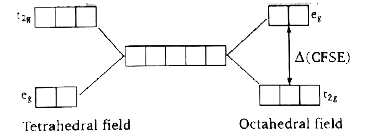
When degenerate d-orbitals of an isolated atom/ion come under influence of magnetic field of ligands, the degeneray is lost. The two set `t_(2g)(d_(xy),d_(yz),d_(xz)) and e_(g) (d_(x^(2))-d_(x^(2)-y^(2))` are either stabilized or destabilized depending upon the nature of magnetic field. it can be expressed diagrammatically as:

Value of CFSE depends upon nature of ligand and a spectrochemical series has been made experimentally, for tetrahedral complexes, `Delta` is about 4/9 times to `Delta_(0)` (CFSE for octahedral complex). this energy lies in visible region and i.e., why electronic transition are responsible for colour. such transition are not possible with `d^(0) and d^(10)` configuration.
Q. `Ti^(3+)(aq)`. is purple while `Ti^(4+)(aq)`. is colourless because:

A

there is not crystal field effec in `Ti^(4+)`

B

The energy difference between `t_(2g) and e_(g) Ti^(4+)` is quite high and does not fall in the visible region

C

`Ti^(4+)` has `d^(0)` configuration

D

`Ti^(4+)` is very small in comparison to `Ti^(3+)` and hence does not absorb any radiation

Text Solution

Verified by Experts

The correct Answer is:

C
Promotional Banner

Topper's Solved these Questions

  • CO-ORDINATION COMPOUNDS

    VK JAISWAL ENGLISH|Exercise ONE OR MORE ANSWERS IS/ARE CORRECT|71 Videos
  • CO-ORDINATION COMPOUNDS

    VK JAISWAL ENGLISH|Exercise MATCH THE COLUMN|36 Videos
  • CO-ORDINATION COMPOUNDS

    VK JAISWAL ENGLISH|Exercise LEVEL 2|144 Videos
  • CHEMICAL BONDING (BASIC)

    VK JAISWAL ENGLISH|Exercise SUBJECTIVE PROBLEMS|54 Videos
  • d-BLOCK ELEMENTS

    VK JAISWAL ENGLISH|Exercise ASSERTION-REASON TYPE QUESTIONS|32 Videos

Similar Questions

Explore conceptually related problems

When degenerate d-orbitals of an isolated atom/ion come under influence of magnetic field of ligands, the degeneray is lost. The two set t_(2g)(d_(xy),d_(yz),d_(xz)) and e_(g) (d_(x^(2))-d_(x^(2)-y^(2)) are either stabilized or destabilized depending upon the nature of magnetic field. it can be expressed diagrammatically as: Value of CFSE depends upon nature of ligand and a spectrochemical series has been made experimentally, for tetrahedral complexes, Delta is about 4/9 times to Delta_(0) (CFSE for octahedral complex). this energy lies in visible region and i.e., why electronic transition are responsible for colour. such transition are not possible with d^(0) and d^(10) configuration. Q. The d-orbitals, which are stabillized in an octahedral magnetic field, are:

When degenerate d-orbitals of an isolated atom/ion come under influence of magnetic field of ligands, the degeneray is lost. The two set t_(2g)(d_(xy),d_(yz),d_(xz)) and e_(g) (d_(x^(2))-d_(x^(2)-y^(2)) are either stabilized or destabilized depending upon the nature of magnetic field. it can be expressed diagrammatically as: Value of CFSE depends upon nature of ligand and a spectrochemical series has been made experimentally, for tetrahedral complexes, Delta is about 4/9 times to Delta_(0) (CFSE for octahedral complex). this energy lies in visible region and i.e., why electronic transition are responsible for colour. such transition are not possible with d^(0) and d^(10) configuration. Q. The extent of crystal field splitting in octahedral complexes of the given metal with particular weak field ligand are:

When degenerate d-orbitals of an isolated atom/ion come under influence of magnetic field of ligands, the degeneray is lost. The two set t_(2g)(d_(xy),d_(yz),d_(xz)) and e_(g) (d_(x^(2))-d_(x^(2)-y^(2)) are either stabilized or destabilized depending upon the nature of magnetic field. it can be expressed diagrammatically as: Value of CFSE depends upon nature of ligand and a spectrochemical series has been made experimentally, for tetrahedral complexes, Delta is about 4/9 times to Delta_(0) (CFSE for octahedral complex). this energy lies in visible region and i.e., why electronic transition are responsible for colour. such transition are not possible with d^(0) and d^(10) configuration. Q. Which of the following is correct arrangement of ligand in terms of the Dq values of their complexes with any particularr 'hard' metal ion:

When degenerate d-orbitals of an isolated atom/ion come under influence of magnetic field of ligands, the degeneray is lost. The two set t_(2g)(d_(xy),d_(yz),d_(xz)) and e_(g) (d_(x^(2))-d_(x^(2)-y^(2)) are either stabilized or destabilized depending upon the nature of magnetic field. it can be expressed diagrammatically as: Value of CFSE depends upon nature of ligand and a spectrochemical series has been made experimentally, for tetrahedral complexes, Delta is about 4/9 times to Delta_(0) (CFSE for octahedral complex). this energy lies in visible region and i.e., why electronic transition are responsible for colour. such transition are not possible with d^(0) and d^(10) configuration. Q. Which of the following is correct arrangement of ligand in terms of the Dq values of their complexes with any particularr 'hard' metal ion:

When degenerate d-orbitals of an isolated atom/ion come under influence of magnetic field of ligands, the degeneray is lost. The two set t_(2g)(d_(xy),d_(yz),d_(xz)) and e_(g) (d_(x^(2))-d_(x^(2)-y^(2)) are either stabilized or destabilized depending upon the nature of magnetic field. it can be expressed diagrammatically as: Value of CFSE depends upon nature of ligand and a spectrochemical series has been made experimentally, for tetrahedral complexes, Delta is about 4/9 times to Delta_(0) (CFSE for octahedral complex). this energy lies in visible region and i.e., why electronic transition are responsible for colour. such transition are not possible with d^(0) and d^(10) configuration. Q. Cr^(3+) form four complexes with four different ligands which are [Cr(Cl)_(6)]^(3-), [Cr(H_(2)O)_(6)]^(3+) , [Cr(NH_(3))_(6)]^(3+) and [Cr(CN)_(6)]^(3-) , the order of CFSE (Delta_(0)) in these complexes in the order:

When degenerate d-orbitals of an isolated atom/ion come under influence of magnetic field of ligands, the degeneray is lost. The two set t_(2g)(d_(xy),d_(yz),d_(xz)) and e_(g) (d_(x^(2))-d_(x^(2)-y^(2)) are either stabilized or destabilized depending upon the nature of magnetic field. it can be expressed diagrammatically as: Value of CFSE depends upon nature of ligand and a spectrochemical series has been made experimentally, for tetrahedral complexes, Delta is about 4/9 times to Delta_(0) (CFSE for octahedral complex). this energy lies in visible region and i.e., why electronic transition are responsible for colour. such transition are not possible with d^(0) and d^(10) configuration. Q. For an octahedral complex, which of the followin d-electron configuration will give maximum CFSE?

When degenerate d-orbitals of an isolated atom/ion come under influence of magnetic field of ligands, the degeneray is lost. The two set t_(2g)(d_(xy),d_(yz),d_(xz)) and e_(g) (d_(x^(2))-d_(x^(2)-y^(2)) are either stabilized or destabilized depending upon the nature of magnetic field. it can be expressed diagrammatically as: Value of CFSE depends upon nature of ligand and a spectrochemical series has been made experimentally, for tetrahedral complexes, Delta is about 4/9 times to Delta_(0) (CFSE for octahedral complex). this energy lies in visible region and i.e., why electronic transition are responsible for colour. such transition are not possible with d^(0) and d^(10) configuration. Q. The vlaue of CFSE (Delta_(0)) for completes given below follow the order, (I) [Co(NH_(3))_(6)]^(3+) (II) [Rh(NH_(3))_(6)]^(3+) (III) [IR(NH_(3))_(6)]^(3+)

In the absence of external magnetic field, d-orbital is

A: The degeneracy of d-orbitals is lost under strong field ligand R: The degeneracy of d-orbitals does not get lost under weak field ligand

Which of the following orbitals are degenerate? 3d_(xy),4d_(xy),3d_(z^(2),3d_(yz),4d_(yz),4d_(z^(2))

VK JAISWAL ENGLISH-CO-ORDINATION COMPOUNDS-LEVEL 3 (PASSAGE TYPE)
  1. An isomer of the complex Co(en)(2)(H(2)O)IC l(2), on reaction with con...

    Text Solution

    |

  2. An isomer of the complex Co(en)(2)(H(2)O)IC l(2), on reaction with con...

    Text Solution

    |

  3. An isomer of the complex Co(en)(2)(H(2)O)IC l(2), on reaction with con...

    Text Solution

    |

  4. In complexes off wea field ligands, Delta(o) lt P (pairing energy), th...

    Text Solution

    |

  5. In complexes off wea field ligands, Delta(o) lt P (pairing energy), th...

    Text Solution

    |

  6. In complexes off wea field ligands, Delta(o) lt P (pairing energy), th...

    Text Solution

    |

  7. Complex compounds are molecular compounds which retain their identitie...

    Text Solution

    |

  8. Complex compounds are molecular compounds which retain their identitie...

    Text Solution

    |

  9. Complex compounds are molecular compounds which retain their identitie...

    Text Solution

    |

  10. Recent X-ray work, IR and other spectroscopic methods have proved that...

    Text Solution

    |

  11. Recent X-ray work, IR and other spectroscopic methods have proved that...

    Text Solution

    |

  12. On the basic of stability of complex ion in the solution, complexes ma...

    Text Solution

    |

  13. On the basic of stability of complex ion in the solution, complexes ma...

    Text Solution

    |

  14. When degenerate d-orbitals of an isolated atom/ion come under influenc...

    Text Solution

    |

  15. When degenerate d-orbitals of an isolated atom/ion come under influenc...

    Text Solution

    |

  16. When degenerate d-orbitals of an isolated atom/ion come under influenc...

    Text Solution

    |

  17. When degenerate d-orbitals of an isolated atom/ion come under influenc...

    Text Solution

    |

  18. When degenerate d-orbitals of an isolated atom/ion come under influenc...

    Text Solution

    |

  19. When degenerate d-orbitals of an isolated atom/ion come under influenc...

    Text Solution

    |

  20. When degenerate d-orbitals of an isolated atom/ion come under influenc...

    Text Solution

    |
