Home
Class 11
PHYSICS
The angle which the vector vec(A)=2hat(i...

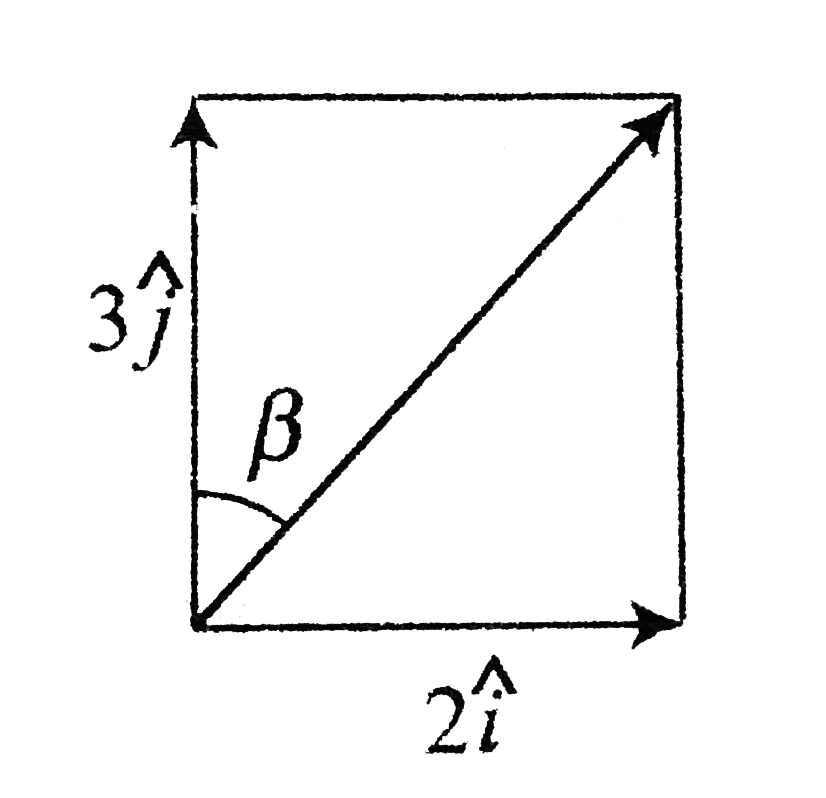
The angle which the vector `vec(A)=2hat(i)+3hat(j)` makes with the y-axis, where `hat(i)` and `hat(j)` are unit vectors along x- and y-axis, respectively, is

A

a. `cos^(-1)(3//5)`

B

b. `cos^(-1)(2//3)`

C

c. `tan^(-1)(2//3)

D

d. `sin^(-1)(2//3)`

Text Solution

Verified by Experts

The correct Answer is:
C

See (figure)
`tan beta=2/3` or `beta=tan^(-1)(2/3)`
Promotional Banner

Topper's Solved these Questions

  • VECTORS

    CENGAGE PHYSICS ENGLISH|Exercise Exercise Multiple Correct|5 Videos
  • VECTORS

    CENGAGE PHYSICS ENGLISH|Exercise Exercise Subjective|28 Videos
  • TRAVELLING WAVES

    CENGAGE PHYSICS ENGLISH|Exercise Integer|9 Videos
  • WORK, POWER & ENERGY

    CENGAGE PHYSICS ENGLISH|Exercise Archives (integer)|4 Videos

Similar Questions

Explore conceptually related problems

The unit vector along vec(A)=2hat(i)+3hat(j) is :

The unit vector along vec(A)= 2 hat i + 3 hat j is :

A body constrained to move along the z-axis of a co-ordinate system, is subjected to a constant force vec(F) given by vec(F)=-hat(i)+2hat(j)+3hat(k) Newton where hat(i),hat(j) and hat(k) represent unit vectors along x-,y-,and z-axes of the system, respectively. Calculate the work done by this force in displacing the body through a distance of 4m along the z-axis.

Find the angles which the vector vec a= hat i- hat j+sqrt(2) hat k makes with the coordinate axes.

Find the angles which the vector vec a= hat i- hat j+sqrt(2) hat k makes with the coordinate axes.

Find the angle of vector vec a = 6 hat i + 2 hat j - 3 hat k with x -axis.

Find the angle between the vector vec(a) =2 hat(i) + 3hat(j) - 4 hat(k) and vec(b) = 4hat(i) +5 hat(j) - 2hat(k) .

The angles with a vector hat(i)+hat(j)+sqrt(2hat(k)) makes with X,Y and Z axes respectively are

Unit vector along the vector hat(i) + hat(j) + hat(k) is

Angle made by vector sqrt(3)hat(i)+sqrt(2)hat(j)-2hat(k) with -ve y- axis is :

CENGAGE PHYSICS ENGLISH-VECTORS-Exercise Single Correct
  1. If vec(A)=vec(B)+vec(C ), and the magnitudes of vec(A),vec(B),vec(C ) ...

    Text Solution

    |

  2. Let A=hatiA cos theta+hatj A sin theta be any vector .Another vector B...

    Text Solution

    |

  3. The angle which the vector vec(A)=2hat(i)+3hat(j) makes with the y-axi...

    Text Solution

    |

  4. Given vec(P)=3hat(i)-4hat(j). Which of the following is perpendicular ...

    Text Solution

    |

  5. In going from one city to another, a car travels 75km north, 60km nort...

    Text Solution

    |

  6. What is the angle between vec(A) and vec(B), If vec(A) and vec(B) are ...

    Text Solution

    |

  7. Two vectors vec(a) and vec(b) are such that |vec(a)+vec(b)|=|vec(a)-ve...

    Text Solution

    |

  8. Given vec(A)=4hat(i)+6hat(j) and vec(B)=2hat(i)+3hat(j). Which of the ...

    Text Solution

    |

  9. Given vec(A)=2hat(i)+phat(j)+qhat(k) and vec(B)=5hat(i)+7hat(j)+3hat(k...

    Text Solution

    |

  10. If vec(A) is perpendicular to vec(B), then

    Text Solution

    |

  11. If the angle between the vectors vec(a) and vec(b) is an acute angle, ...

    Text Solution

    |

  12. Given that vec(A)+vec(B)=vec(C ). If |vec(A)|=4, |vec(B)|=5 and |vec(C...

    Text Solution

    |

  13. If vec(b)=3hat(i)+4hat(j) and vec(a)=hat(i)-hat(j) the vector having t...

    Text Solution

    |

  14. Choose the wrong statement.

    Text Solution

    |

  15. What displacement at an angle 60^(@) to the x-axis has an x-component ...

    Text Solution

    |

  16. Mark the correct statement.

    Text Solution

    |

  17. Out of the following forces, the resultant of which cannot be 10N?

    Text Solution

    |

  18. Which of the following pairs of forces cannot be added to give a resul...

    Text Solution

    |

  19. In an equilateral triangle ABC, AL, BM, and CN are medians. Forces alo...

    Text Solution

    |

  20. The sum of two vectors A and B is at right angles to their difference....

    Text Solution

    |

