Home
Class 11
PHYSICS
In a particular crash test, a car of mas...

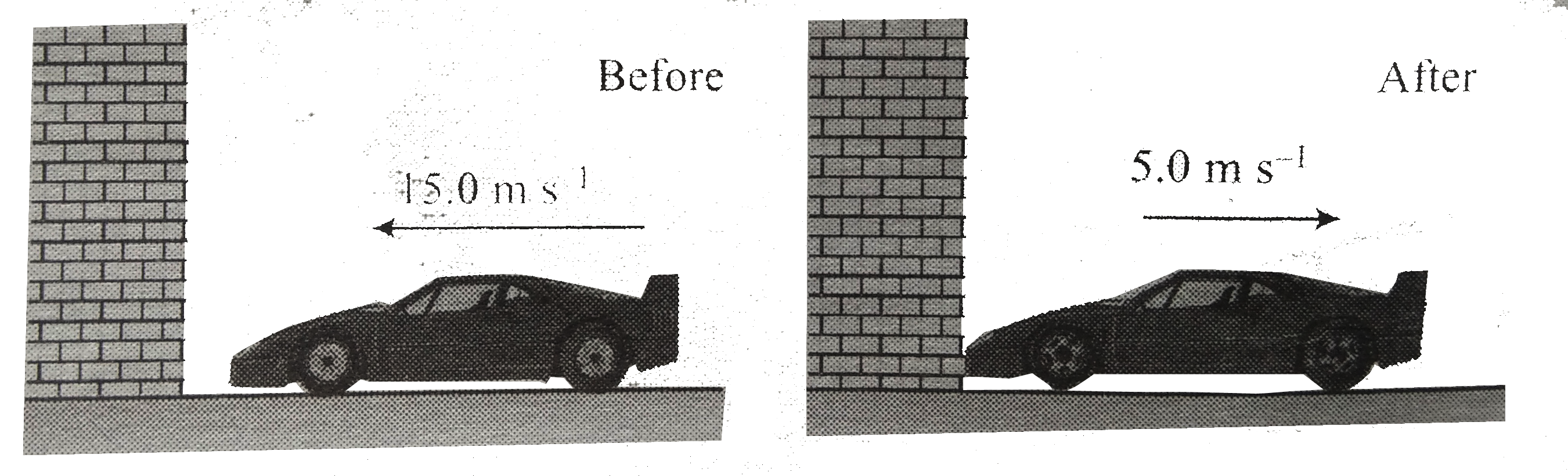
In a particular crash test, a car of mass 1500 kg collies with a wall as shown in fig. The initial and final velocities on the car are `vec(v_i)=-15.0 hat(i)ms^(-1)` and `vec(v_f)=5.00 hat(i) ms^(-1)`, respectively. If the collision lasts `0.150s`, find the impulse caused by the collision and the average force exerted on the car.

Text Solution

Verified by Experts

The collision time is short, so we can imagine the car being brought to rest very rapidly and then moving back in the opposite direction with a raduced speed.
Let us assume that the force exerted by the wall on the car is large compred with other forces on the car (such as friction and air resistance). Furthermore, the gravitational force and the normal force exerted by the road on the car are perpendicular to the motion and , therefore, do not affect the horizontal momentum. Therefore, we categorize the problem as one in which we can apply the impusle approximation in the horizontal direction. Evaluating the inital and final momenta of the car, we get
`vec(P)_(i)=mvec(v)_(i)=(1500 kg)(-15.0 hat(i) ms^(-1))`
`=-2.25 xx 10^(4)hat(i) g ms^(-1)`
`vec(p)_(f)=m vec(v)_(f)=(1500 kg)(5.0 hat(i) ms^(-1))`
`=0.75 xx 10^(4)hat(i) kg ms^(-1)`
Impulse on the car:
`vec(J)=Delta vec(p)=vec(p)_(f)=vec(p)_(i)`
`=0.75 xx 10^(4) hat(i) kgms^(-1) -(-2.25 xx 10^(4)hat(i) kg ms^(-1))`
`implies vec(J)=300 xx 10^(4)hat(i) kg ms^(-1)`
The average force exerted by the wall on the car
`vec(F)_(avg)=(Delta vec(p))/(Delta t) =(3.00 xx 10^(4)hat(i)kgms^(-1))/(0.150s) = 2.00 xx 10^(5)hat(i)N`.
Promotional Banner

Topper's Solved these Questions

  • NEWTON'S LAWS OF MOTION 1

    CENGAGE PHYSICS ENGLISH|Exercise Solved Examples|11 Videos
  • NEWTON'S LAWS OF MOTION 1

    CENGAGE PHYSICS ENGLISH|Exercise Exercise 6.1|11 Videos
  • MISCELLANEOUS VOLUME 2

    CENGAGE PHYSICS ENGLISH|Exercise INTEGER_TYPE|10 Videos
  • NEWTON'S LAWS OF MOTION 2

    CENGAGE PHYSICS ENGLISH|Exercise Integer type|1 Videos
