Home
Class 11
PHYSICS
A block of mass m is placed on a horizon...

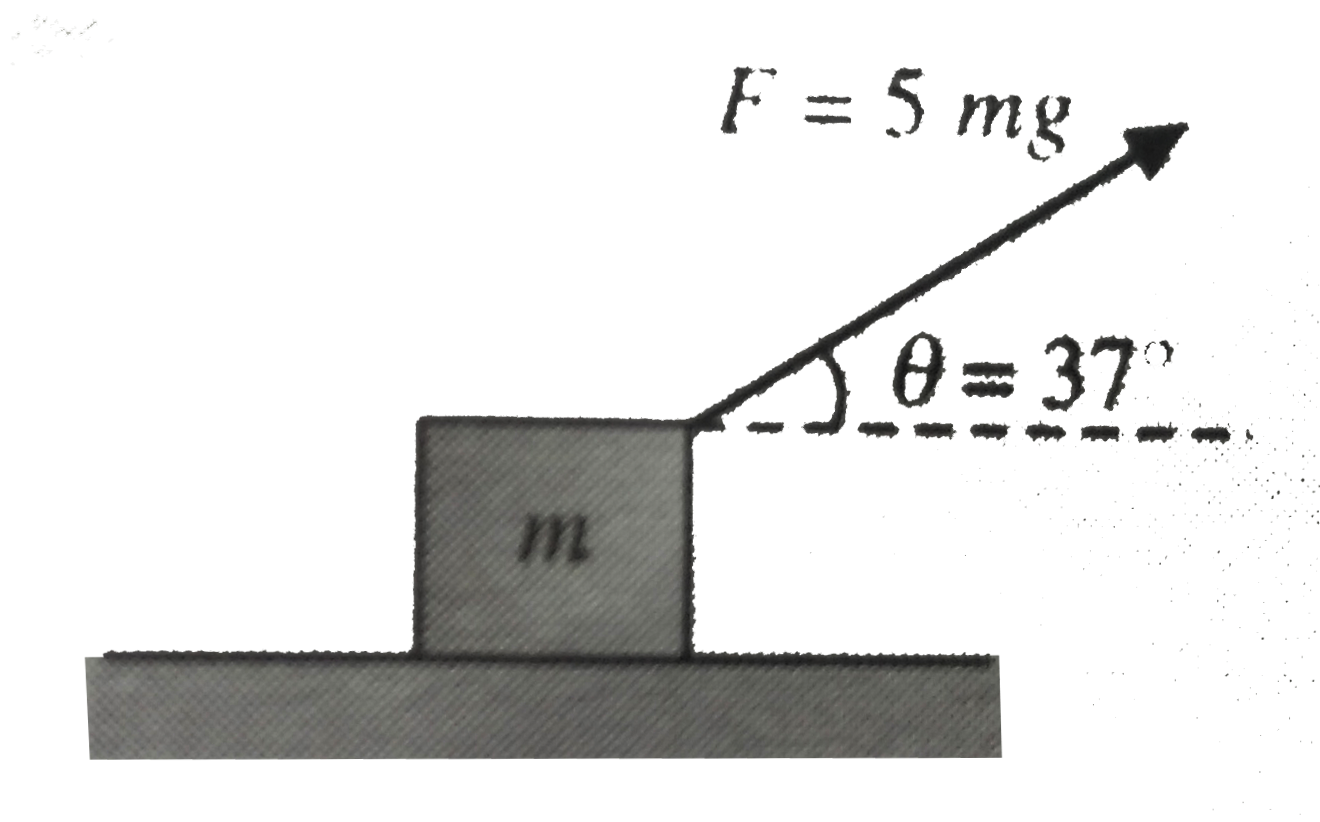
A block of mass m is placed on a horizontla surface. If the block is pulled by applying a force of magnitude F=5mg at an angle `theta=37^(@)`, with horizontal as shown in fig. find the acceleration of the block at the given instant.

Text Solution

Verified by Experts
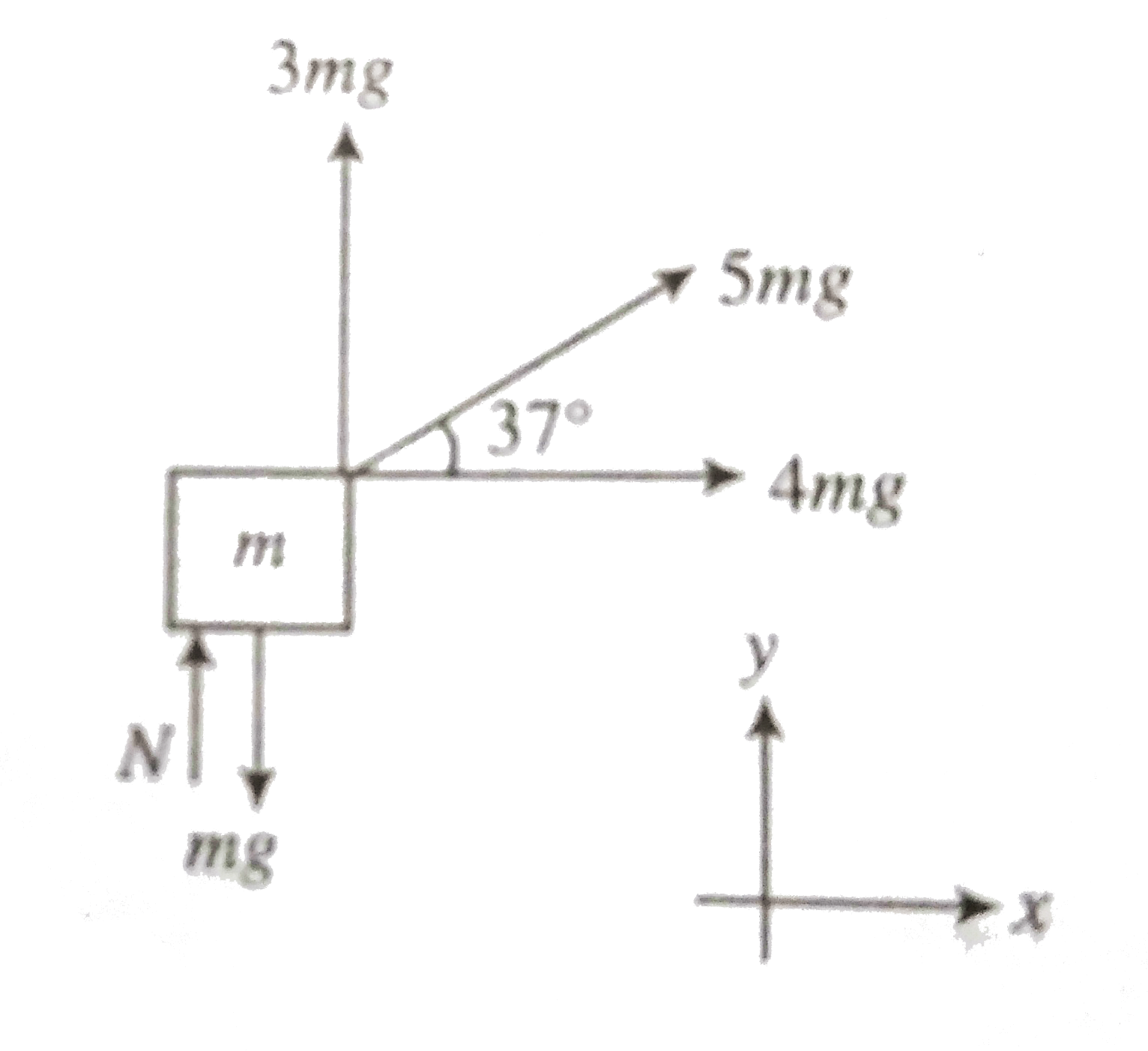
Three forces act on the block (a) `mg darr (b) F=5mg (c ) N uarr`

Resolving the forces along x- and y-axis, we have equation of motion.
`Sigma F_(x)=ma_(x)`
`4mg=ma_(x)`
This gives`a_(x)=4g` ...(i)
`Sigma F_(y)=ma_(y)`
`3mg-mg +N = ma_(y)`
`2mg+N = ma^(y)` ..(iii)
Let `a_(y)=0. Then N=-2mg`
The nagative result signifies that N will be directed down (opposite to assumed direction), but the ground cannot pull the block down. Hence, the block will lose contact with the ground.
or `N=0`
Hence, from (ii) , `a_(y)=2 g uarr`
Hence, the acceleration , `|vec(a)|=sqrt(a_(x)^(2)+a_(y)^(2))`
Where `a_(x)=4g` form eq. (i) and `a_(y)=2g` from eq. (ii)
This gives `a=sqrt(a_(x)^(2)+a_(y)^(2)) = sqrt((4g)^(2)+(20)^(2))=2sqrt(5) g` .
Promotional Banner

Topper's Solved these Questions

  • NEWTON'S LAWS OF MOTION 1

    CENGAGE PHYSICS ENGLISH|Exercise Solved Examples|11 Videos
  • NEWTON'S LAWS OF MOTION 1

    CENGAGE PHYSICS ENGLISH|Exercise Exercise 6.1|11 Videos
  • MISCELLANEOUS VOLUME 2

    CENGAGE PHYSICS ENGLISH|Exercise INTEGER_TYPE|10 Videos
  • NEWTON'S LAWS OF MOTION 2

    CENGAGE PHYSICS ENGLISH|Exercise Integer type|1 Videos

Similar Questions

Explore conceptually related problems

A block of mass M is pulled on a smooth horizontal table by a string making an angle theta with the horizontal as shown in figure. If the acceleration of the block is a , find the force applied by the string and by the table N on the block.

A block of mass m is placed at rest on a horizontal rough surface with angle of friction phi . The block is pulled with a force F at an angle theta with the horizontal. The minimum value of F required to move the block is

A block of mass m is placed at rest on a horizontal rough surface with angle of friction phi . The block is pulled with a force F at an angle theta with the horizontal. The minimum value of F required to move the block is

A block of mass m = 10 kg is pulled by a force F = 100 N at an angle theta=30^(@) with the horizontal along a smooth horizontal surface. What is the acceleration of the block? (g = 10m//s^(2))

A block of mass M is pulled along a horizontal surface by applying a force at angle theta with the horizontal. The friction coefficient between the block and the surface is mu . If the block travels at a uniform velocity, find the work done by this applied force during a displacement d of the block.

A block of mass M is pulled along a horizontal surface by applying a force at angle theta with the horizontal. The friction coefficient between the block and the surfasce is mu . If the block travels at a uniform velocity, find the work donen by this applied force during a displacement d of the blcok.

A wooden block of mass M resting on a rough horizontal surface is pulled with a force T at an angle q to the horizontal. If m is coefficient of kinetic friction between the block and the surface, the acceleration of the block is

A block of mass 10 kg is placed on the rough horizontal surface. A pulling force F is acting on the block which makes an angle theta above the horizontal. If coefficient of friction between block and surface is 4/3 then minimum value of force required to just move the block is (g = 10 m/s^2)

A block of mass 5 kg is placed on a rough horizontal plane . The coefficients of stastic and kinetic friction between the block and surface are 0*5 and 0*3 respectively. A force of 100 N is applied at an angle 30^(@) with the horizontal as shown in the figure . The acceleration of the block will be [ g = 10 m//s^(2) ]

A block of mass M is pulled along a horizontal frictionless surface by a rope of mass m as shown in A horizontal force F is applied to one end of the rope. Find (a) the acceleration of the rope and block (b) the force that the rope exerts on the block (c) the tension in the rope at its mid point

