Home
Class 11
PHYSICS
Two block of masses m(1) and m(2) are pl...

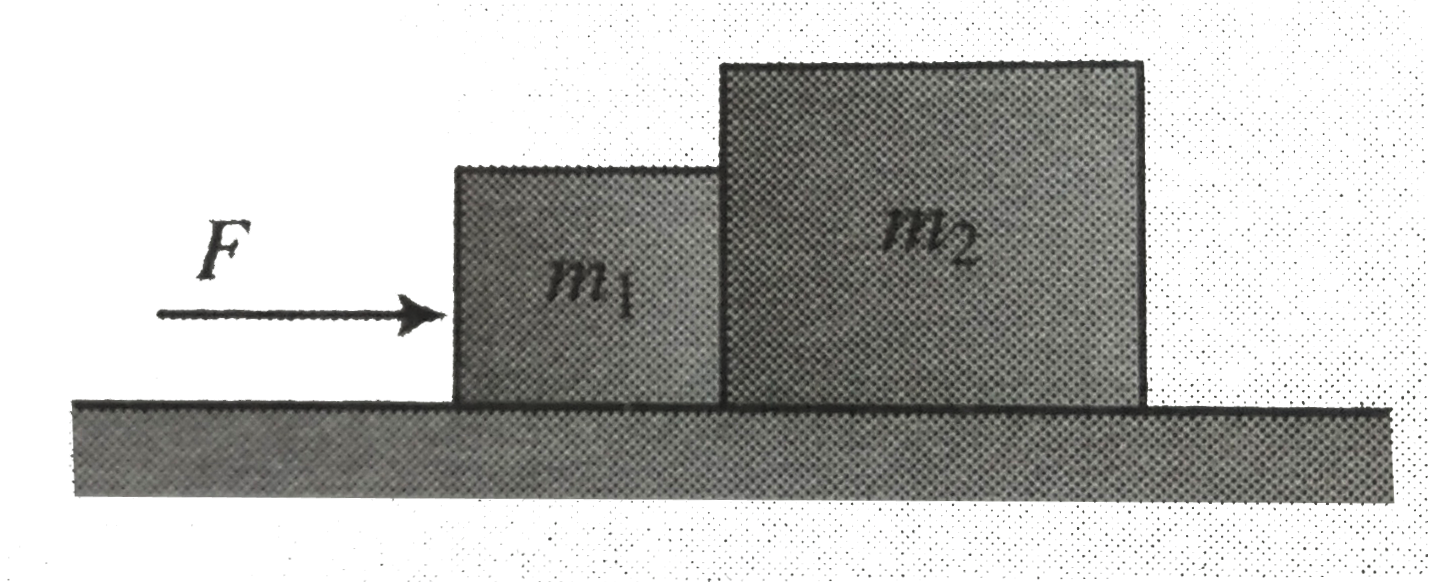
Two block of masses `m_(1) and m_(2)` are placed side by side on a smooth horizontal surface as shown in fig. A horizontal force F is applied on the block .

(a) Find the acceleration of each block.
(b) Find the normal reaction between the two blocks.

Text Solution

Verified by Experts
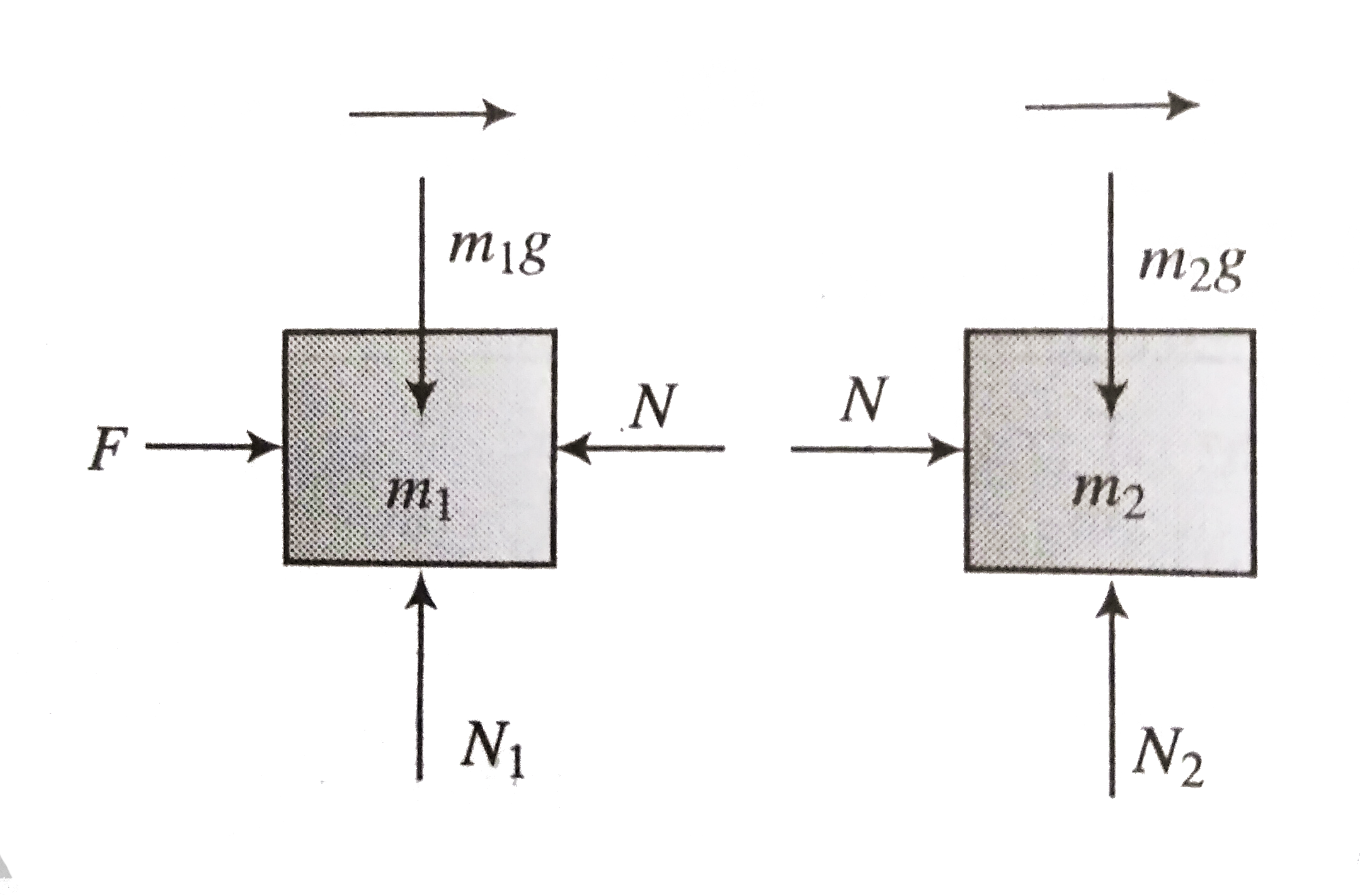
Method 1: Since the two blocks always remain in contact with each other, they msut move with the same acceleration.

Using Newton's second law, we get
For block `m_(1):F-N=m_(1)a`
For block `m_(2): N = m_(2)a`
On adding the two equations, we get
`f=(m_(1)+m_(2)) a implies a=(F)/(m_(1)+m_(2))`
Substituting the value of a in (ii), we get
`N=m_(2)a = (Fm_(2))/(m_(1)+m_(2))`
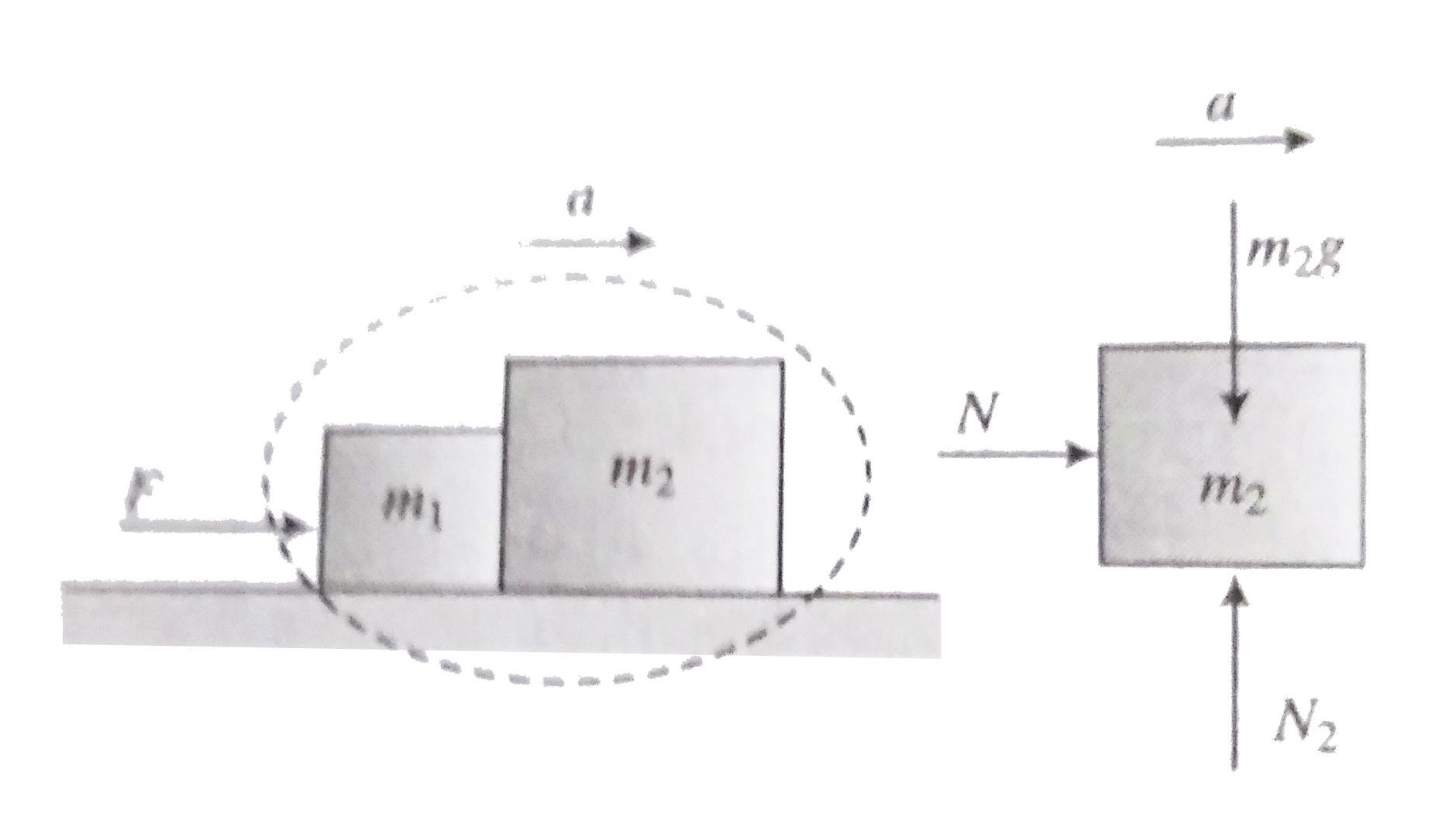
Method 2 : The situation may be considered as follows : Instead of drawing the free-body diagrams of each block, we can draw the free-body diagram of both blocks together as shown in fig

The net force acting on the system is F, and the total mass of the system is `m_(1)+m_(2)`. Thus, `a=(F)/(m_(1)+m_(2))`
To find out the normal reaction N between the two blocks, we can imagine the following: Block `m_(2)` is moving with an acceleration a, therefore, the net force acting on it most be `m_(2)a` which is nothing but the normal reaction applied by the block `m_(1)`. Thus
`N=m_(2)a = (m_(2)F)/(m_(1)+m_(2))` .
Promotional Banner

Topper's Solved these Questions

  • NEWTON'S LAWS OF MOTION 1

    CENGAGE PHYSICS ENGLISH|Exercise Solved Examples|11 Videos
  • NEWTON'S LAWS OF MOTION 1

    CENGAGE PHYSICS ENGLISH|Exercise Exercise 6.1|11 Videos
  • MISCELLANEOUS VOLUME 2

    CENGAGE PHYSICS ENGLISH|Exercise INTEGER_TYPE|10 Videos
  • NEWTON'S LAWS OF MOTION 2

    CENGAGE PHYSICS ENGLISH|Exercise Integer type|1 Videos

Similar Questions

Explore conceptually related problems

Two blocks of masses 4kg and 2kg are placed side on a smooth horizontal surface as shown in the figure. A horizontal force of 20N is applied on 4kg block. Find (a) the acceleration of each block. (b) the normal reaction between two blocks.

Two blocks of masses 4kg and 2kg are placed side on a smooth horizontal surface as shown in the figure. A horizontal force of 20N is applied on 4kg block. Find (a) the acceleration of each block. (b) the normal reaction between two blocks.

Two blocks of masses 1 kg and 2 kg are placed in contact on a smooth horizontal surface as shown in fig. A horizontal force of 6N is applied d(a) on a 1-kg block. Find the force of interaction of the blocks. .

Three blocks of masses 3kg ,2kg and 1kg are placed side by side on a smooth surface as shown in figure. A horizontal force of 12N is applied on 3kg block. Find the net force on 2kg block.

Three blocks of masses 3kg ,2kg and 1kg are placed side by side on a smooth surface as shown in figure. A horizontal force of 12N is applied on 3kg block. Find the net force on 2kg block.

Two blocks of mass m_(1) and m_(2) lie on smooth horizontal table in contact with each other as shown in figure If a force F is applied to the mass m_(1) then the contact force between the block will be

Two blocks of masses M_1 and M_2 are placed in contact with each other on a frictionless horizontal surface. If a force F is applied on the block of mass M_1 , what is the contact force between the two blocks?

Two blocks A and B each of mass m are placed on a smooth horizontal surface. Two horizontal force F and 2F are applied on blocks A and B, respectively, as shown in fig. Block A does not slide on block B. Then then the normal reaction acting between the two blocks is (assume no friction between the blocks)

Two blocks A and B each of mass m are placed on a smooth horizontal surface. Two horizontal force F and 2F are applied on blocks A and B, respectively, as shown in fig. Block A does not slide on block B. Then then the normal reaction acting between the two blocks is (assume no friction between the blocks)

Two blocks A and B each of mass m are placed on a smooth horizontal surface. Two horizontal force F and 2F are applied on blocks A and B, respectively, as shown in fig. Block A does not slide on block B. Then then the normal reaction acting between the two blocks is (assume no friction between the blocks)