Home
Class 11
PHYSICS
Find the force of interaction between th...

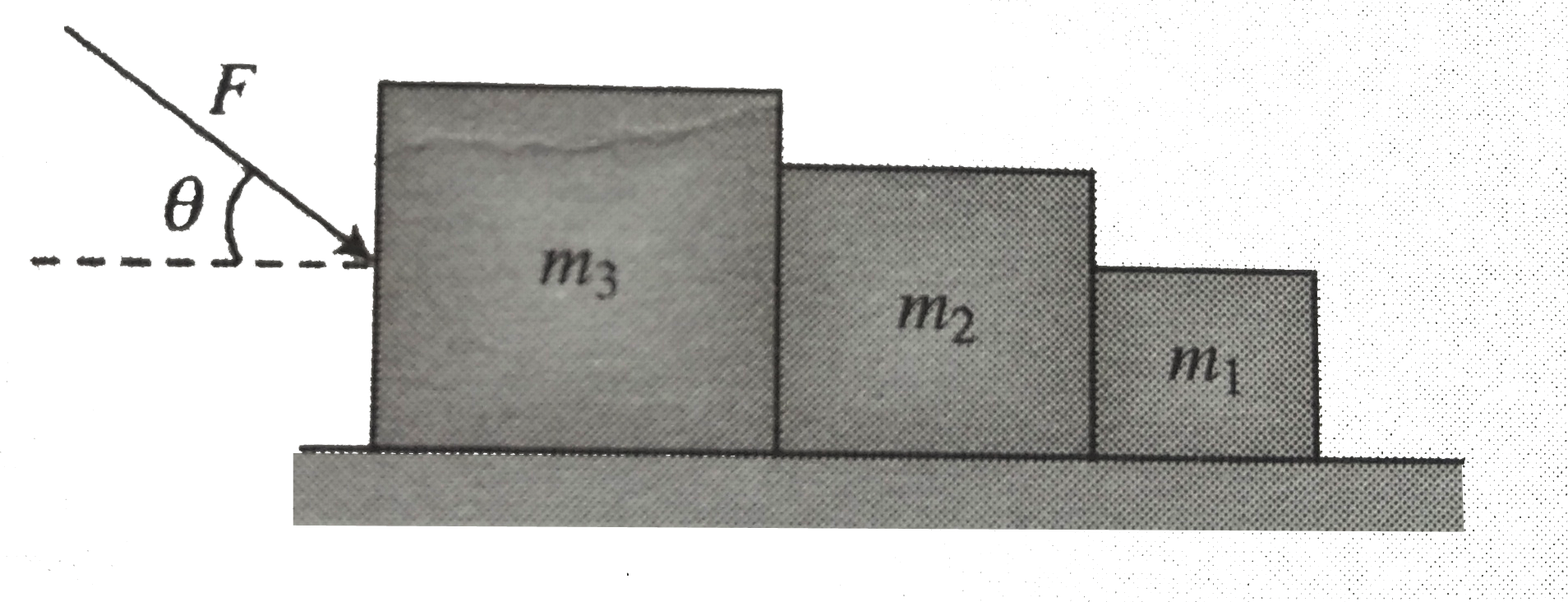
Find the force of interaction between the bodies as shown in fig. Blocks are in contact.

Text Solution

Verified by Experts
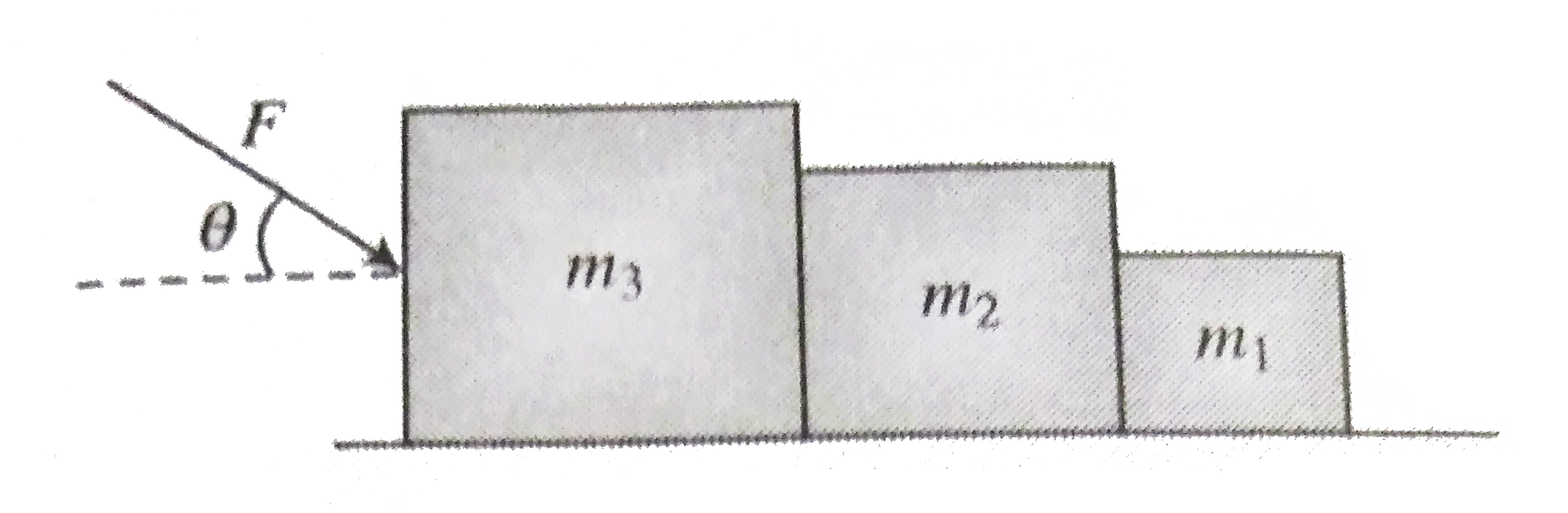
All the bodies move together along horizontal direction with an acceleration,
`a=([F_("horizontal")]_("net"))/(m_("total")) = (F cos theta)/(m_(1)+m_(2)+m_(3))`

By Newton's second law for block `m_(1)` ,
`N_(1)=m_(1)a = m_(1)((F cos theta)/(m_(1)+m_(2)+m_(3)))`
and for block `m_(2)`, we have `N_(2)-N_(1) = m_(2)a`
or `N_(2) = N_(1) + m_(2)a = N_(1)+m_(2)((F cos theta)/(m_(1)+m_(2)+m_(3)))`
and for block `m_(2)` we have `N-(2)-N_(1)=m_(2)a`
or `N_(2)=N_(1)+m_(2)a = N_(1)+m_(2)((F cos theta)/(m_(1)+m_(2)+m_(3)))`
Here the force of interaction is of compressive nature.
Hence, `N_(2)=((m_(1)+m_(2))f cos theta)/((m_(1)+m_(2)+m_(3)))`
We can caluculate the value of `N_(2)` by taking `m_(1) and m_(2)` together as system. From FBD of `'m_(1)+m_(2)'` as fig.
or `N_(2)=(m_(1)+m_(2))a=((m_(1)+m_(2))f cos theta)/((m_(1)+m_(2)+m_(3)))`.
Promotional Banner

Topper's Solved these Questions

  • NEWTON'S LAWS OF MOTION 1

    CENGAGE PHYSICS ENGLISH|Exercise Solved Examples|11 Videos
  • NEWTON'S LAWS OF MOTION 1

    CENGAGE PHYSICS ENGLISH|Exercise Exercise 6.1|11 Videos
  • MISCELLANEOUS VOLUME 2

    CENGAGE PHYSICS ENGLISH|Exercise INTEGER_TYPE|10 Videos
  • NEWTON'S LAWS OF MOTION 2

    CENGAGE PHYSICS ENGLISH|Exercise Integer type|1 Videos

Similar Questions

Explore conceptually related problems

Find the force of friction acting between both the blocks shown in the figure.

Find the force of interaction between two current carrying coils, the distance between the centres of which is much greater than their linear dimensions (Fig. 28.16).

Two blocks of mass = 2 kg and M = 5 kg are in contact on a frictionless table. A horizonatal force F (= 35 N) is applies to m. Find the force of contact between the block, will the force of contact remain same if F is applied to M ?

Name the type of interaction seen between fig and wasps.

How does the distance of separation between two bodies affect the magnitude of the non-contact force between them ?

Find the input resistance of the circuit between the points A and B of fig. shown

The fricition coefficient between the table and block shown in fig. is 0.2 find the acceleration of the system (Take g=10 m//s^(2) )

A block of mass m is placed on a rough inclined plane. The corfficient of friction between the block and the plane is mu and the inclination of the plane is theta .Initially theta=0 and the block will remain stationary on the plane. Now the inclination theta is gradually increased . The block presses theinclined plane with a force mgcostheta . So welding strength between the block and inclined is mumgcostheta , and the pulling forces is mgsintheta . As soon as the pulling force is greater than the welding strength, the welding breaks and the blocks starts sliding, the angle theta for which the block start sliding is called angle of repose (lamda) . During the contact, two contact forces are acting between the block and the inclined plane. The pressing reaction (Normal reaction) and the shear reaction (frictional force). The net contact force will be resultant of both. Answer the following questions based on above comprehension: Q. If mu=(3)/(4) then what will be frictional force (shear force) acting between the block and inclined plane when theta=30^@ :

A block of mass m slides down an inclined plane of inclination theta with uniform speed. The coefficient of friction between the block and the plane is mu . The contact force between the block and the plane is

A block of weight 30 N is in contact with a rough wall. A force of 50 N is applied as shown in the figure. Find the coefficient of static friction between the wall and the block assuming the block is just about to slip.

