Home
Class 11
PHYSICS
If the pulley is massles and moves with ...

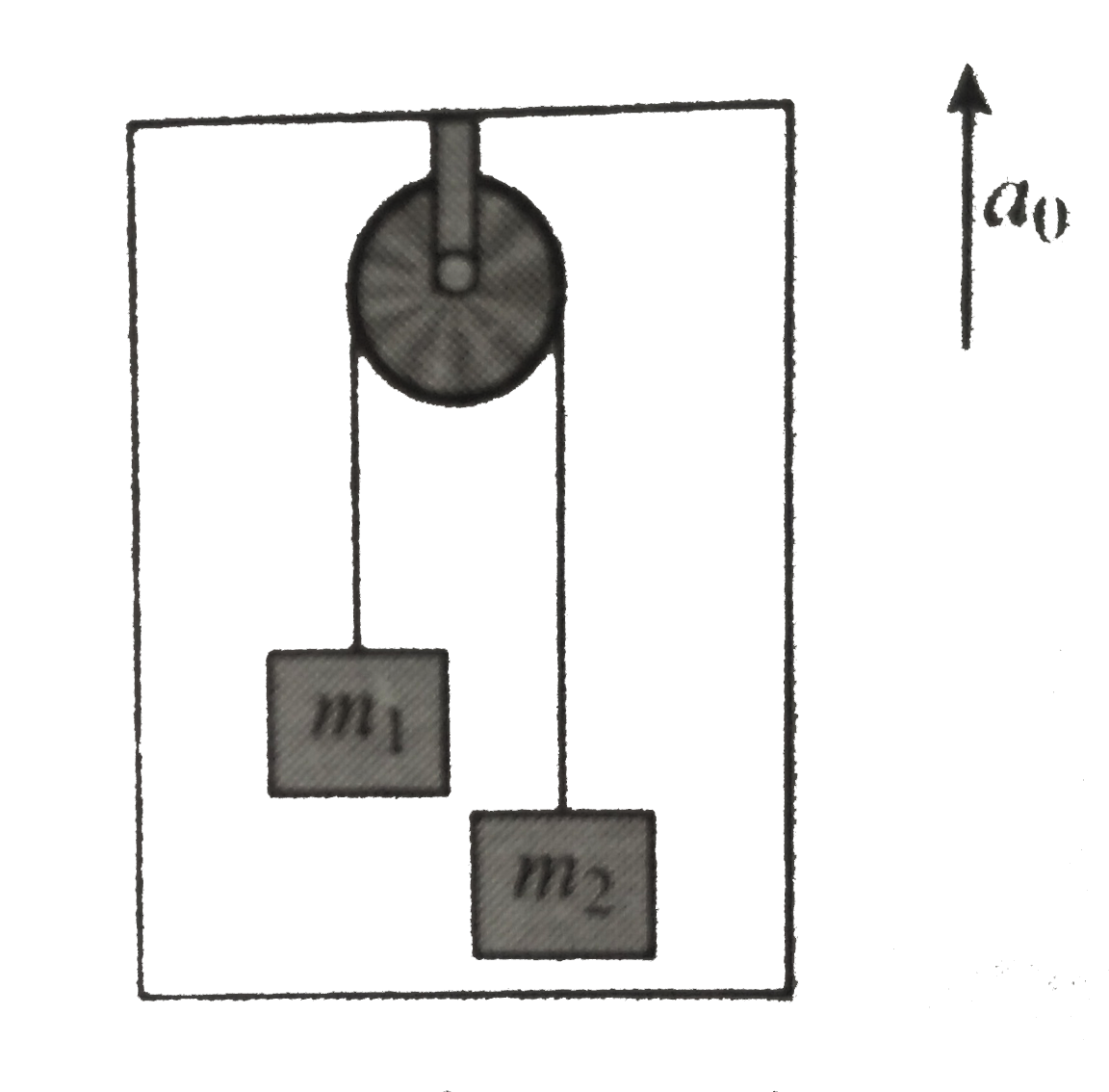
If the pulley is massles and moves with an upward acceleration `a_(0)`. Find the acceleration of `(m_1)and (m_2)` w.r.t to elevator.

Text Solution

Verified by Experts
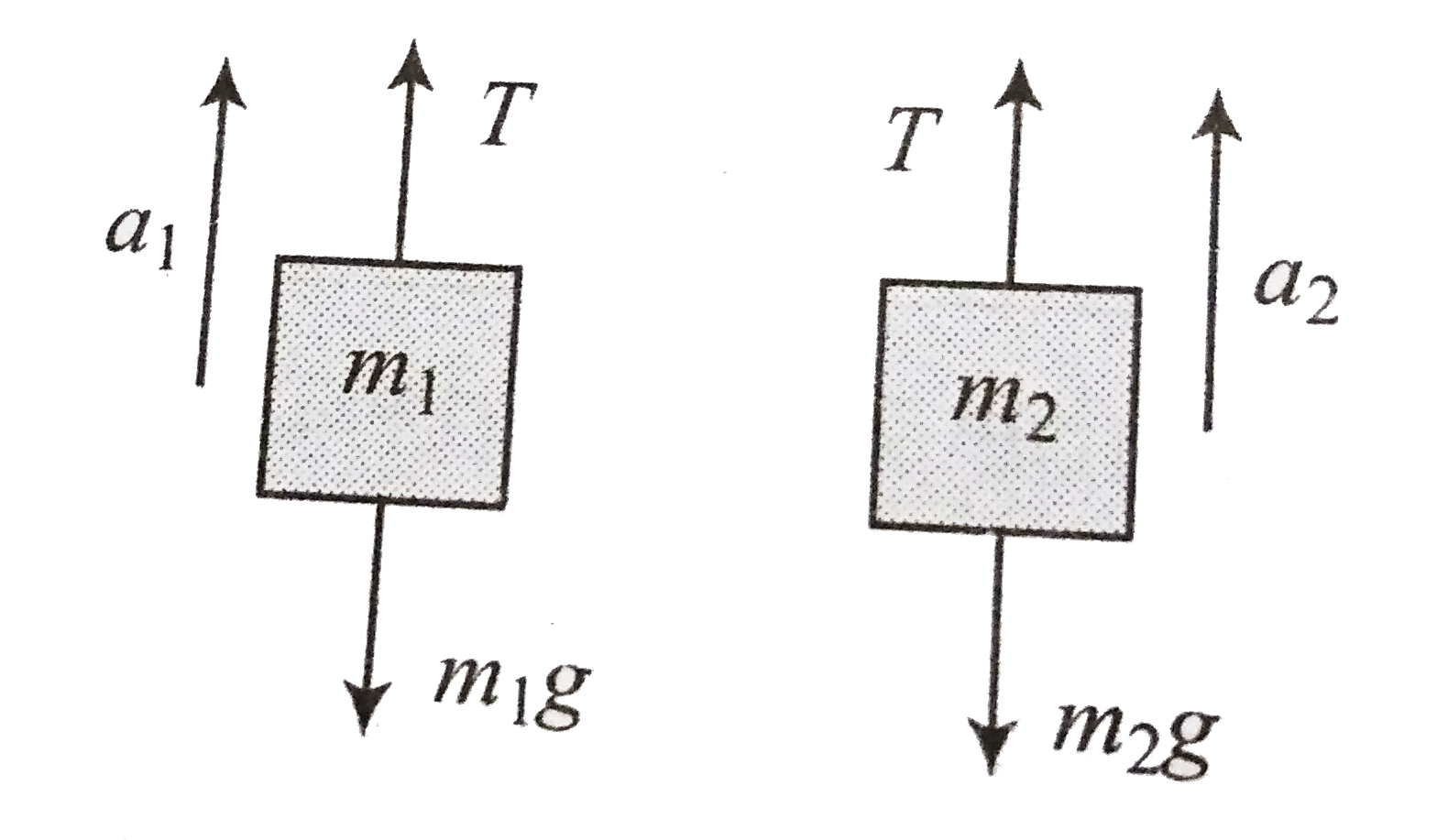
Method 1: (Ground frame) :

Let acceleration of block `m_(1)` with respect to pulley be a (upward) and the acceleration of `m_(2)` w.r.t pulley is a (down ward)
Equation of motion for '`m_(1)`'
`T-m_(1)g=m_(1)a_(1)` ...(i)
`T-m_(2)g=m_(2)a_(2)` ...(i)
`vec(a)_(1)=vec(a)_(1,p)+vec(a)_(p)=a+a_(0)` ...(iii)
`vec(a)_(2)=vec(a)_(2,p)+vec(a)_(p)= -a+a_(0)` ...(iv)
subsituting `a_(1)` from (iii) in (i),
`T-m_(1)g=m_(1)(a+a_(0))` ...(v)
Subsituting `a_(2)` from (iv) in (ii)
`T-m_(2)g=m_(2)(-a+a_(0))` ...(vi)
Solving (v) and (iv),
`T=(2m_(1)m_(2))/(m_(1)+m_(2))(g+a_(0))`
and `a=(m_(2)-m_(1))/(m_(1)+m_(2))(g+a_(0))` .
Method 2: Solving problem from non-inertial frame of reference
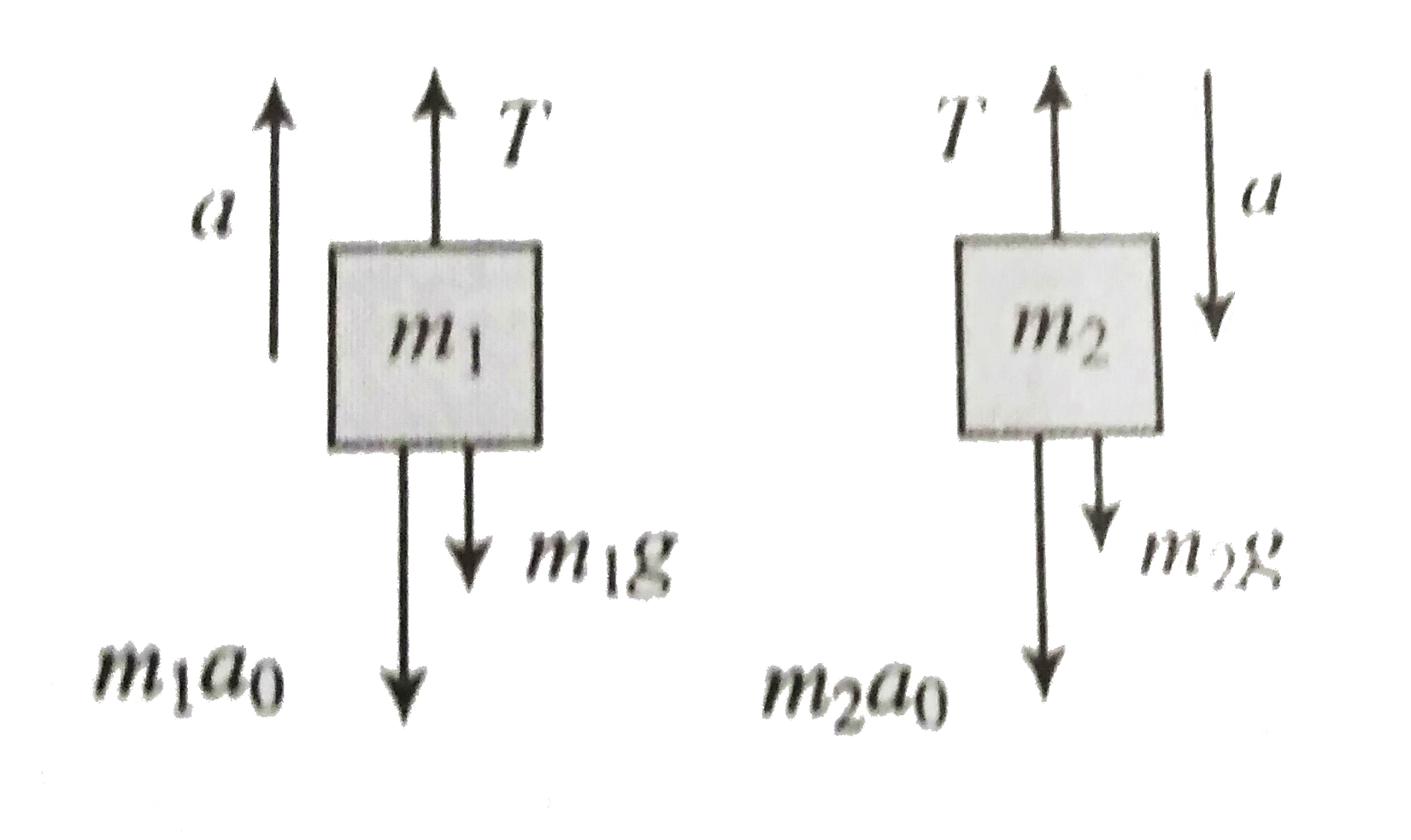
Let us build the equations by using Newton's second law sittion on the accelerationg pulley. Hence, we impose pseudo force `m_(1)a_(0)` darr and `m_(2)a_(0)darr` on both `m_(1)` and `m_(2)`, respectively, in addition to the upward tension and their weight 1 `m_(1)gdarr m_(2)g darr`, respectively. If `m_(1)` accelerates up relative to the pulley, `m_(2)` must accelerate down relative to the pulley with acceleration a.

Force equation:
for `m_(1):T-m_(1)g-m_(1)a_(0)=m_(1)a` ..(i)
for `m_(2):m_(2)a_(0)-T=m_(2)a`...(ii)
Solving (i) and (ii) we have
`a=(m_(2)-m_(1))/(m_(1)+m_(2))(g+a_(0))`.
Promotional Banner

Topper's Solved these Questions

  • NEWTON'S LAWS OF MOTION 1

    CENGAGE PHYSICS ENGLISH|Exercise Solved Examples|11 Videos
  • NEWTON'S LAWS OF MOTION 1

    CENGAGE PHYSICS ENGLISH|Exercise Exercise 6.1|11 Videos
  • MISCELLANEOUS VOLUME 2

    CENGAGE PHYSICS ENGLISH|Exercise INTEGER_TYPE|10 Videos
  • NEWTON'S LAWS OF MOTION 2

    CENGAGE PHYSICS ENGLISH|Exercise Integer type|1 Videos

Similar Questions

Explore conceptually related problems

If block A is moving with an acceleration of 5ms^(-2) , the acceleration of B w.r.t. ground is

Find acceleration a and angular acceleration alpha . If F=2N,m=1 kg and l=2m

A pulley fixed to the ceiling of an elevator car carries a thread whose ends are attached to the masses m_(1) and m_(2) . The car starts going up with an acceleration a_(0) . Assuming the masses of the pulley and the thread as well as the friction to be negligible, find: (a) the acceleration of the load m_(1) relative to the elevator shaft and relative to the car (b) the force exerted by the pulley on the ceiling of the car. Given m_(1) gt m_(2) .

A ring of mass m connected through a string of length L with a block of mass M. If the ring is moving up with acceleration a_(m) and a_(M) is the acceleration of block. The relation between a_(m) and a_(M) is.

A balloon of mass M with a light rope having monkey on the rope is in equilibrium. If the monkey starts moving up with acceleration a w.r.t. rope . Then the acceleration of cenre of mass of the system is

A ball is dropped from an elevator moving upward with acceleration 'a' by a boy standing in it. The acceleration of ball with respect to [Take upward direction positive]

Two masses are connected by a string which passes over a pulley acceleration upward at a rate A shown. If a_(1) and a_(2) be the accelerations of bodies 1 and 2 respectively then,

Passage X) A 2kg block hangs without vibrating at the bottom end of a spring with a force constant of 400 N/m. The top end of the spring is attached to the ceiling of an elevator car. The car is rising with an upward acceleration of 5m/s^(2) when the acceleration suddenly ceases at t=0 and the car moves upward with constant speed. (g=10m/ s^(2) ) What is the angular frequency of oscillation of the block after the acceleration ceases?

A 2kg block hangs without vibrating at the bottom end of a spring with a force constant of 400 N//m . The top end of the spring is attached to the ceiling of an elevator car. The car is rising with an upward acceleration of 5 m//s^(2) when the acceleration suddenly ceases at time t = 0 and the car moves upward with constant speed (g = 10 m//s^(2)) What is the angular frequencyof the block after the acceleration ceases ?

The pulleys in figure are identical, each having a radius R and moment of inertia I. Find the acceleration of the block M.