Home
Class 11
PHYSICS
A pulley-rope-mass arrangement is shown ...

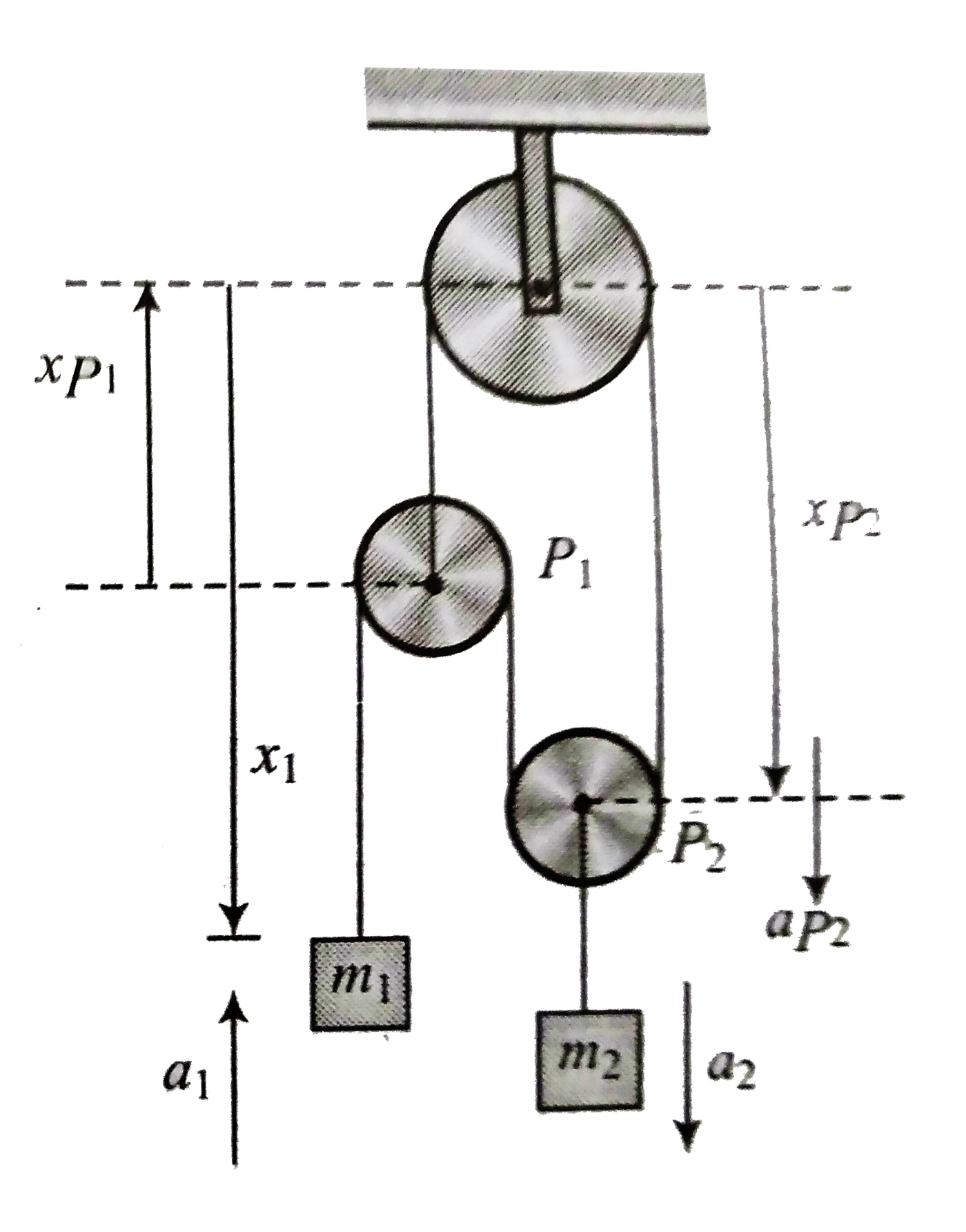
A pulley-rope-mass arrangement is shown in fig. Find the acceleration of block `m_(1)` when the masses are set free to move. Assume that the pulley and the ropes are ideal.

Text Solution

Verified by Experts
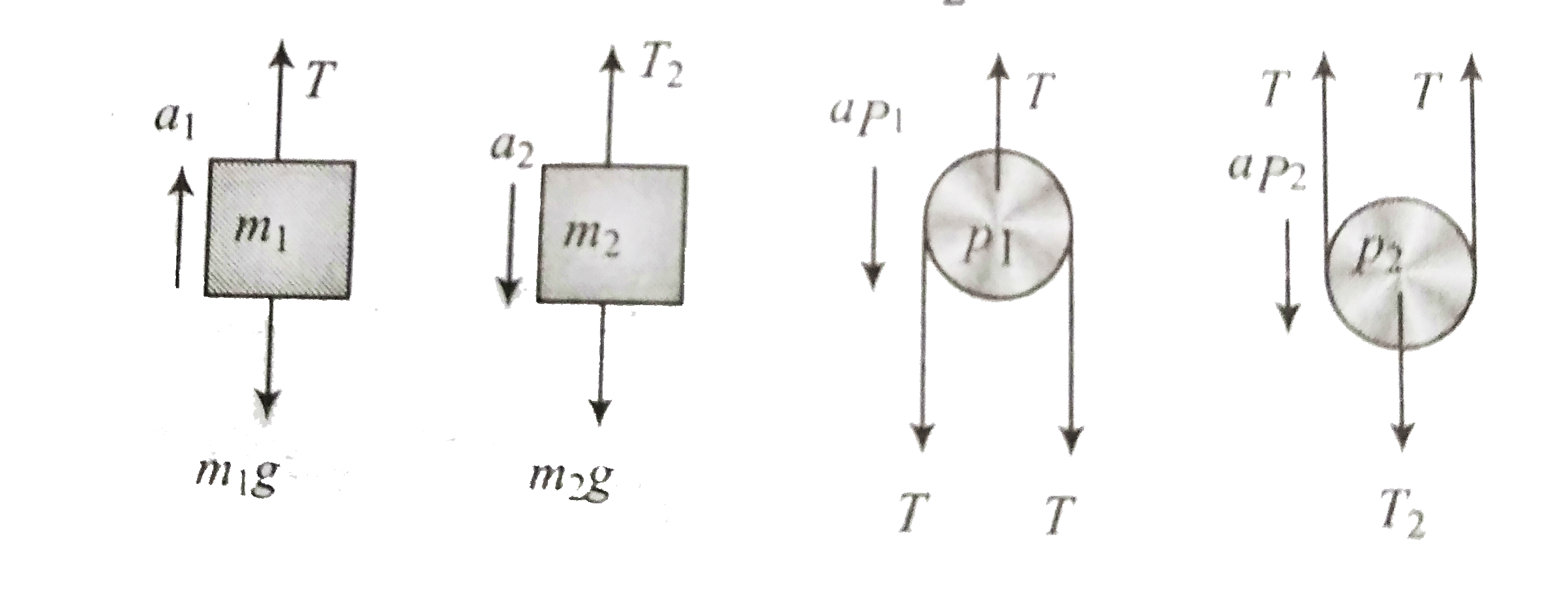
Appling the equations of motion for pulleys and blocks
For `m_(1):T-m_(1)g=m_(1)a_(1)` ….(i)
For `m_(2): m_(2)g-T_(2)=m_(2)a_(2)` …(ii)
For pulley `P_(1) : 2T-T = 0 xx a_(p_1)`
For pulley `P_(2): T_(2)-T=0xxa_(p_2)` …(iv)

From Eq (iii), `T=0`, from (iv), `T_(2)=0` and from (i) and (ii). `a_(1)=-g` , also `a_(2)=g`. Hence, blocks `m_(1)` and `m_(2)` both will move down with acceleration g downward direction.
Calculating `a_(P_1)` and `a_(P_2)`
Constraint relations: Consider the reference line and the position vectors of the pulley and masses as shown in fig .write the length of the rope in terms of position vector and differentiate it to obtain the relation between acceleration of the masses and pulleys.

* For the length of the string connecting `P_(2)` and `m_(2)` not to change and for this rope not to slacken, `a_(p_2)=a_(2)=g`.
* Length of the string connecting `P_(1)` to `m_(1)` not to change and for this rope not to slacken:
`l=(x_(1)-x_(P_1))+x_(P_(1))+(x_(P_(2))-x_(P_(1)))+x_(P_(2))`
`=x_(1)-x_(P_1)+x_(P_2)`
Differentiating this equation w.r.t twice we get
`(d^(2)l)/(dt^(2))=(d^(2)x_(1))/(dt^(2))-(d^(2)x_(P_(1)))/(dt^(2)) +2(d^(2)x_(P_(2)))/(dt^(2))implies 0=a_(1)-a_(P_1)-2a_(P_2)`
`implies 0=g-a_(P_1)+2g implies a_(P_1)=3g`.
Promotional Banner

Topper's Solved these Questions

  • NEWTON'S LAWS OF MOTION 1

    CENGAGE PHYSICS ENGLISH|Exercise Solved Examples|11 Videos
  • NEWTON'S LAWS OF MOTION 1

    CENGAGE PHYSICS ENGLISH|Exercise Exercise 6.1|11 Videos
  • MISCELLANEOUS VOLUME 2

    CENGAGE PHYSICS ENGLISH|Exercise INTEGER_TYPE|10 Videos
  • NEWTON'S LAWS OF MOTION 2

    CENGAGE PHYSICS ENGLISH|Exercise Integer type|1 Videos

Similar Questions

Explore conceptually related problems

In the pulley-block arrangement shown in figure , find the relation between acceleration of blocks A and B

In the pulley-block arrangement shown in figure , find the relation between acceleration of blocks A and B

Find the acceleration of blocks in fig. The pulley and the string are massless.

For given system as shown in figure, the acceleration of block of mass m(m=M/2) kept on smooth table when the system is released from rest is (Strings and pulleys are ideal)

The velocities of A and B shown in fig. Find the speed (in ms^(-1) ) of block C. (Assume that the pulleys and string are ideal).

For given system as shown in figure, the acceleration of block of mass m(m=frac{M}{2}) kept on smooth table when the system is released from rest is (Strings and pulleys are ideal)

In the arrangement shown, the mass m will ascend with an acceleration ( Pulley and rope are massless)

In the arrangement shown, the mass m will ascend with an acceleration ( Pulley and rope are massless)

find the acceleration of the block of mass M in the situation shown in figure. All the surfaces are frictionless and the pulleys and the string are light.

A block of mass m=5kg is placed on the wedge of mass M=32kg as shown in the figure. Find the acceleration of wedge with respect to ground. (Neglect any type of friction. Spring and pulley are ideal)