Home
Class 11
PHYSICS
A plank of mass m rests symmetrically on...

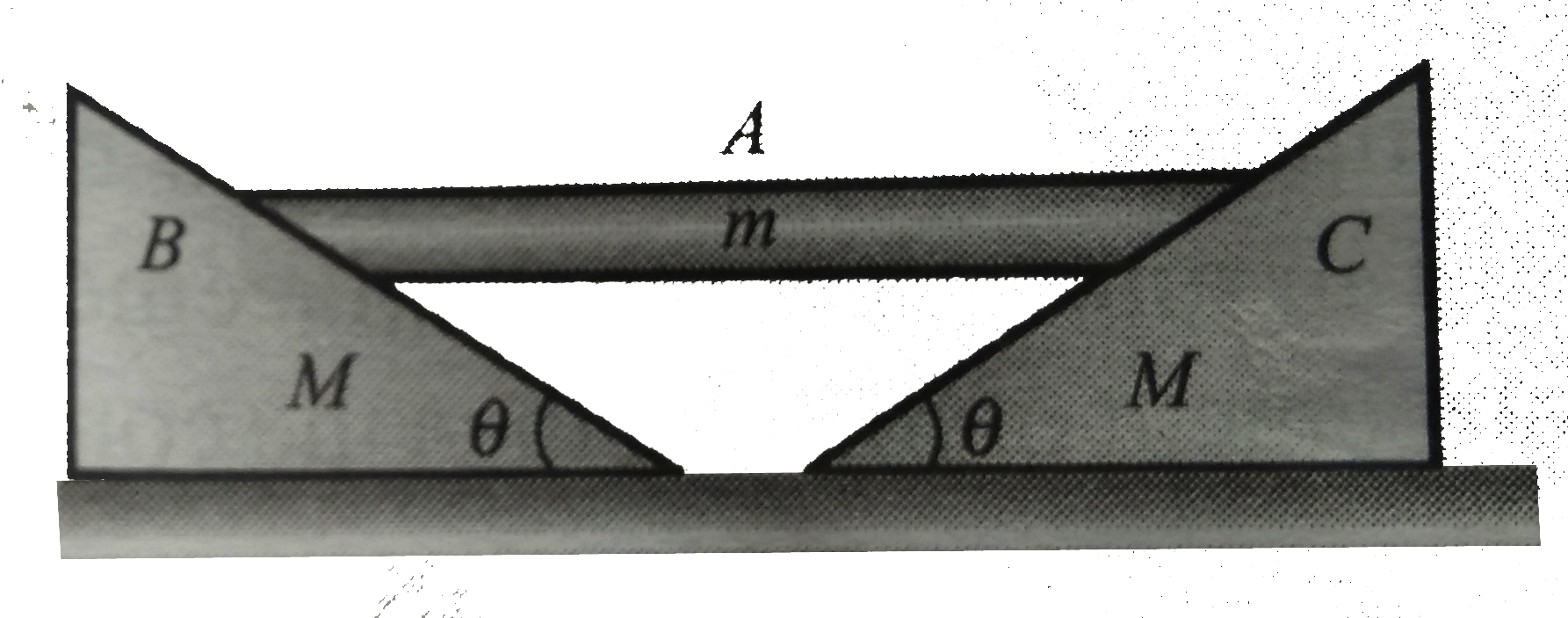
A plank of mass m rests symmetrically on two wedges B and C of mass M. What is the acceleration of the plank? Neglect friction between all the contact surfaces.

Text Solution

Verified by Experts
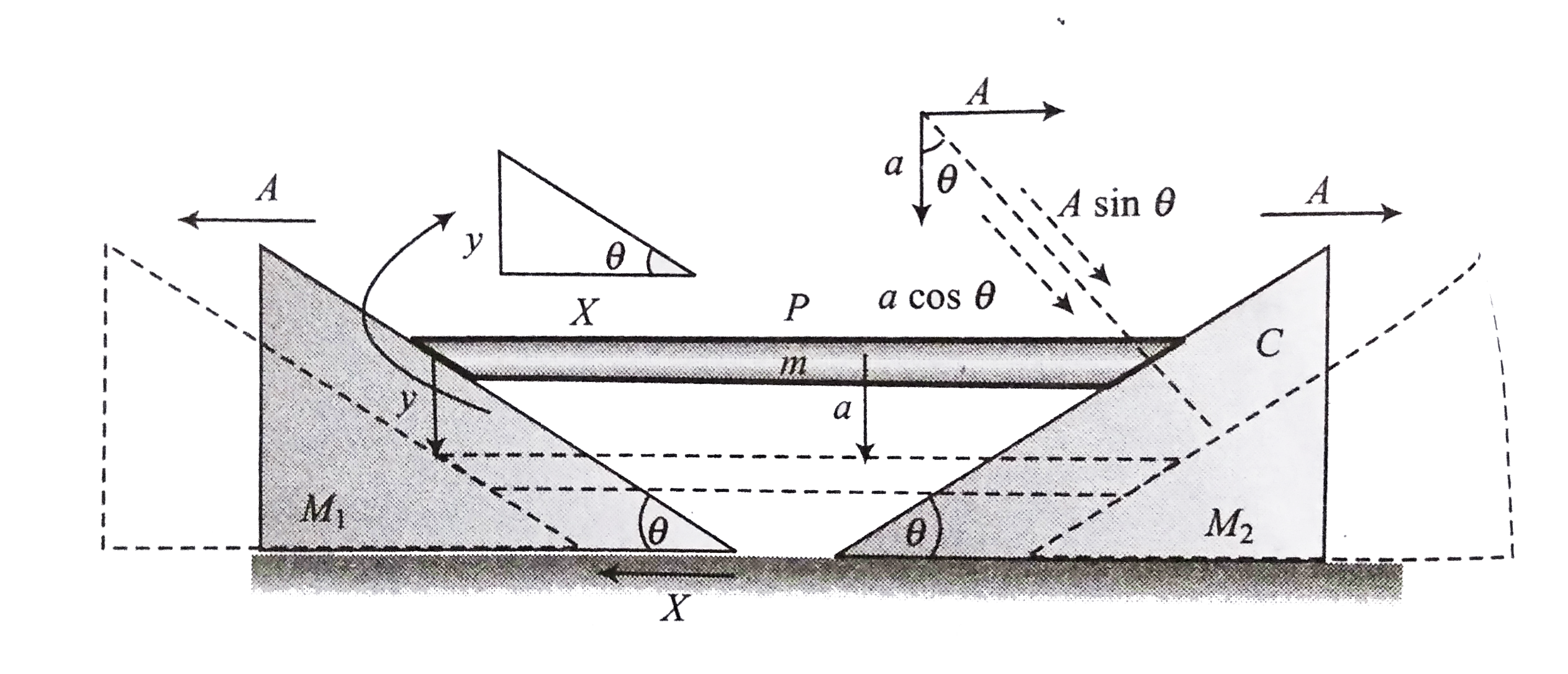
When the plank is released, let it fall through a distance and let both the wedges move through a distance x.
(i)`y= x tan theta`...(i)

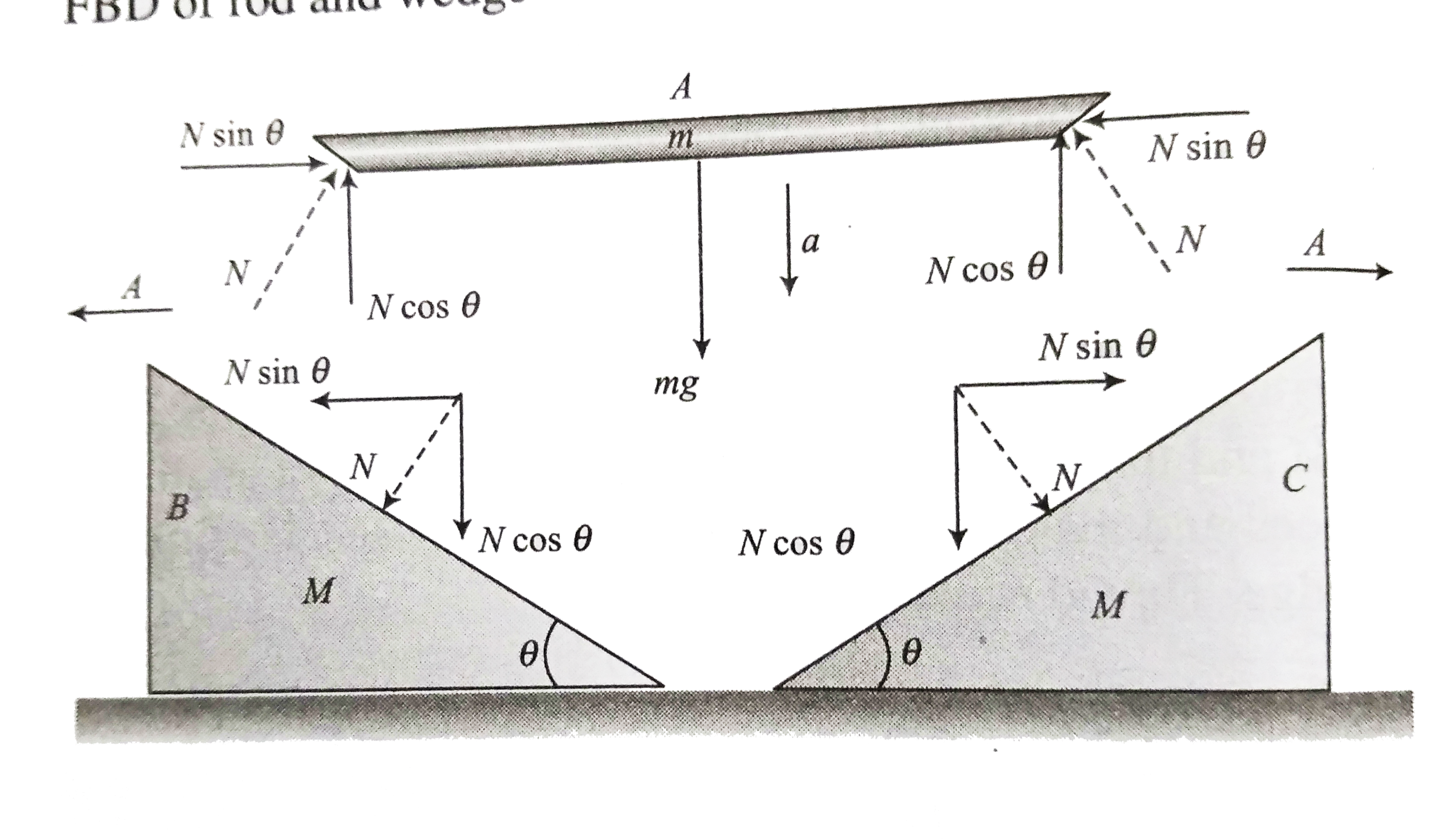
On differnetiating this expression twice, we obtain `a=A tan theta` FBD of rod and wedge

Equation of wedge
`Sigma F_(x)=N sin theta=MA` ...(ii)
`Sigma F_(y)=N'-Ncos theta - Mg=0` ...(iii)
Equations of plank:
`Sigma F_(x)=N sin theta-N sin theta=0`....(iv)
`Sigma F_(y)=mg-2N cos theta =ma` ...(v)
From (ii), `N=(MA)/(sin theta)`
On substituting expression for N and a in (v), we obtain
`mg-(2Ma cos theta)/(sin theta)=(mA sin theta)/(cos theta)`
`implies A=(mg sin theta cos theta)/(m sin^(2)theta+2M cos^(2)theta)`.
Promotional Banner

Topper's Solved these Questions

  • NEWTON'S LAWS OF MOTION 1

    CENGAGE PHYSICS ENGLISH|Exercise Solved Examples|11 Videos
  • NEWTON'S LAWS OF MOTION 1

    CENGAGE PHYSICS ENGLISH|Exercise Exercise 6.1|11 Videos
  • MISCELLANEOUS VOLUME 2

    CENGAGE PHYSICS ENGLISH|Exercise INTEGER_TYPE|10 Videos
  • NEWTON'S LAWS OF MOTION 2

    CENGAGE PHYSICS ENGLISH|Exercise Integer type|1 Videos

Similar Questions

Explore conceptually related problems

A rod of mass m is supported on a wedge of mass M shown in fig. Find the accelerations of rod and wedge in the arrangement. The friction between all contact surfaces in negligible.

A block A of mass M rests on a wedge B of mass 2M and inclination theta . There is sufficient friction between A and B so that A does not slip on B. If there is no friction between B and ground, the compression in spring is

A block A of mass M rests on a wedge B of mass 2M and inclination theta . There is sufficient friction between A and B so that A does not slip on B. If there is no friction between B and ground, the compression in spring is

Find the accelerations of rod A and wedge B in the arrangement shown in figure if the ratio of the mass of the wedge to that of the rod equals eta , and the friction between all contact surfaces is negligible.

A man of mass m starts moving on a plank of mass M with constant velocity v with respect to plank. If the plank lies on a smooth horizontal surface, then velocity of plank with respect to ground is

In fig. mass m is being pulled on the incline of a wedge of mass M. All the surfaces are smooth. Find the acceleration of the wedge.

Block A of mass m rests on the plank B of mass 3m which is free to slide on a frictionless horizo-ntal surface. The coefficient of friction between the block and plank is 0.2. If a horizontal force of magnitude 2 mg is applied to the plank B, the acceleration of A relative to the plank and relative to the ground respectively, are:

a Block of mass m is placed on a wedge of mass M there is no friction between the block and the wedge .The minmum coefficient of friction between the wedge and the gound so that wedge does not move is,

A man of mass m is standing at one end of of a plank of mass M. The length of the plank is L and it rests on a frictionless horizontal ground. The man walks to the other end of the plank. Find displacement of the plank and man relative to the ground.

A block of mass m=5kg is placed on the wedge of mass M=32kg as shown in the figure. Find the acceleration of wedge with respect to ground. (Neglect any type of friction. Spring and pulley are ideal)