Home
Class 11
PHYSICS
In fig. a ball of mass m(1) and a block ...

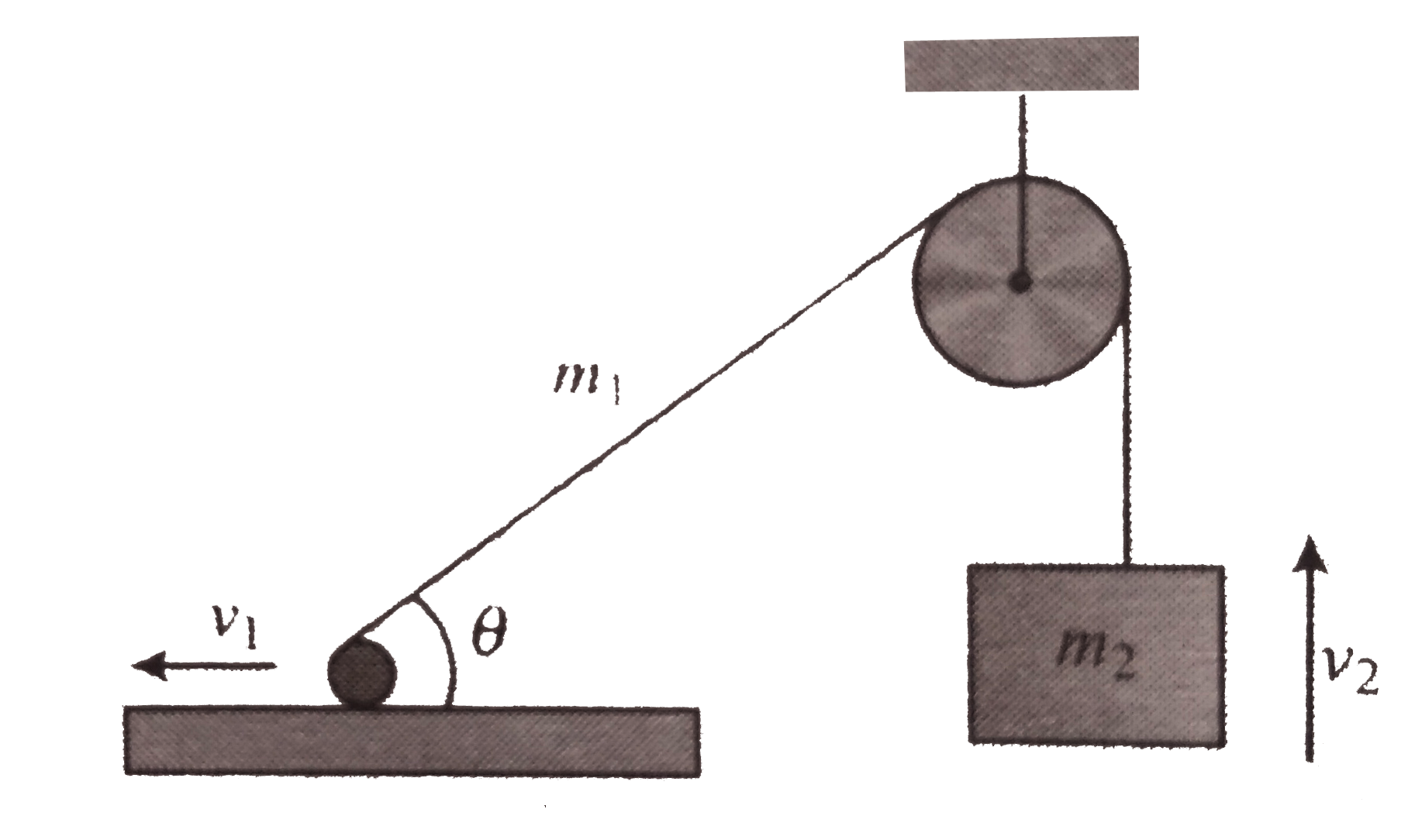
In fig. a ball of mass `m_(1)` and a block of mass `m_(2)` are joined together with an inextensible string. The ball can slide on a smooth horizontal surface. If `v_(1)` and `v_(2)` are the respective speeds of the ball and the block, then determine the constraint relation between the two.

Text Solution

Verified by Experts
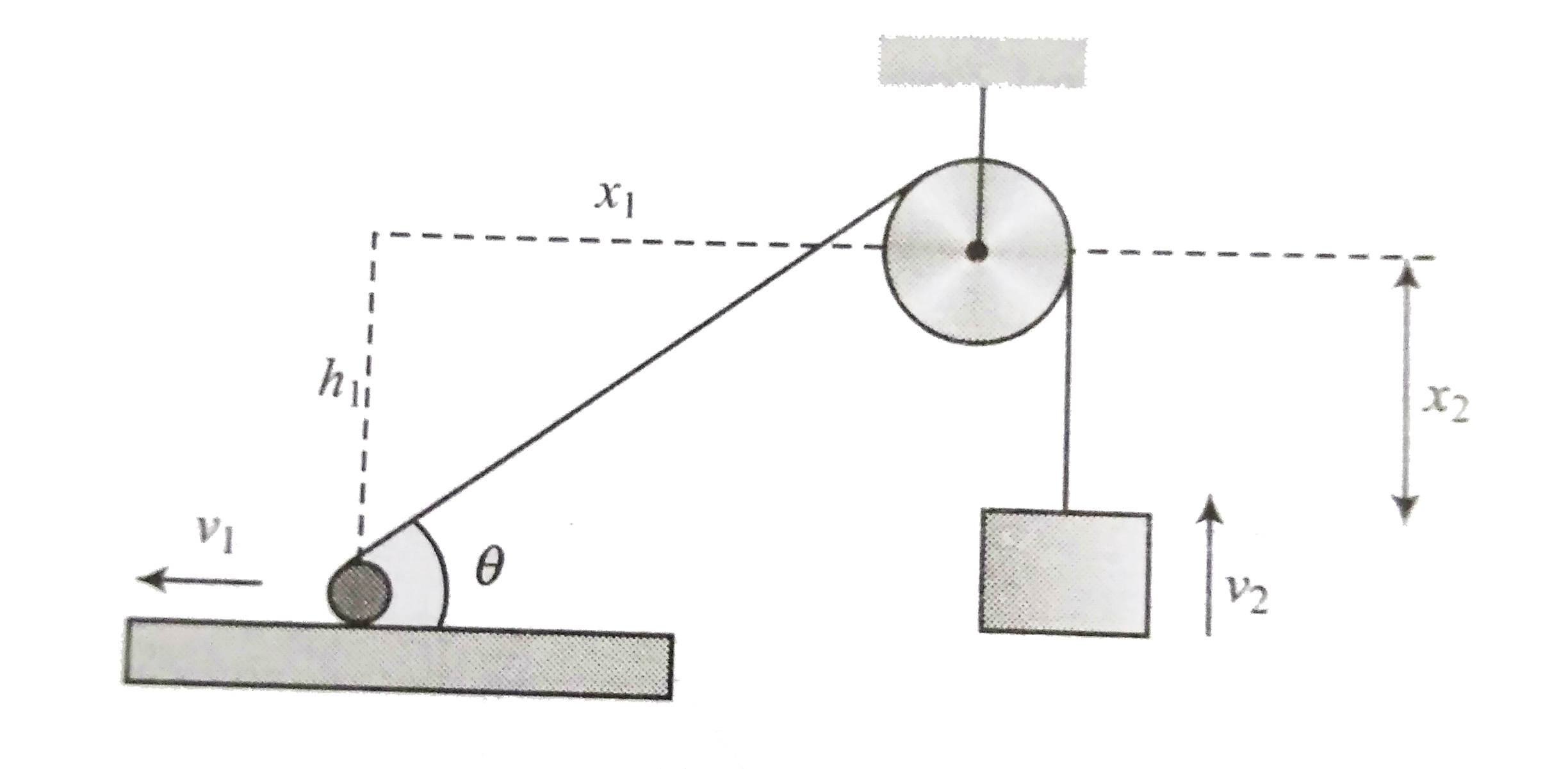
Method 1: Distances are assumed from the center of the pulley as shown in fig.

Consraint: Length of the string remains constant.
`sqrt(x_(1)^(2)+h_(1)^(2))+x_(2)` = constant
Differentiating both the side w.r.t. time, we get
`(2x_(1))/(2sqrt(x_(1)^(2)+h_(1)^(2)))(dx_(1))/(dt)+(dx_(2))/(dt)=0`
Since the ball moves so as to increases `x_(1)` with time and block moves so as to decrease `x_(2)` with time,
`(dx_(1))/(dt) +v_(1)` and `(dx_(2))/(dt)=-v_(2)`
also, `(x_1)/(sqrt(x_(1)^(2)+h_(1)^(2))) = cos theta` or `v_(2)=v_(1) cos theta`
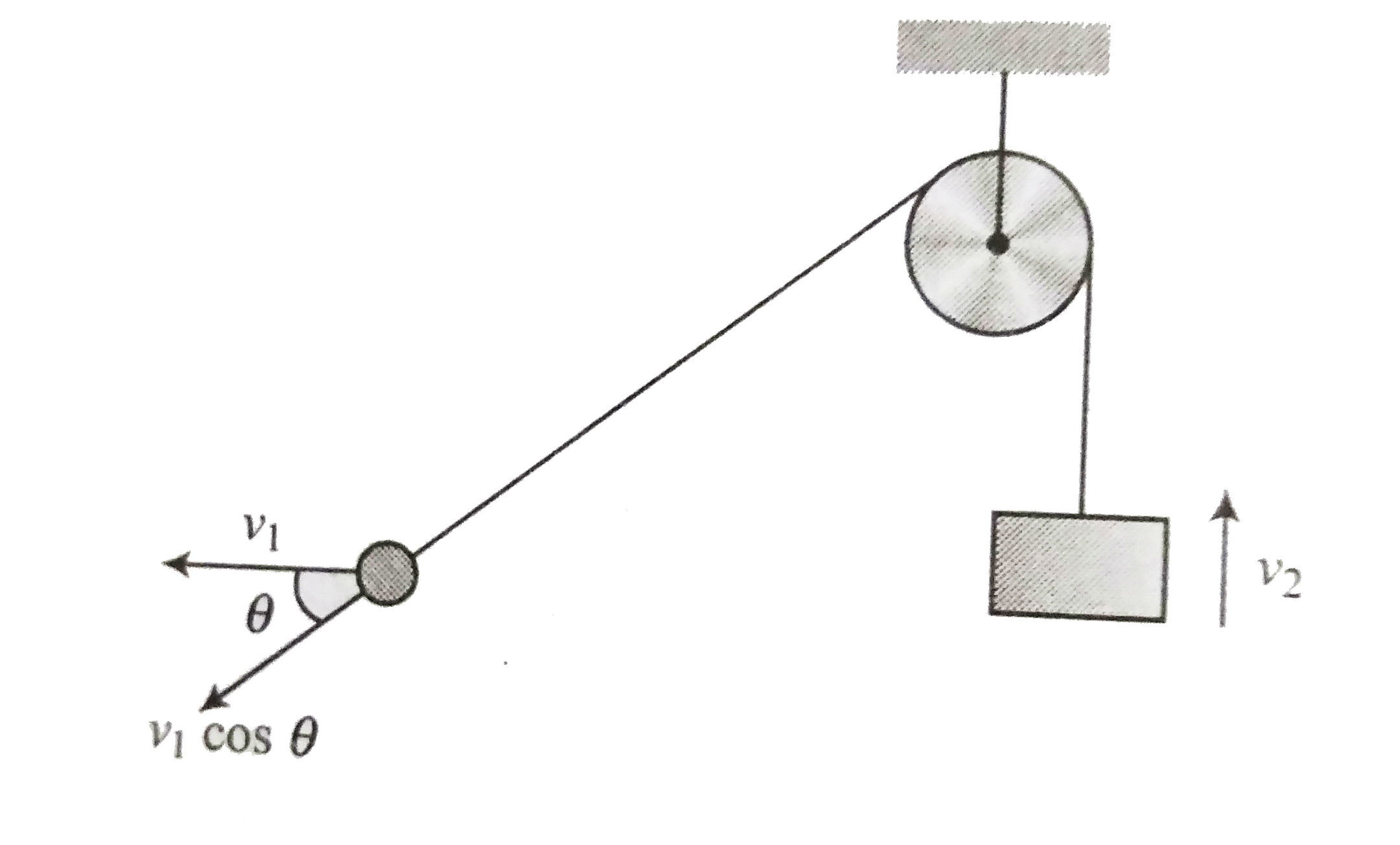
Method 2: The problem can be solved very easily if we look at the problem from a different viewpoint and identify a difference constraint. i.e., the velocity of any two points along the string is same. Obviously, from fig., we have `v_(1) cos theta=v_(2)`

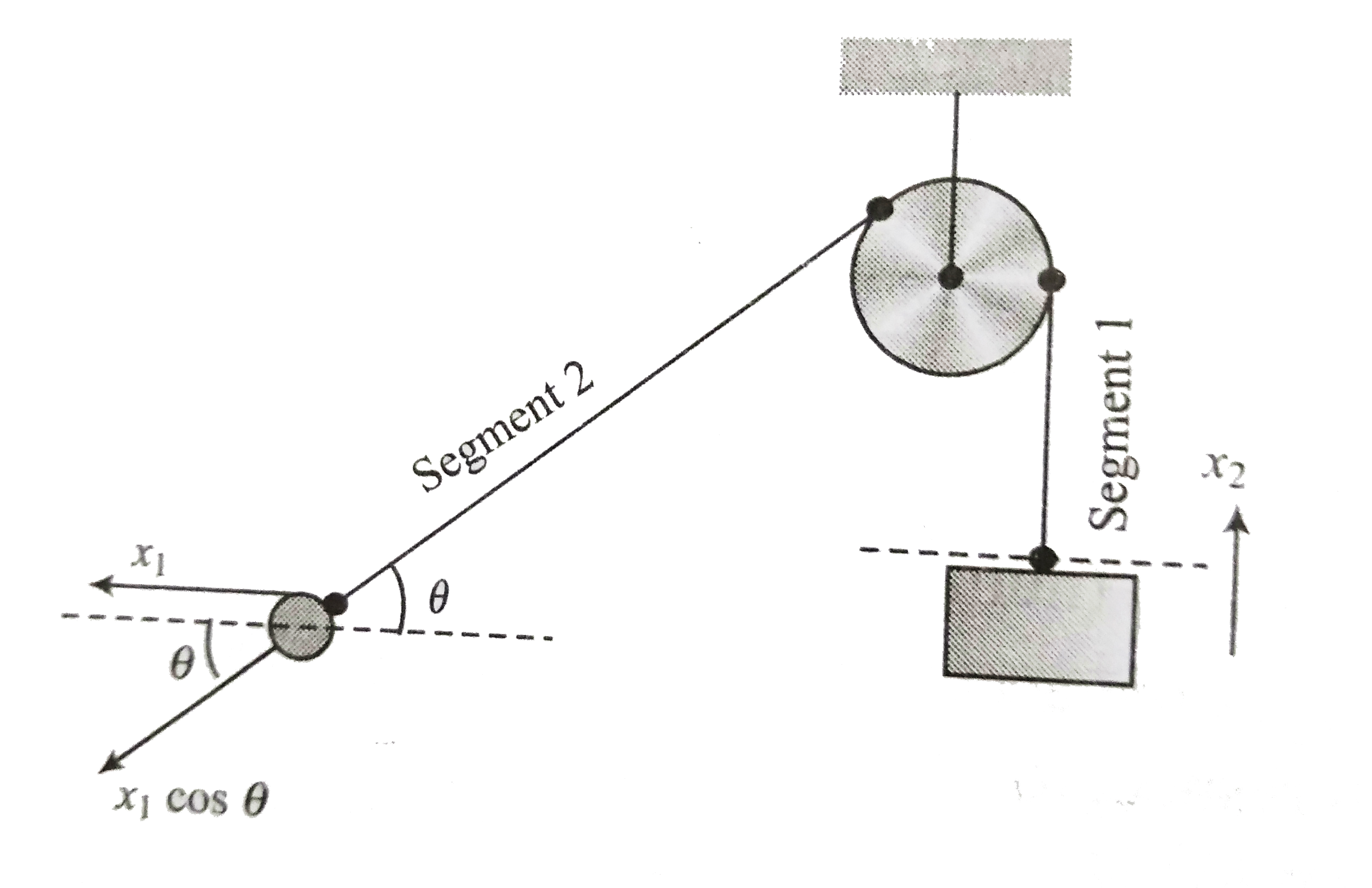
Method 3: Change in length of segment I,
`Delta l_(1)=0+-(x_(2))=-x_(2)`

Change in length of segment II,
`Delta l_(1)=(x_(2)cos theta)+0=x_(1) cos theta`
Total change in the length of all segments should be zero, as the length of string is constant.
`Delta l=Delta l_(1)+Delta l_(2)`
`=-x_(2)+x_(1) cos theta=0`
`implies x_(2)=x_(1) cos theta` or `v_(2)=v_(1) cos theta`.
Promotional Banner

Topper's Solved these Questions

  • NEWTON'S LAWS OF MOTION 1

    CENGAGE PHYSICS ENGLISH|Exercise Solved Examples|11 Videos
  • NEWTON'S LAWS OF MOTION 1

    CENGAGE PHYSICS ENGLISH|Exercise Exercise 6.1|11 Videos
  • MISCELLANEOUS VOLUME 2

    CENGAGE PHYSICS ENGLISH|Exercise INTEGER_TYPE|10 Videos
  • NEWTON'S LAWS OF MOTION 2

    CENGAGE PHYSICS ENGLISH|Exercise Integer type|1 Videos

Similar Questions

Explore conceptually related problems

A block of mass m rests on a stationary wedge of mass M. The wedge can slide freely on a smooth horizontal surface as shown in figure. If the block starts from rest

Two blocks of masses m and M are connected by an inextensible light string . When a constant horizontal force acts on the block of mass M. The tension in the string is

Two block of masses m_(1) and m_(2) are placed side by side on a smooth horizontal surface as shown in fig. A horizontal force F is applied on the block . (a) Find the acceleration of each block. (b) Find the normal reaction between the two blocks.

A block of mass m is placed at rest on a smooth wedge of mass M placed at rest on a smooth horizontal surface. As the system is released

Two identical small balls, each of mass m , are connected by a massless and inextensible string of length l and placed on a smooth horizontal xy plane. An external agent pulling the string from its mid-point along y -axis with velocity v_(0) as shown in Fig. When the separation between the two balls reduces to l//2 then the speed of each ball will be

Two identical balls each of mass m interconnected by a small light inextensible string are kept on a smooth horizontal surface. One of the balls is pushed towards the other with a speed v_(0) find the loss of K.E. of the ball. What will be the final velocities of the balls ? (e=1).

Two blocks of masses m_(1) and m_(2) are connected by an ideal sprit, of force constant k . The blocks are placed on smooth horizontal surface. A horizontal force F acts on the block m_(1) . Initially spring is relaxed, both the blocks are at rest. What is acceleration of centre of mass of system at the instant of maximum elongation of spring

Two smooth blocks of mases m_(1) and m_(2) attached with an ideal spring of stiffness k and kept on hrozontal surface. If m_(1) is projected with a horizontal velocity v_(0) . Find the maximum compression of the spring.

Two balls of masses m_(1)=5kg, m_(2)=10kg are connected by a light inextensible string. A horizontal force F = 15 N is acting on the ball m_(2) along the line joining two balls as shown. What is the (a) acceleration of the balls (b) tension in the string?

Two blocks A and B each of mass m are placed on a smooth horizontal surface. Two horizontal force F and 2F are applied on blocks A and B, respectively, as shown in fig. Block A does not slide on block B. Then then the normal reaction acting between the two blocks is (assume no friction between the blocks)