Home
Class 11
PHYSICS
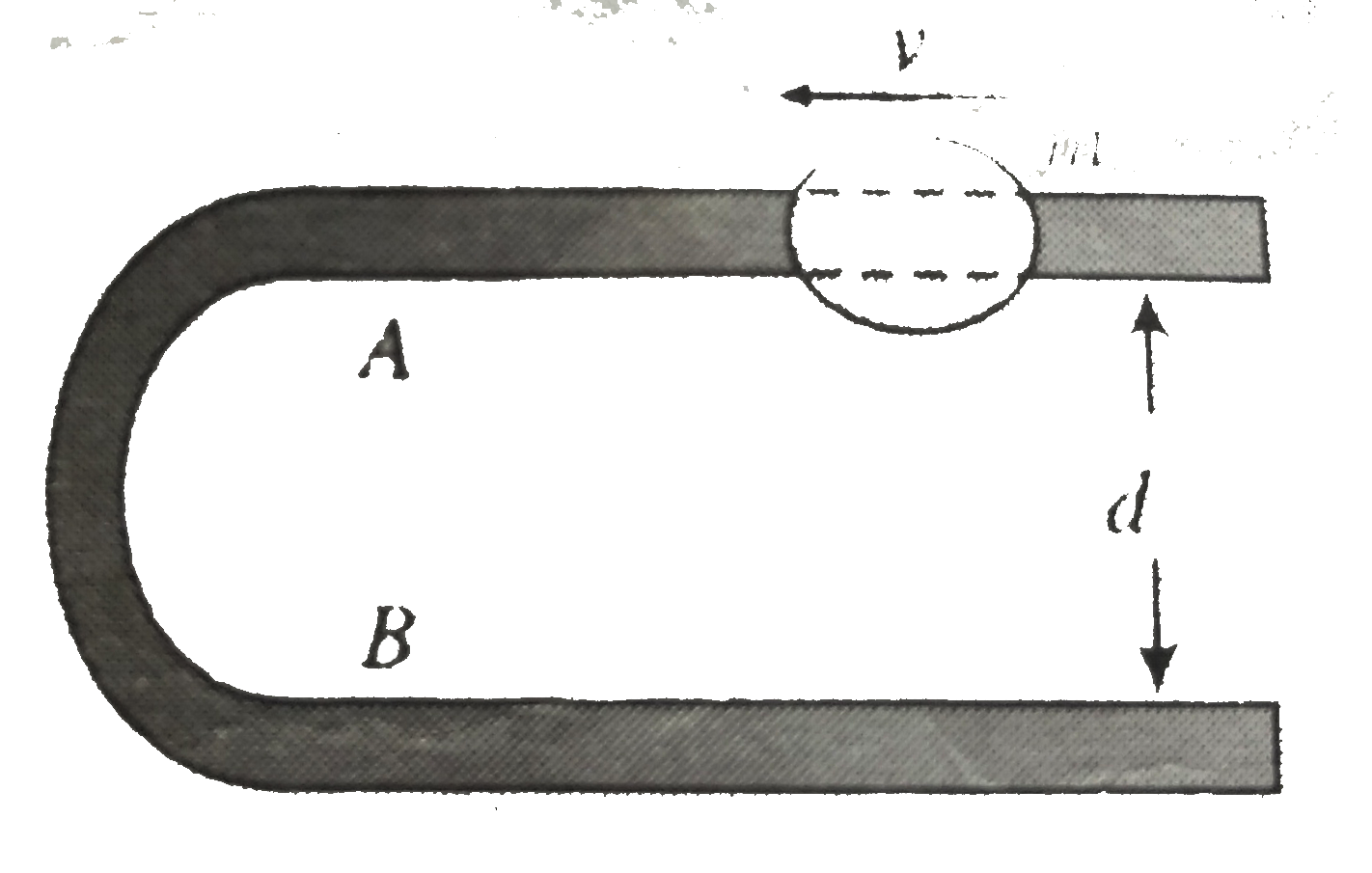
A U-shaped smooth wire has a semi-circul...

A U-shaped smooth wire has a semi-circular bending between A and B as shown in fig. A bead of mass m moving with uniform speed v through the wire enters the semiculcular bent at A and leaves at B. Find the average force exerted by the bead on the part AB of the wire.

Text Solution

Verified by Experts

Choosing the position X-Y axis as shown in the figure, the momentum of the bead at A is `vec(P)_(i)= +mvec(v)`. The momentum of the bead at B is `vec(P)_(f)=-mvec(v)`.
Therefore, the magnitude of the change in momentum between A and B is
`Delta vec(p) = vec(p)_(f) - vec(p)_(i) = -2m vec(v)`
i.e. `Delta p=2mv` along positive X-axis.
The time interval taken by the bead to reach from A to B is
`Delta t=(pi.d//2)/(v) =(pi d)/(2 v)`
Therefore, the average force exerted by the bead on the wire is
`F_(av)=(Delta P)/(Delta t)=(2mv)/((pid)/(2v))=(4mv^(2))/(pi d)`.
Promotional Banner

Topper's Solved these Questions

  • NEWTON'S LAWS OF MOTION 1

    CENGAGE PHYSICS ENGLISH|Exercise Exercise 6.2|35 Videos
  • NEWTON'S LAWS OF MOTION 1

    CENGAGE PHYSICS ENGLISH|Exercise Exercise 6.3|19 Videos
  • NEWTON'S LAWS OF MOTION 1

    CENGAGE PHYSICS ENGLISH|Exercise Solved Examples|11 Videos
  • MISCELLANEOUS VOLUME 2

    CENGAGE PHYSICS ENGLISH|Exercise INTEGER_TYPE|10 Videos
  • NEWTON'S LAWS OF MOTION 2

    CENGAGE PHYSICS ENGLISH|Exercise Integer type|1 Videos

Similar Questions

Explore conceptually related problems

A fixed U -shaped smooth wire has a semi-circular bending between A and B as shown in the figure. A bead of mass 'm' moving with uniform speed v through the wire enters the semicircular bend at A and leaves at B . The magnitude of average force exerted by the bead on the part AB of the wire is

A U -shaped wire has a semicircular bending between A and B as shown in Fig. A bead of mass m moving with uniform speed v through a wire enters the semicircular bend at A and leaves at B with velocity v//2 after time T . The average force exerted by the bead on the part AB of the wire is

A particle of mass m moves with constant speed v on a circular path of radius r as shown in figure. The average force on it during its motion from A to B is

A semicircular conducting wire of radius a is moving perpendicular to a uniform magnetic field B with speed √2 v as shown in the figure.The emf induced across the wire Is

A copper wire bent in the shape of a semicircle of radius r translates in its plane with a constant velocity v. A uniform magnetic field B exists in the direction perpendicular to the plane of the wire. Find the emf induced between the ends of the wire if (a) the velocity is perpendicular ot the diameter joining free ends, (b) the velocity is parallel to this diameter.

In a trapeze-shaped structure, two rigid wires of negligble mass support a conducting bar of mass m and length L as shown in Fig. A source of emf is applied to the wires so that a current I flows through the bar. A uniform magnetic field vec B is perpendicular to the plane of the wires and bar. a. Compute the current that the source of emf must provide so that there is no tension in the wires. b. If the current is reduced to half the value computed in (a) and the plane of the structure is moved through an angle theta , compute the tension in the wires and the magnitude of the net unbalanced force on the bar at the instant it is released from this angle.

A wire, which passes through the hole in a small bead, is bent in the form of quarter of a circle. The wire is fixed vertically on ground as shown in the figure. The bead is released from near the top of the wire and it slides along the wire without friction. As the bead moves from A to B, the force it applies on the wire is

A smooth wire of length 2pir is bent into a circle and kept in a vertical plane. A bead can slide smoothly on the wire. When the circle is rotating with angular speed about the vertical diameter AB, as shown in the figure, the bead is at rest with respect to the circular ring at potion P as shown. Then the value of omega^(2) is equal to:

The wires A and B shown in Fig. are made of the same material and have radii r_(A) and r_(B) , respectively. The block between them has a mass m . When the force F is mg//3 , one of the wires breaks. Then

The wires A and B shown in Fig. are made of the same material and have radii r_(A) and r_(B) , respectively. The block between them has a mass m . When the force F is mg//3 , one of the wires breaks. Then

