Home
Class 11
PHYSICS
A ring A which can slide on a smooth wir...

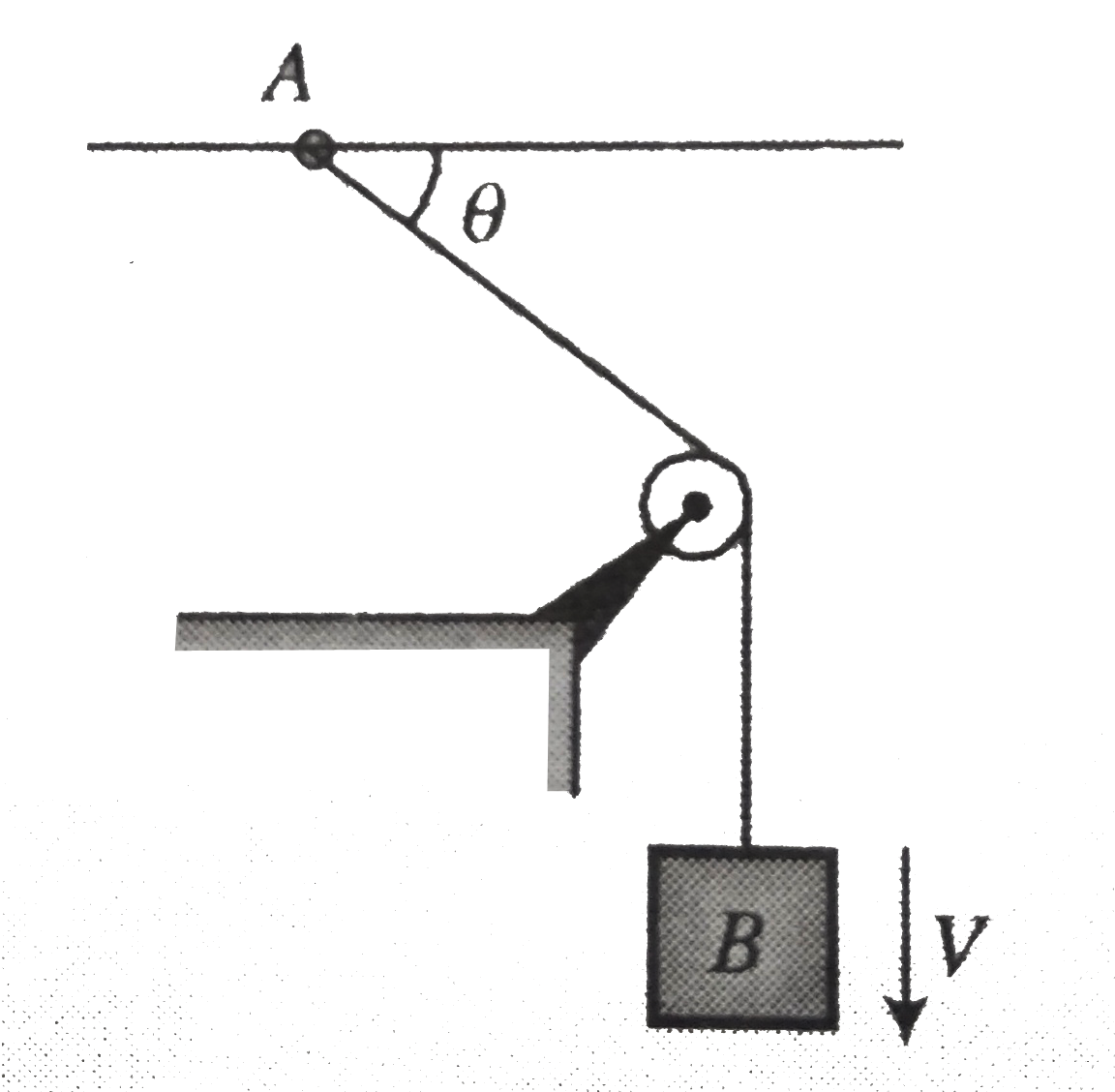
A ring A which can slide on a smooth wire is connected to one end of a string as shown in fig. Other end of the string is connected to a hanging mass B. Find the speed of the ring when the string makes an angle `theta` with the wire and mass B is going down with a velocity v.

Text Solution

Verified by Experts

Let the speed of the ring is u, then `u cos theta=v`.Because components of velocity along the string should be same.
` implies u=v//cos theta=v sec theta`.
Promotional Banner

Topper's Solved these Questions

  • NEWTON'S LAWS OF MOTION 1

    CENGAGE PHYSICS ENGLISH|Exercise Exercise 6.4|13 Videos
  • NEWTON'S LAWS OF MOTION 1

    CENGAGE PHYSICS ENGLISH|Exercise Subjective|15 Videos
  • NEWTON'S LAWS OF MOTION 1

    CENGAGE PHYSICS ENGLISH|Exercise Exercise 6.2|35 Videos
  • MISCELLANEOUS VOLUME 2

    CENGAGE PHYSICS ENGLISH|Exercise INTEGER_TYPE|10 Videos
  • NEWTON'S LAWS OF MOTION 2

    CENGAGE PHYSICS ENGLISH|Exercise Integer type|1 Videos

Similar Questions

Explore conceptually related problems

The block A is moving downward with constant velocity v_(0.) Find the velocity of the block B. When the string makes an angle theta with the horizontal

A ring of mass m can slide on the vertical smooth rod. Ring is connected by block with string as shown in figure. Pulley is of mass-less and smooth the system is released from reast. Initial tension in string is

A particle is rotated in a vertical circle by connecting it to a string of length l and keeping the other end of the string fixed. The minimum speed of the particle when the string is horizontal for which the particle will complete the circle is

A bead can slide on a smooth straight wire and a particle of mass m attached to the bead by a light string of length L . The particle is held in contact with the wire and with the string taut and is then let fall. If the bead has mass 2m then when the string makes an angle theta with the wire, the bead will have slipped a distance.

A block of mass m can slide freely in a slot made in a bigger of mass M as shown in fig. There is no friction anywhere in the system. The block m is connected to one end of a string whose other end is fixed at point P. system is released from rest when the string at P makes an angle theta with horizontal. Find the acceleration of m and M after release.

A stone of mass m tied to a string of length l is rotated in a circle with the other end of the string as the centre. The speed of the stone is v. If the string breaks, the stone will move

A simple pendulum is constructed by attaching a bob of mass m to a string of length L fixed at its upper end. The bob oscillates in a vertical circle. It is found that the speed of the bob is v when the string makes an angle theta with the vertical. Find the tension in the string at this instant.

A sphere of mass M is held at rest on a horizontal floor. One end of a light string is fixed at a point that is vertically above the centre of the sphere. The other end of the string is connected to a small particle of mass m that rest one the sphere. The string makes an angle alpha = 30^(@) with the vertical. Then the acceleration of the spherer immediately after it is released is : (There is no frication anywhere and string is tangene to the sphere) :

A system of men and trolley is shown in Fig. To the left, end of the string, a trolley of mass M is connected on which a man of mass m is standing. To the right end of the string another trolley of mass m is connected on which a man of mass M is standing. Initially, the system is at rest. All of a sudden both the men leap upwards simultaneously with the same velocity u w.r.t. ground. Find the impulse generated in the string connecting the trolleys during this process.

The pulleys and strings shown in fig are smooth and of negligible mass. For the system to remain in equilibrium the angle theta should be:

CENGAGE PHYSICS ENGLISH-NEWTON'S LAWS OF MOTION 1-Exercise 6.3
  1. Block A is given an acceleration 12 ms^(-2) towards left as shown in f...

    Text Solution

    |

  2. The three block shown in fig. move with constant velocities. Find the ...

    Text Solution

    |

  3. For the system as shown in fig. find the acceleration of C. the accele...

    Text Solution

    |

  4. System is shown in fig. and wedge is moving toward left with speed 2ms...

    Text Solution

    |

  5. In fig. shown, the speed of the truck is v to the right. Find the spee...

    Text Solution

    |

  6. Determine the speed with which block B rises in fig. if the end of the...

    Text Solution

    |

  7. An inextensible string AB is tied to a block B of negligible dimension...

    Text Solution

    |

  8. Find the acceleration of blocks in fig. The pulley and the string are...

    Text Solution

    |

  9. In the pulley-block arrangement shown in figure , find the relation be...

    Text Solution

    |

  10. Figure shows a pulley over which is string passes and connected to two...

    Text Solution

    |

  11. Find the relation in the accelerations of the three masses shown in fi...

    Text Solution

    |

  12. A ring A which can slide on a smooth wire is connected to one end of a...

    Text Solution

    |

  13. Figure shows a block A constrained to slide along the inclined plane o...

    Text Solution

    |

  14. Find the acceleration of block B as shown in fig. (a) and (b) relative...

    Text Solution

    |

  15. If the string is inextensible, determine the velocity u of each block ...

    Text Solution

    |

  16. Calculate the acceleration of block A and B in cases (a),(b), and (c )...

    Text Solution

    |

  17. A rod of mass m is supported on a wedge of mass M shown in fig. Find t...

    Text Solution

    |

  18. In fig, no relative motion takes place between the wedge and the block...

    Text Solution

    |

  19. The velocities of A and B shown in fig. Find the speed (in ms^(-1)) of...

    Text Solution

    |

