Home
Class 11
PHYSICS
Calculate the acceleration of block A an...

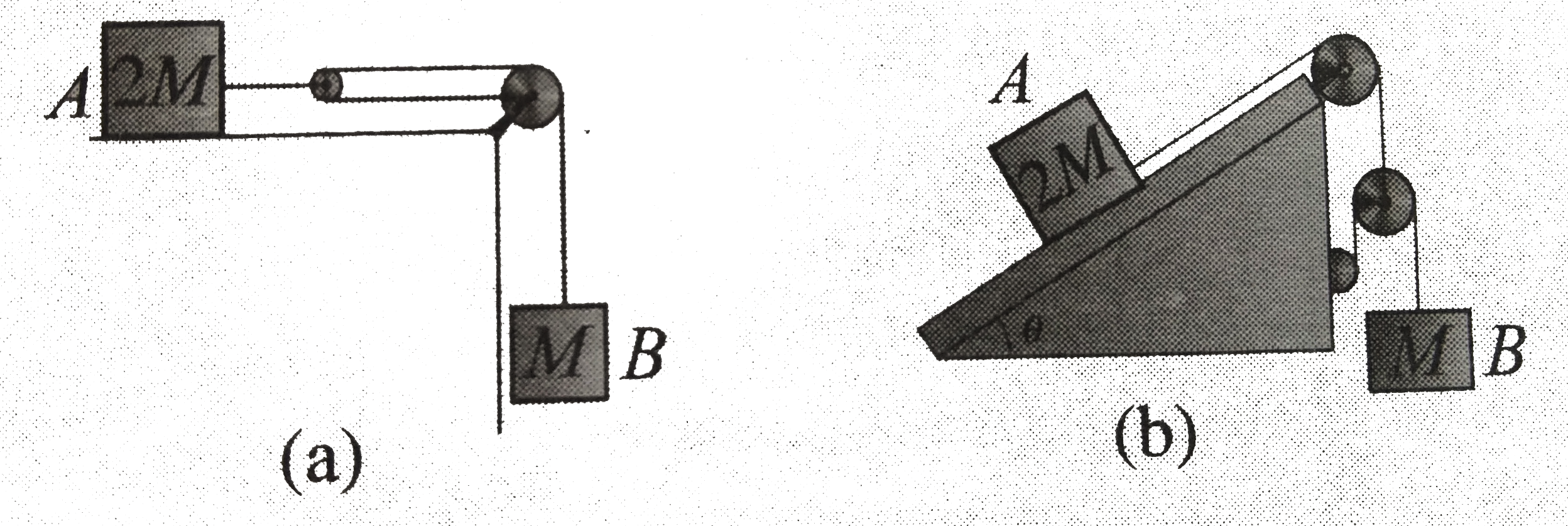
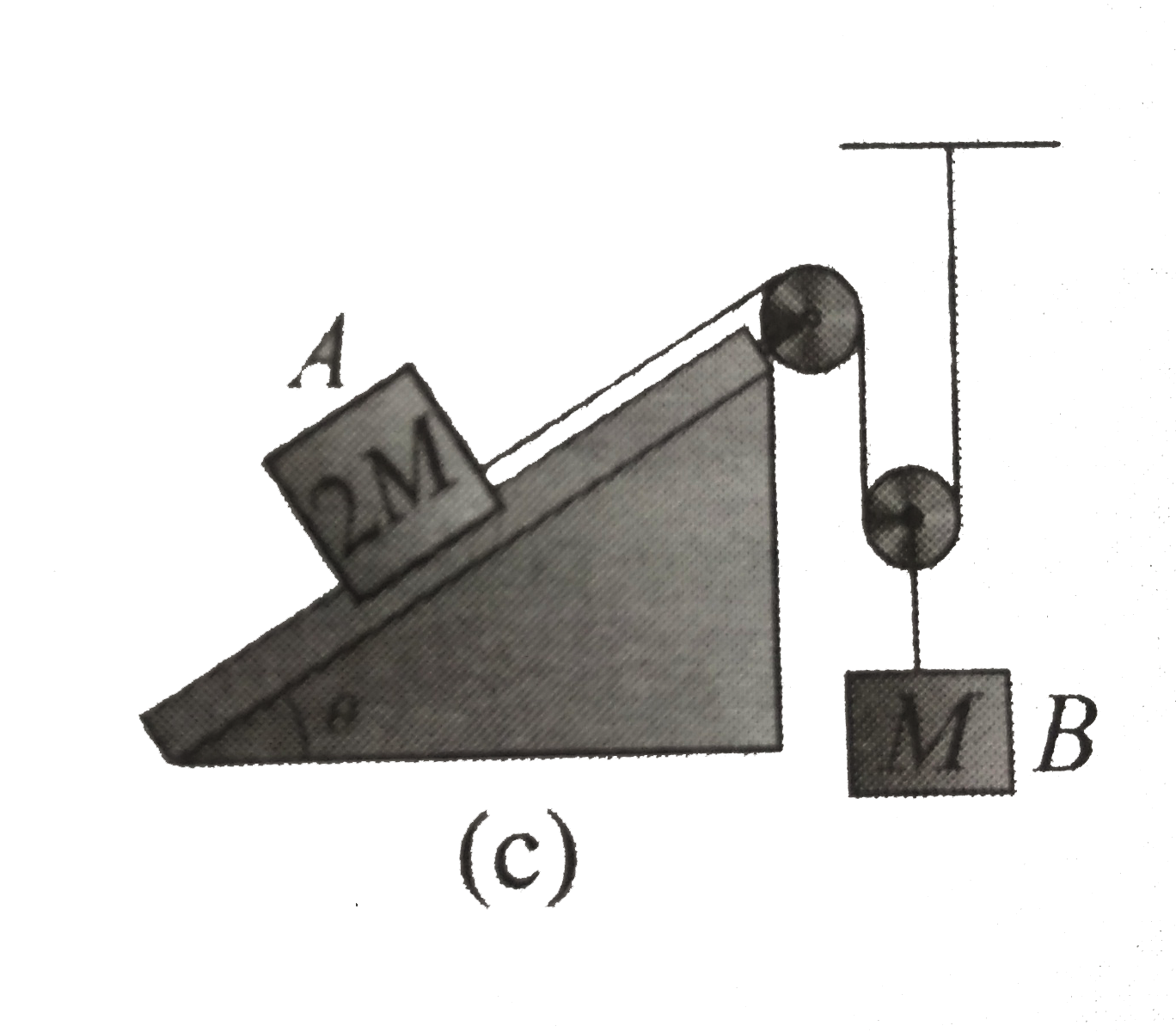
Calculate the acceleration of block A and B in cases (a),(b), and (c ).


Text Solution

Verified by Experts
(a) For block `2M, 2T=2Ma` …(i)
For block `M, Mg-t=M2a` …(ii)
Solving equation (i) and (ii), we get `a=g//3`
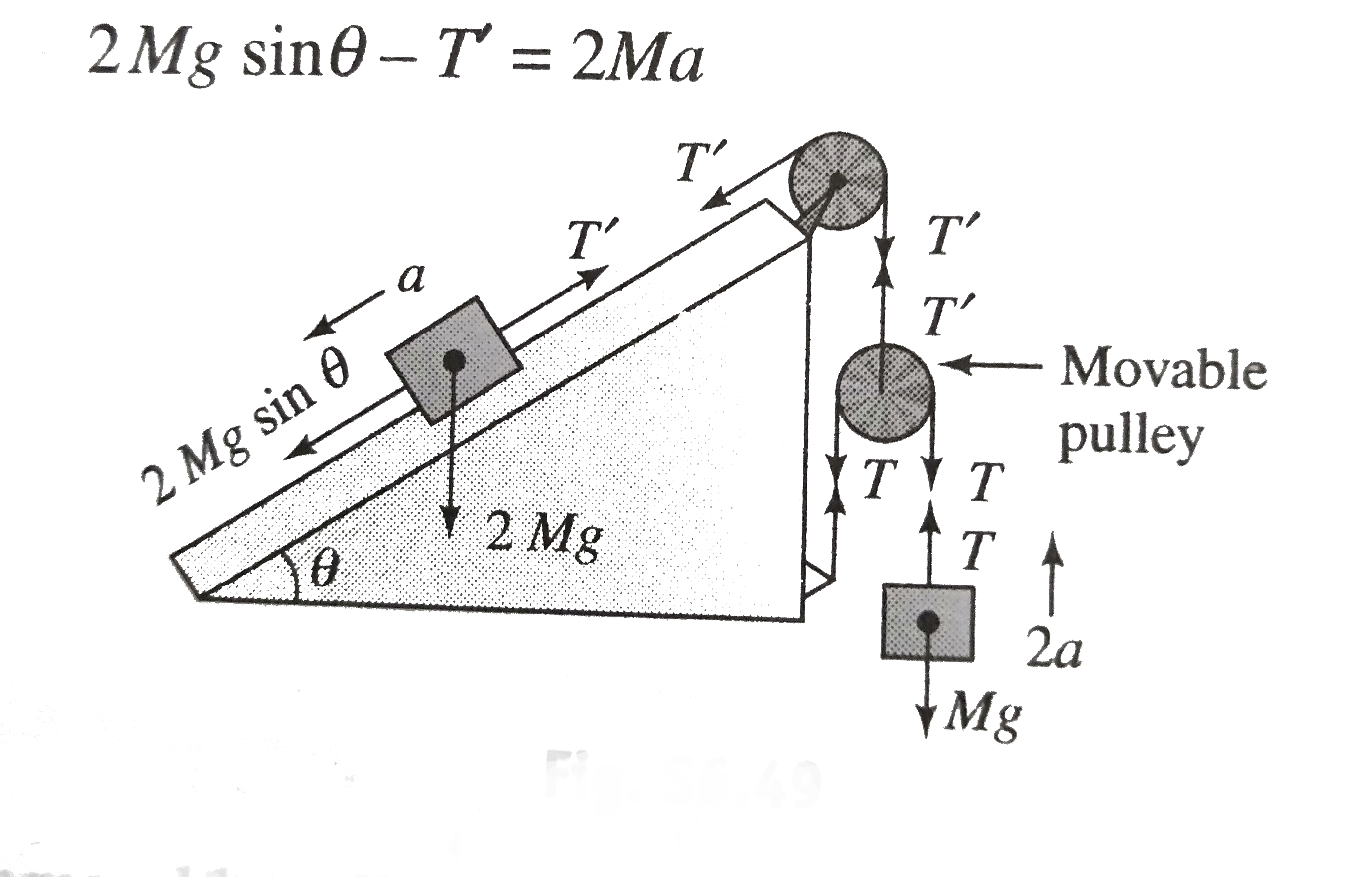
(b) For block 2M,
`2Mg sin theta-T'=2Ma`...(i)

For movable pulley,
`T'-2T=0xxa implies T'=2T` ...(ii)
For block `M,T-Mg=M2a` ...(iii)
Solving eq, (i), (ii) , and (iii), we get `a=(g[sin theta-1])/(3)`
This is negative, hence direction of accelerations will be opposite to those shown in fig.
Note: Here we assume that the itblock `2M` is moving down the plane. You may assume that it is moving up the plane. The magnitude of the acceleration found will remain the same.
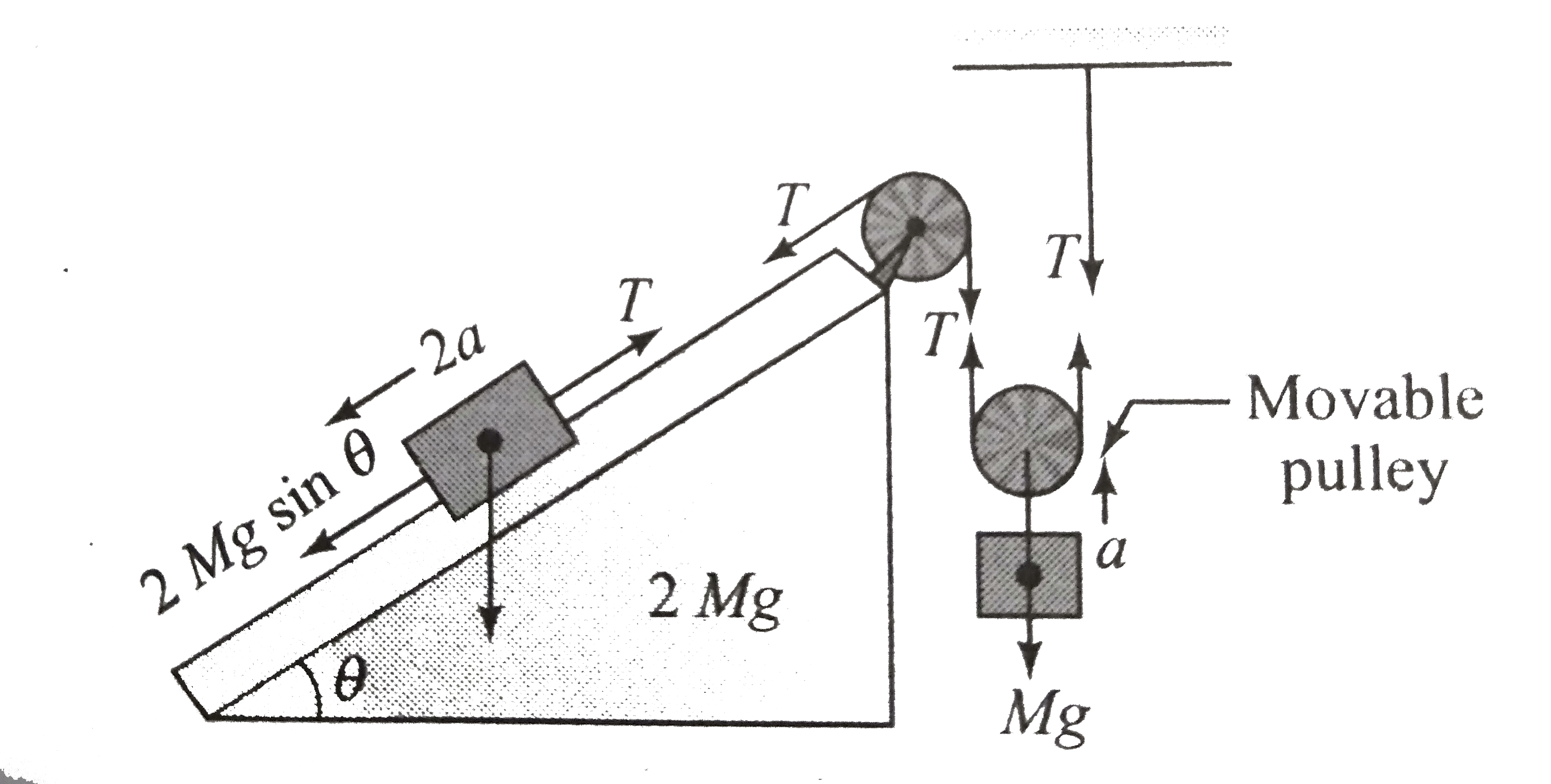
(c) For block 2M,
`2Mg sin theta-T=2M(2a)` ...(i)

For block `M, 2T-Mg=Ma` ...(ii)
Solving Eqs (i) and (ii), we get `a=(g[4 sin theta-1])/(9)`.
Promotional Banner

Topper's Solved these Questions

  • NEWTON'S LAWS OF MOTION 1

    CENGAGE PHYSICS ENGLISH|Exercise Exercise 6.4|13 Videos
  • NEWTON'S LAWS OF MOTION 1

    CENGAGE PHYSICS ENGLISH|Exercise Subjective|15 Videos
  • NEWTON'S LAWS OF MOTION 1

    CENGAGE PHYSICS ENGLISH|Exercise Exercise 6.2|35 Videos
  • MISCELLANEOUS VOLUME 2

    CENGAGE PHYSICS ENGLISH|Exercise INTEGER_TYPE|10 Videos
  • NEWTON'S LAWS OF MOTION 2

    CENGAGE PHYSICS ENGLISH|Exercise Integer type|1 Videos

Similar Questions

Explore conceptually related problems

A block of mass M = 10 kg is placed inclined plane , inclined at angle theta = 37^(@) with horizontal The coefficient of friction between the block and inclined is mu = 0.5 a. Calculate the acceleration of the block when it is released b. Now a force F = 75 N is appling on block as shown find out the acceleration of the block If the block is initially at rest . c. In case (b), how much force should be added to 75 N force so that block the starts to move up the incline. d. In case (b), what is the minimum force by which 75N force should be replaced with so that the block does not move?

A block of mass 5 kg is (i) pushed in case (A) and (ii) pulled in case (B), by a force F=20 N , making an angle of 30^(@) with the horizontal, as shown in the figures. The coefficient of friction between the block and floor is mu = 0.2 . The difference between the accelerattion of the block, in case (B) and case (A) will be : (g = 10 ms^(-2)) . .

Three blocks A, B, and C of masses 3M, 2M , and M are suspended vertically with the help of spring PQ and TU, and a string RS as shown in fig. If the acceleration of blocks A, B and C is a_(1), a_(2) and a_(3) , respectively, then The value of acceleration a_(3) at the moment spring PQ is cut is

Three blocks A, B, and C of masses 3M, 2M , and M are suspended vertically with the help of spring PQ and TU, and a string RS as shown in fig. If the acceleration of blocks A, B and C is a_(1), a_(2) and a_(3) , respectively, then The value of acceleration a_(1) at the moment string RS is cut is

Three blocks A, B, and C of masses 3M, 2M , and M are suspended vertically with the help of spring PQ and TU, and a string RS as shown in fig. If the acceleration of blocks A, B and C is a_(1), a_(2) and a_(3) , respectively, then The value of acceleration a_(2) at the moment spring TU is cut is

Find the acceleration of block B as shown in fig. (a) and (b) relative to block A and relative to ground if block A is moving toward right with acceleration a.

Three block A,B,and C of mass m_(1),m_(2) and m_(3) , respectively are resting one on top of the other as shown in fig. A horizontal force F is applied on block B. Assuming all the surfaces are frictionless, calculate (1) acceleration of block A, block B, and block C, (2) normal reactions between A and B, B and C, and between C and ground .

In figures (a), (b) and (c) shown, the objects A, B and C are of same mass. String, spring and pulley are massless. C strikes B with velocity u in each case and sticks it. The ratio of velocity of B in case (a) to (b) to (c) is

Two blocks 'A' and 'B' having masses m_(A) and m_(a) , respectively are connectd by an arrangement shown in the figure. Calculate the downward acceleration of the block B. Assume the pulleys to be massless. Under what condition will block A have downward acceleration?

In figure calculate the linear acceleration of the blocks. Mass of block B= 8kg mass of disc shaped pulley =2kg (take g=10m//s^(2) )

CENGAGE PHYSICS ENGLISH-NEWTON'S LAWS OF MOTION 1-Exercise 6.3
  1. Block A is given an acceleration 12 ms^(-2) towards left as shown in f...

    Text Solution

    |

  2. The three block shown in fig. move with constant velocities. Find the ...

    Text Solution

    |

  3. For the system as shown in fig. find the acceleration of C. the accele...

    Text Solution

    |

  4. System is shown in fig. and wedge is moving toward left with speed 2ms...

    Text Solution

    |

  5. In fig. shown, the speed of the truck is v to the right. Find the spee...

    Text Solution

    |

  6. Determine the speed with which block B rises in fig. if the end of the...

    Text Solution

    |

  7. An inextensible string AB is tied to a block B of negligible dimension...

    Text Solution

    |

  8. Find the acceleration of blocks in fig. The pulley and the string are...

    Text Solution

    |

  9. In the pulley-block arrangement shown in figure , find the relation be...

    Text Solution

    |

  10. Figure shows a pulley over which is string passes and connected to two...

    Text Solution

    |

  11. Find the relation in the accelerations of the three masses shown in fi...

    Text Solution

    |

  12. A ring A which can slide on a smooth wire is connected to one end of a...

    Text Solution

    |

  13. Figure shows a block A constrained to slide along the inclined plane o...

    Text Solution

    |

  14. Find the acceleration of block B as shown in fig. (a) and (b) relative...

    Text Solution

    |

  15. If the string is inextensible, determine the velocity u of each block ...

    Text Solution

    |

  16. Calculate the acceleration of block A and B in cases (a),(b), and (c )...

    Text Solution

    |

  17. A rod of mass m is supported on a wedge of mass M shown in fig. Find t...

    Text Solution

    |

  18. In fig, no relative motion takes place between the wedge and the block...

    Text Solution

    |

  19. The velocities of A and B shown in fig. Find the speed (in ms^(-1)) of...

    Text Solution

    |