Home
Class 11
PHYSICS
The velocities of A and B shown in fig. ...

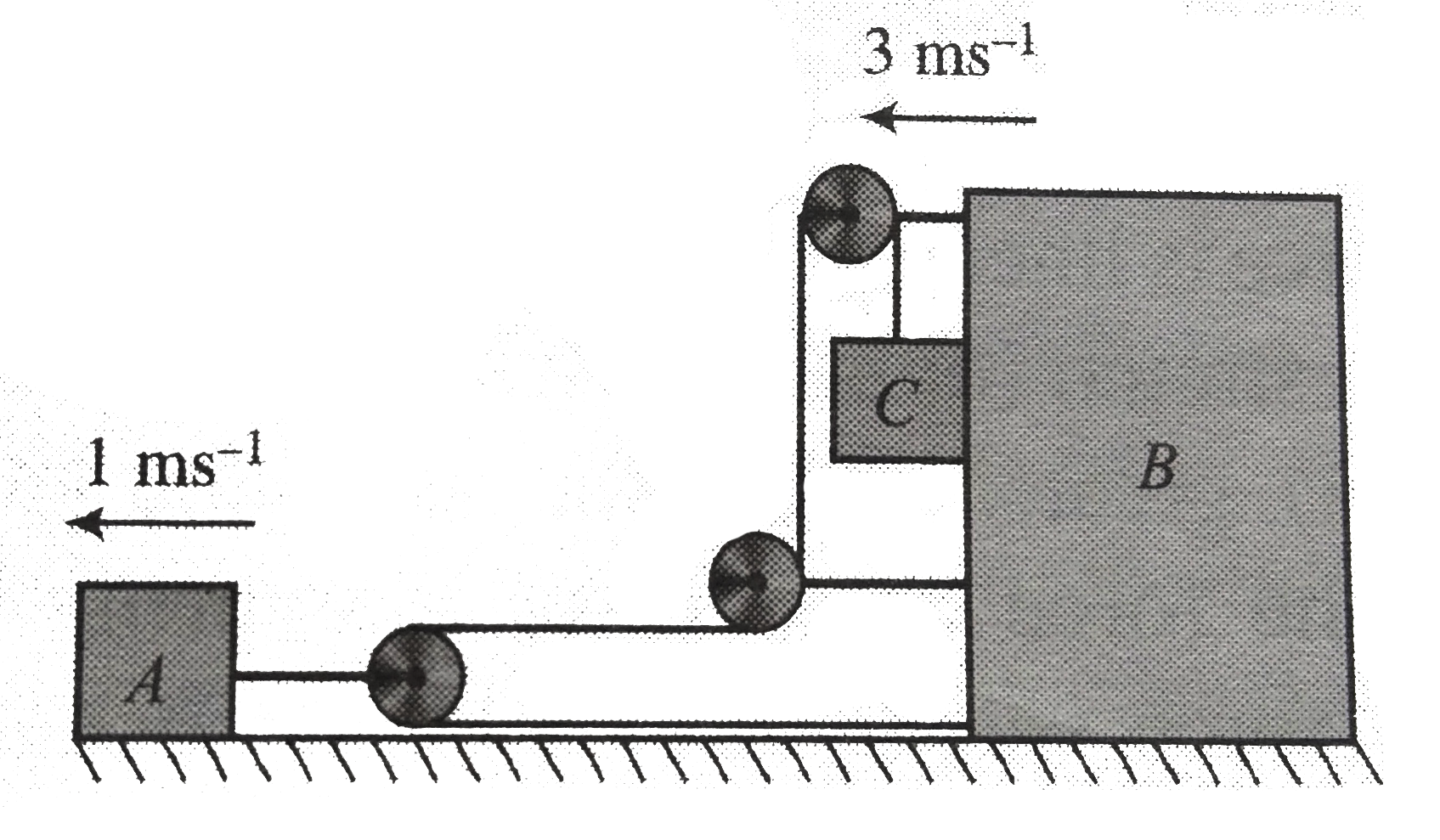
The velocities of A and B shown in fig. Find the speed (in `ms^(-1)`) of block C. (Assume that the pulleys and string are ideal).

Text Solution

Verified by Experts
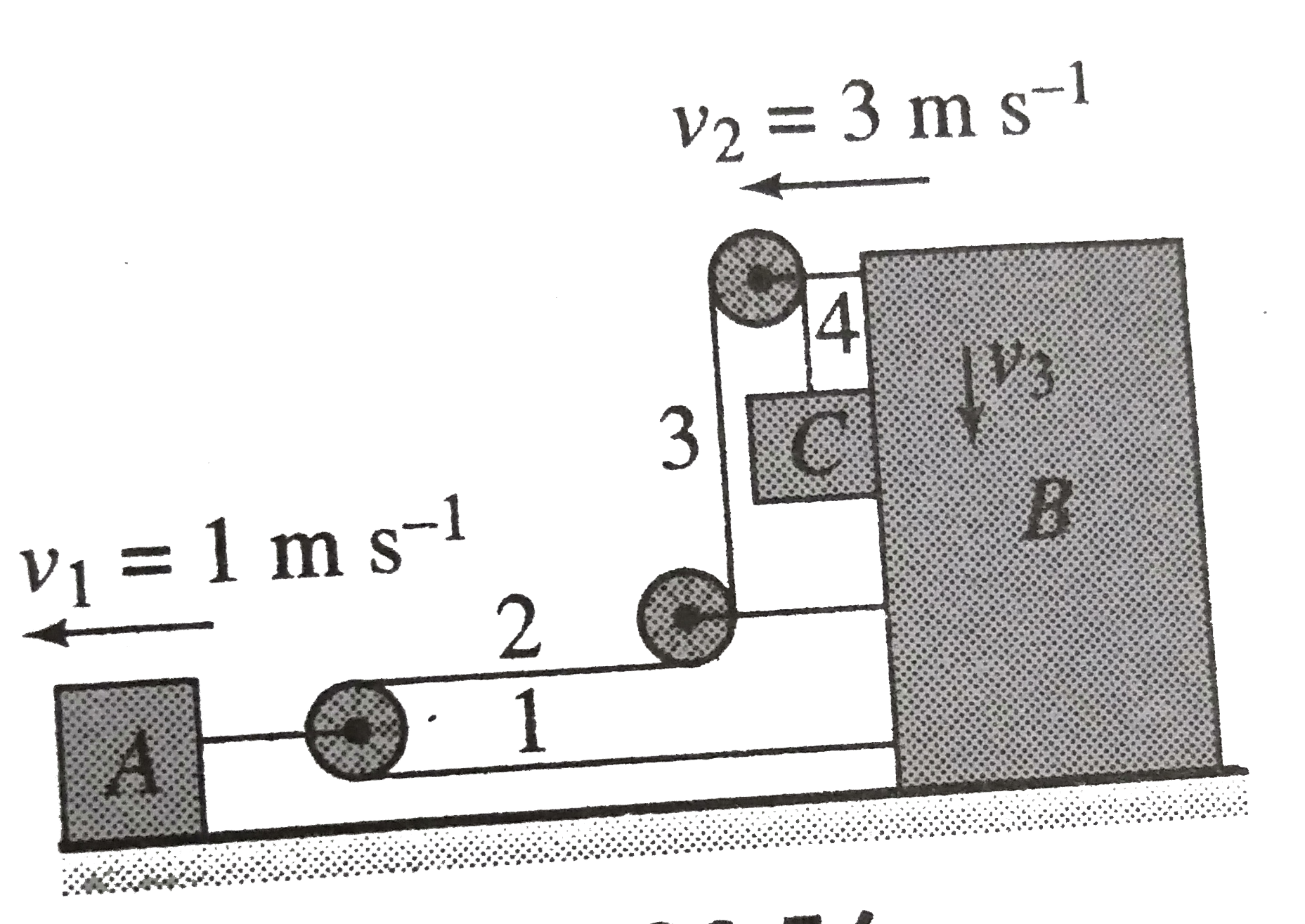
`v_(1)=1 ms^(-1), v_(2)=3 ms^(-1)`
Let the velocity of c is `v_(3)` downward w.r.t B. then
`(v_(1)-v_(2))+(v_(1)-v_(2))+v_(3)=0`
`implies v_(3)=2(v_(2)-v_(1))=2(3-1)`
`=4ms^(-1)`
Net velocity of C =` sqrt(v_(2)^(2)+v_(3)^(2))=sqrt(3^(2)+4^(2))=5 ms^(-1)`
Promotional Banner

Topper's Solved these Questions

  • NEWTON'S LAWS OF MOTION 1

    CENGAGE PHYSICS ENGLISH|Exercise Exercise 6.4|13 Videos
  • NEWTON'S LAWS OF MOTION 1

    CENGAGE PHYSICS ENGLISH|Exercise Subjective|15 Videos
  • NEWTON'S LAWS OF MOTION 1

    CENGAGE PHYSICS ENGLISH|Exercise Exercise 6.2|35 Videos
  • MISCELLANEOUS VOLUME 2

    CENGAGE PHYSICS ENGLISH|Exercise INTEGER_TYPE|10 Videos
  • NEWTON'S LAWS OF MOTION 2

    CENGAGE PHYSICS ENGLISH|Exercise Integer type|1 Videos

Similar Questions

Explore conceptually related problems

The time period of block of mass m is (Assume pulleys and string are massless) .

The block Q moves to the right with a constant velocity v_(0) as shown in figure. The relatives velocity of body P with respect to Q is ( assume all pulleys and strings are ideal)

Find the acceleration of blocks in fig. The pulley and the string are massless.

A pulley-rope-mass arrangement is shown in fig. Find the acceleration of block m_(1) when the masses are set free to move. Assume that the pulley and the ropes are ideal.

A pulley-rope-mass arrangement is shown in fig. Find the acceleration of block m_(1) when the masses are set free to move. Assume that the pulley and the ropes are ideal.

find the acceleration of the block of mass M in the situation shown in figure. All the surfaces are frictionless and the pulleys and the string are light.

Blocks m_(1) and m_(2) starts from rest and move to right with accelerations as shown. If t is in second then the time when block m_(3) again come to rest from t =0 is (pulley and strings are ideal) : .

Two blocks A and B of same mass m attached with a light spring are suspended by a string as shown in fig. Find the acceleration of block A and B just after the string is cut.

Find out velocity of block B in the given figure : (all the pulleys are ideal and string are inextensible massless)

The pulley shown in figure has a moment of inertia I about it's axis and its radius is R. Find the magnitude of the acceleration of the two blocks. Assume that the string is light and does not slip on the pulley.

CENGAGE PHYSICS ENGLISH-NEWTON'S LAWS OF MOTION 1-Exercise 6.3
  1. Block A is given an acceleration 12 ms^(-2) towards left as shown in f...

    Text Solution

    |

  2. The three block shown in fig. move with constant velocities. Find the ...

    Text Solution

    |

  3. For the system as shown in fig. find the acceleration of C. the accele...

    Text Solution

    |

  4. System is shown in fig. and wedge is moving toward left with speed 2ms...

    Text Solution

    |

  5. In fig. shown, the speed of the truck is v to the right. Find the spee...

    Text Solution

    |

  6. Determine the speed with which block B rises in fig. if the end of the...

    Text Solution

    |

  7. An inextensible string AB is tied to a block B of negligible dimension...

    Text Solution

    |

  8. Find the acceleration of blocks in fig. The pulley and the string are...

    Text Solution

    |

  9. In the pulley-block arrangement shown in figure , find the relation be...

    Text Solution

    |

  10. Figure shows a pulley over which is string passes and connected to two...

    Text Solution

    |

  11. Find the relation in the accelerations of the three masses shown in fi...

    Text Solution

    |

  12. A ring A which can slide on a smooth wire is connected to one end of a...

    Text Solution

    |

  13. Figure shows a block A constrained to slide along the inclined plane o...

    Text Solution

    |

  14. Find the acceleration of block B as shown in fig. (a) and (b) relative...

    Text Solution

    |

  15. If the string is inextensible, determine the velocity u of each block ...

    Text Solution

    |

  16. Calculate the acceleration of block A and B in cases (a),(b), and (c )...

    Text Solution

    |

  17. A rod of mass m is supported on a wedge of mass M shown in fig. Find t...

    Text Solution

    |

  18. In fig, no relative motion takes place between the wedge and the block...

    Text Solution

    |

  19. The velocities of A and B shown in fig. Find the speed (in ms^(-1)) of...

    Text Solution

    |

