Home
Class 11
PHYSICS
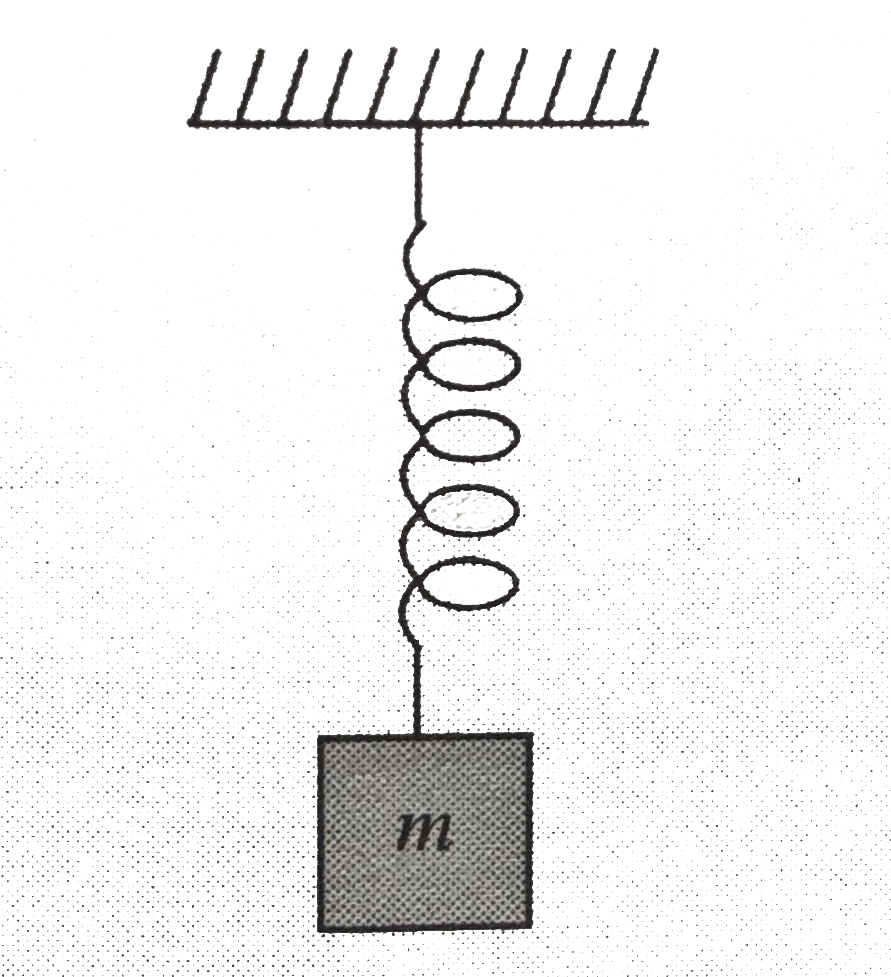
A sand bag of mass m is hanging from a l...

A sand bag of mass m is hanging from a light spring of stiffness k. Find the elongation of the spring. If we pull the sand bag down by an additional distance x and release it, find its acceleration and maximum velocity of block.

Text Solution

Verified by Experts

Since `F=-kx hat(j)` and downward force =`+mg hat(j)`
`Sigma F_(y)=0`
`mg= k Delta x`
`Delta x =(mg)/(K)`
If we apply addition force to pull it down by distance x, then FBD
Upward forces are =`k(x + Delta x)`
Downward force =`F+mg`
If we remove from F then `Sigma F_(y)=ma_(y)`
`K(x+Delta x)-mg=ma`

Maximum acceleration,
`a = (k(Delta x +x))/(m)-g`
`a =(k Delta x)/(m) +(k x)/(m) -g =(k x)/( m)`
Maximum velocity: `F=kx`
`ma=kx implies (vdv)/(dx)=(kx)/(m)implies (v^2)/(2)=(kx^(2))/(2m)`
`v=sqrt((k)/(m)x)`.
Promotional Banner

Topper's Solved these Questions

  • NEWTON'S LAWS OF MOTION 1

    CENGAGE PHYSICS ENGLISH|Exercise Subjective|15 Videos
  • NEWTON'S LAWS OF MOTION 1

    CENGAGE PHYSICS ENGLISH|Exercise Single Correct|75 Videos
  • NEWTON'S LAWS OF MOTION 1

    CENGAGE PHYSICS ENGLISH|Exercise Exercise 6.3|19 Videos
  • MISCELLANEOUS VOLUME 2

    CENGAGE PHYSICS ENGLISH|Exercise INTEGER_TYPE|10 Videos
  • NEWTON'S LAWS OF MOTION 2

    CENGAGE PHYSICS ENGLISH|Exercise Integer type|1 Videos

Similar Questions

Explore conceptually related problems

A block of mass m suspended from a spring of spring constant k . Find the amplitude of S.H.M.

Two identical particles each of mass m are connected by a light spring of stiffness K. The initial deformation of the spring when the system was at rest, x_(0) . After releasing the system, if one of the particles has a speed v and the deformation of the spring is x, find the speed of the other particle neglecting friction.

The block of mass m is released when the spring was in its natrual length. Spring constant is k. Find the maximum elongation of the spring.

A mass M is suspended from a light spring. An additional mass m added to it displaces the spring further by distance x then its time period is

Two blocks A and B of mass m and 2m respectively are connected by a light spring of force constant k. They are placed on a smooth horizontal surface. Spring is stretched by a length x and then released. Find the relative velocity of the blocks when the spring comes to its natural length

Two identicle particles A and B, each of mass m, are interconnected by a spring of stiffness k. If particle B experiences a forec F and the elongation of the spring is x, the acceleration of particle B relative to particle A is equal to

A block of mass m fitted with a light spring of stiffness k and natural length l_(0) kept on a smooth radial groove made on a disc rotaing with a constant angular axis . If the block is released slowly . Find the maximum elongation of the spring

Two blocks of masses m_(1) and m_(2) , connected by a weightless spring of stiffness k rest on a smooth horizontal plane as shown in Fig. Block 2 is shifted a small distance x to the left and then released. Find the velocity of centre of mass of the system after block 1 breaks off the wall.

A smooth block of mass m is connected with a spring of stiffness k(=20Nm^(-1) )and natural length l_(0)=0.25 m . If the block is pulled such that the new length of the spring becomes l=0.3m , find the acceleration of the block at the moment when it is released from given positon.

A block of mass m is suddenly released from the top of a spring of stiffness constant k. a. Find the acceleration of block just after release. b. What is the compression in the spring at equilibrium. c. What is the maximum compression in the spring. d. Find the acceleration of block at maximum compression in the spring.
