Home
Class 11
PHYSICS
Two blocks are connected by a spring. Th...

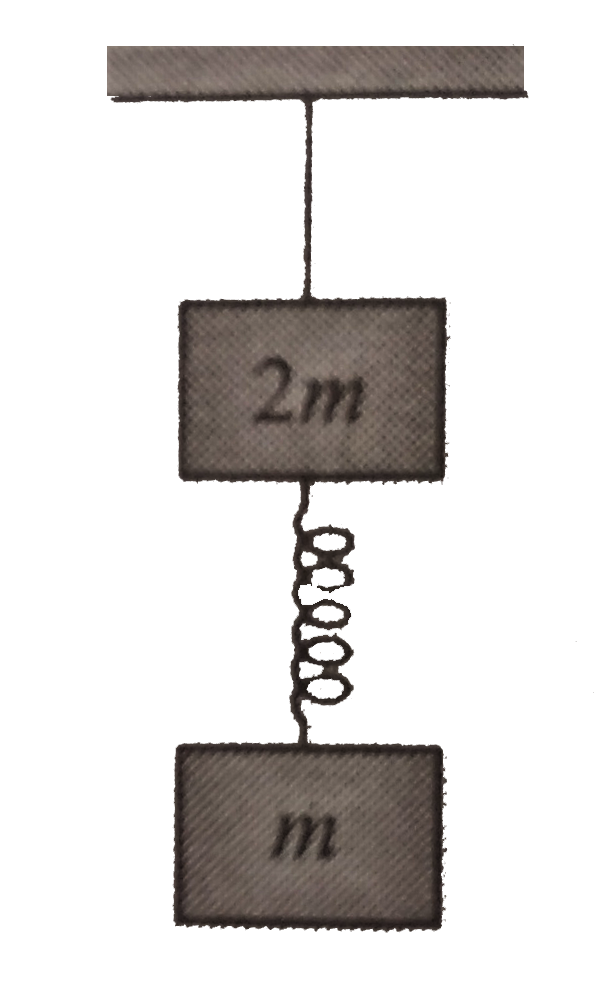
Two blocks are connected by a spring. The combination is suspended, at rest, from a string attached to the ceiling, as shown in fig. The string breaks suddenly.
Immediately after the string breaks, what is the initial downward acceleration of the upper block of mass 2m?

Text Solution

Verified by Experts
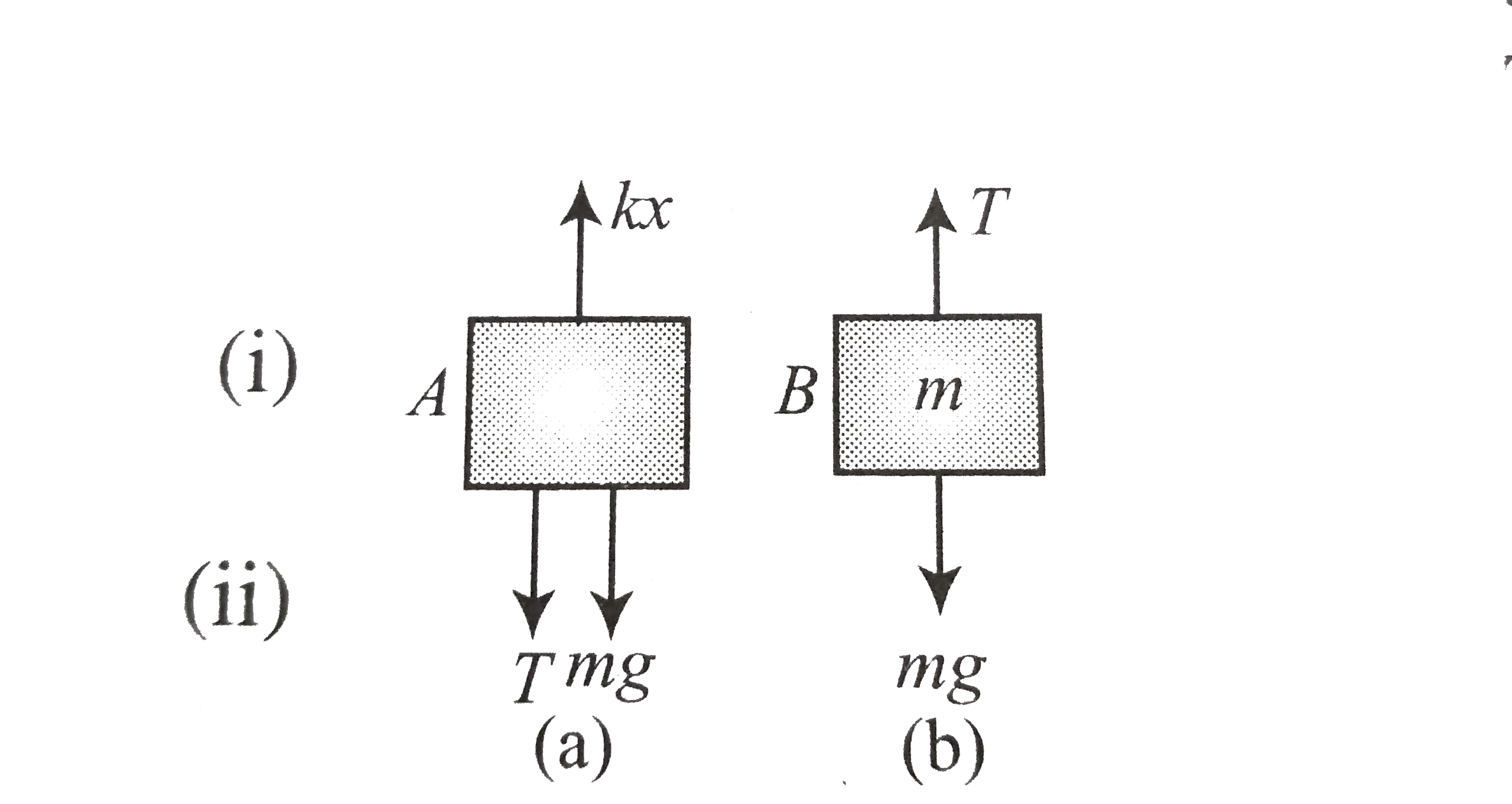
When string is not cut:
FBD of A block
`kx=mg+T`
FBD of B block
`T=mg`
when string is cut:
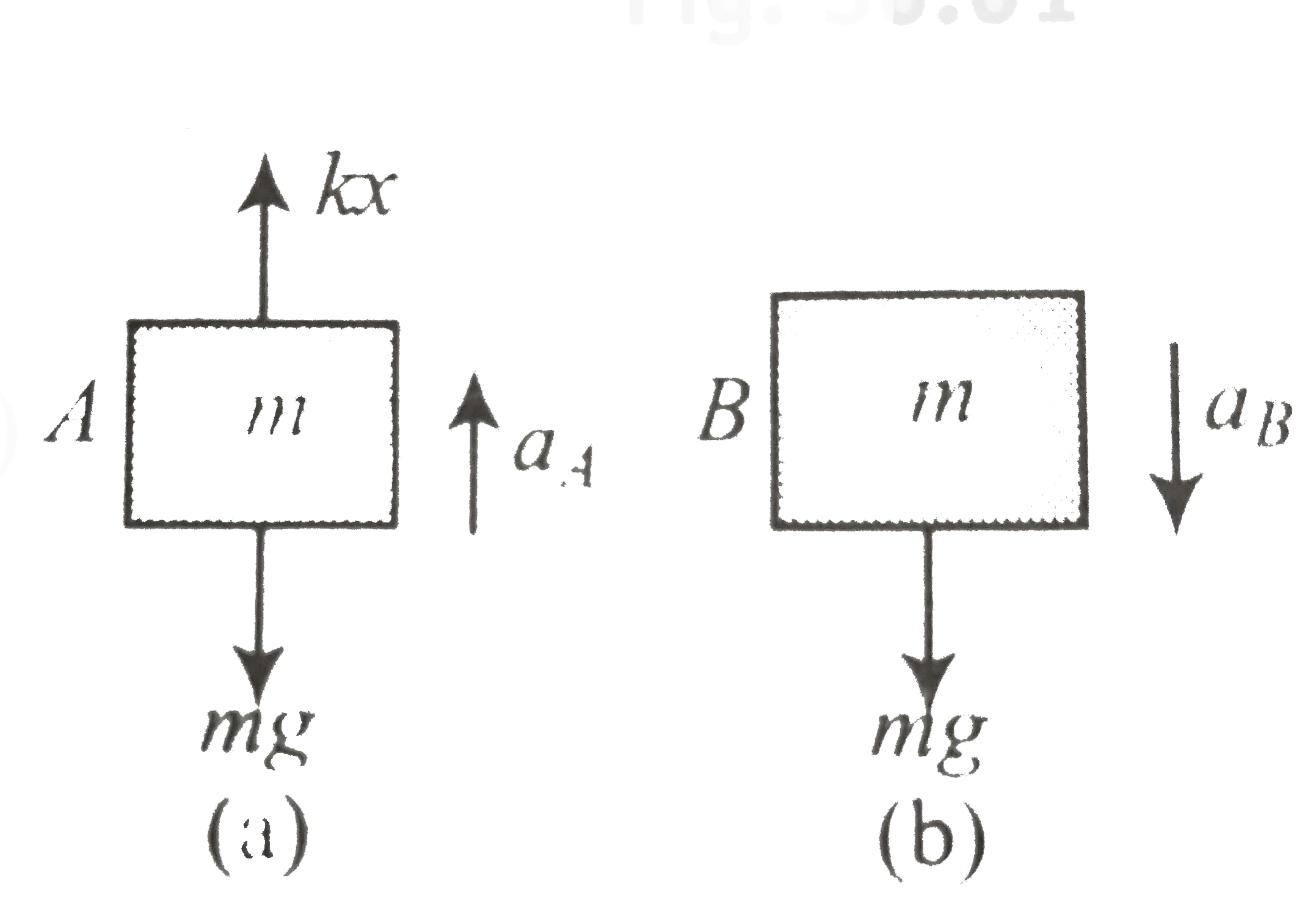
FBD of A block
`kx-mg=ma_(A)`
`2mg-mg=ma_(A)`
`=a_(A)=g` (upwards)
FBD of B block
`ma_(B)=mg`
`a_(B)=g` (downwards). ltBRgt
Promotional Banner

Topper's Solved these Questions

  • NEWTON'S LAWS OF MOTION 1

    CENGAGE PHYSICS ENGLISH|Exercise Subjective|15 Videos
  • NEWTON'S LAWS OF MOTION 1

    CENGAGE PHYSICS ENGLISH|Exercise Single Correct|75 Videos
  • NEWTON'S LAWS OF MOTION 1

    CENGAGE PHYSICS ENGLISH|Exercise Exercise 6.3|19 Videos
  • MISCELLANEOUS VOLUME 2

    CENGAGE PHYSICS ENGLISH|Exercise INTEGER_TYPE|10 Videos
  • NEWTON'S LAWS OF MOTION 2

    CENGAGE PHYSICS ENGLISH|Exercise Integer type|1 Videos

Similar Questions

Explore conceptually related problems

Two blocks are connected by a spring. The combination is suspended, at rest, from a string attached to the ceiling, as shown in the figure. The string breaks suddenly. Immediately after the string breaks, what is the initial downward acceleration of the upper block of mass 2m?

Two identical blocks are connected by a light spring. The combination is suspended at rest from a string attached to the ceiling, as shown in the figure-2.190 below. The string breaks suddenly. Immediately after the string breaks:

Find the acceleration of block A immediately after the string is cut .

A uniform rod of mass m and length l is suspended by means of two light inextensible strings as shown in figure. Tension in one string immediately after the other string is cut is

Two blocks each of mass m are connected over two light and frictionless pulleys and a fixed wedge by a light string as shown in figure. The tension in the string is :

Two block of mass 2kg are connected by a massless ideal spring of spring contant K=10N//m . The upper block is suspended from roof by a light string A . The system shown is in equilibrium. The string A is now cut, the acceleration of upper block just after the string A is cut will be (g=10m//s^(2) .

Two block of mass 2kg are connected by a massless ideal spring of spring contant K=10N//m . The upper block is suspended from roof by a light string A . The system shown is in equilibrium. The string A is now cut, the acceleration of upper block just after the string A is cut will be (g=10m//s^(2) .

Two blocks are connected by a massless string that passes over a frictionless peg as shown in figure. One end of the string is attached to a mass m_1=3kg , i.e., a distance R=1.20m from the peg. The other end of the string is connected to a block of mass m_2=6kg resting on a table. From what angle theta , measured from the vertical, must the 3-kg block be released in order to just lift the 6kg block off the table?

Two blocks m_1 and m_2 are in equilibrium. S_1 is a string and S_2 is a spring of spring constant k. Immediately after the string S_1 is cut,

A uniform rod of mass m and length l is held horizontally by two vertical strings of negligible mass, as shown in the figure. (a). Immediately after the right string is cut, what is the linear acceleration of the end of the rod? (b). Of the middle of the rod? (c). Determine the tension in the left string immediately after the right string is cut.