Home
Class 11
PHYSICS
Two block of masses m(1) and m(2) are in...

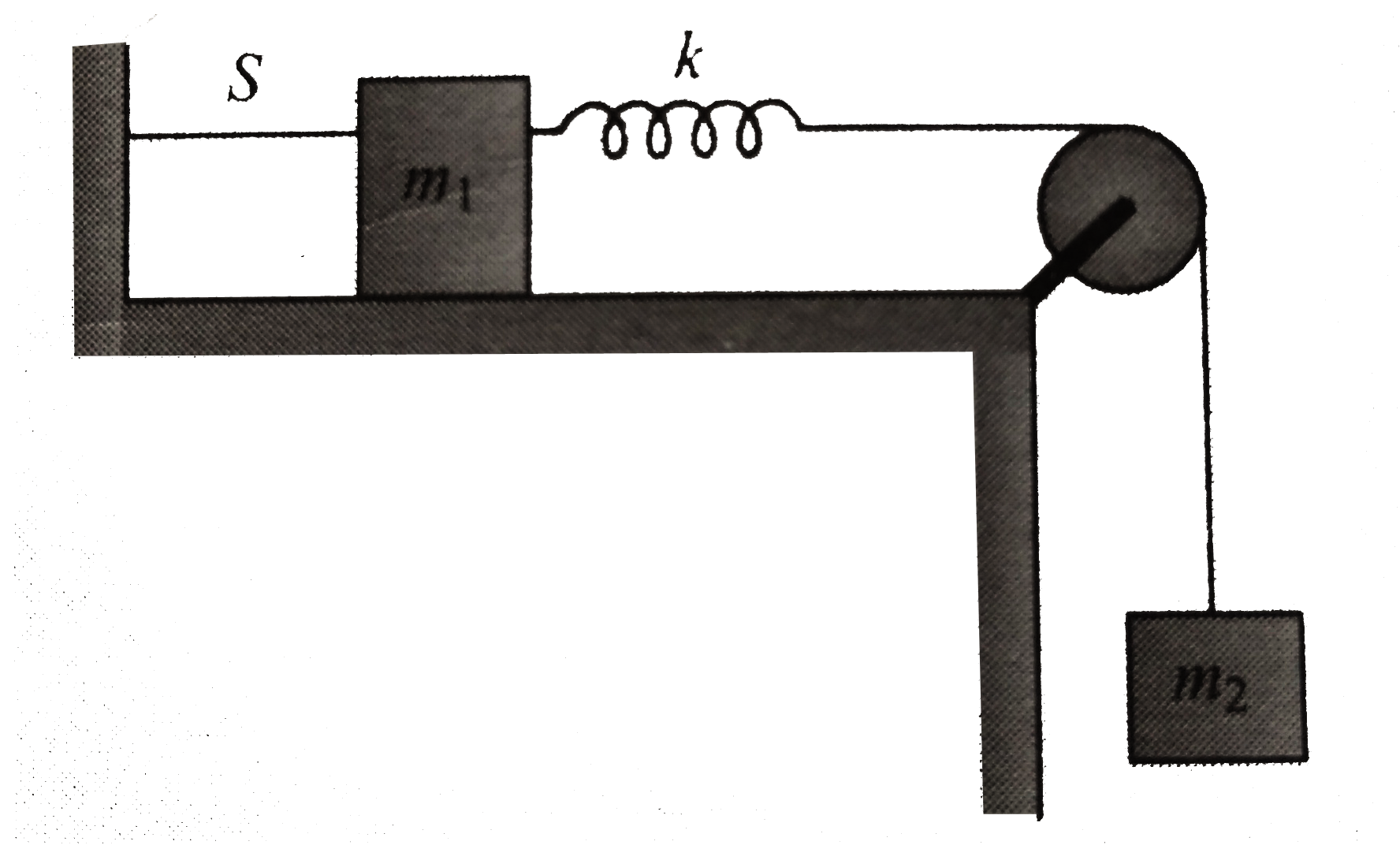
Two block of masses `m_(1)` and `m_(2)` are in equilibrium. The block `m_(2)` hangs from a fixed smooth pulley by an inextensible string that is fitted with a light spring of stiffness k as shown in fig. Neglecting friction and mass of the string, find the acceleration of the bodies just after the string S is cut.

Text Solution

Verified by Experts
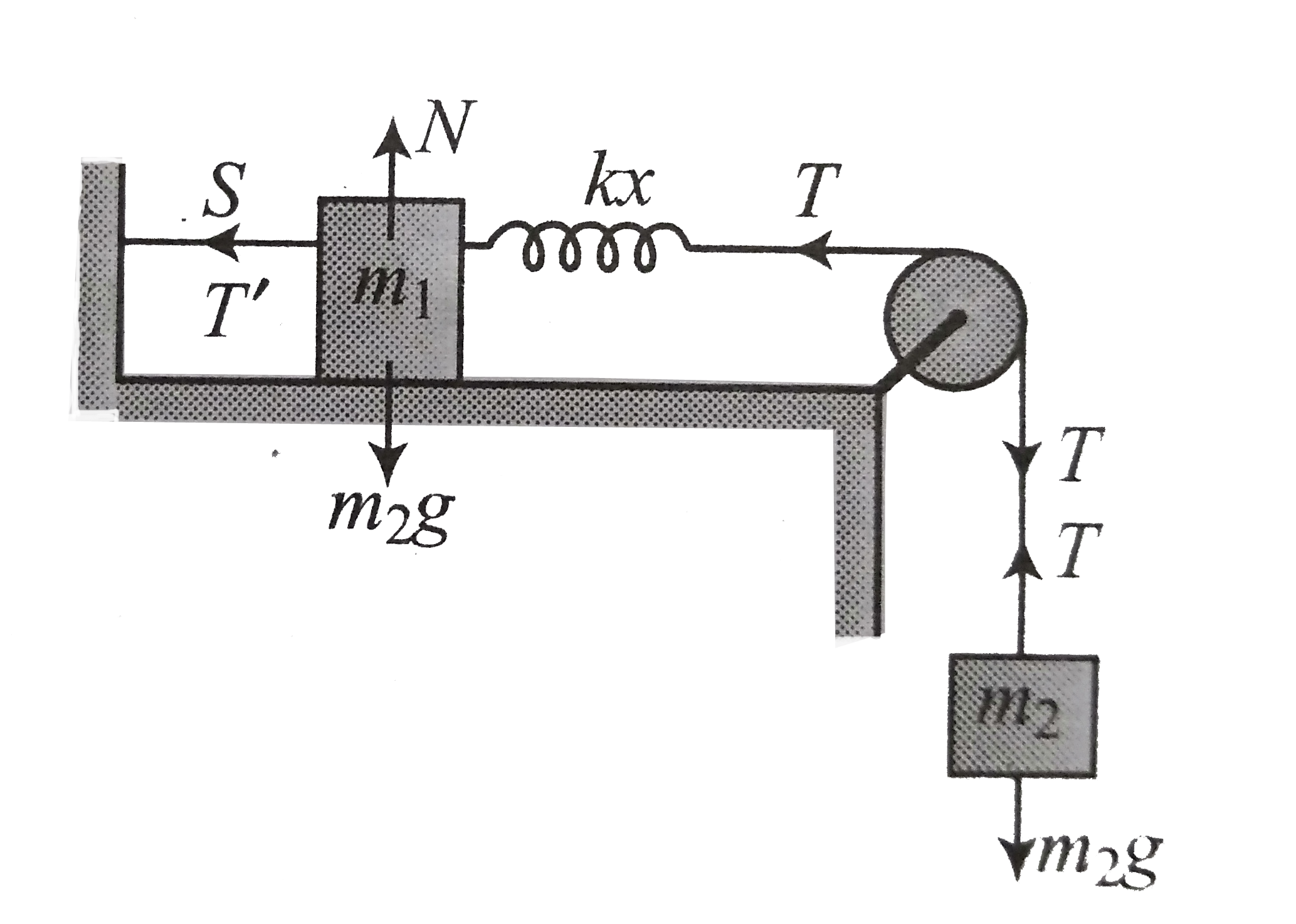
FBD: Let the spring forces be `F=kx` just after cutting the spring. Hence, at that instant, the forces acting on `m_(1)` are `T=kx rarr m_(1)g darr and N uarr`, on `m_(2)` the force are `m_(2)g darr` and `T uarr`.
Force equation: Initially, all the particles are stationary, hence, `a_(1)=a_(2)=0`. applying Newton's second law.
For `m_(1)`: `Sigma F=T'-kx=0`
For `m_(2): Sigma F=T-m_(2)g=0`
for spring: `Sigma F=T-kx=0`
Solving eqs. (i), (ii) and (iii), we have
`T'=T=kx=m_(2)g`
Just after the string S is cut, tension T' vanishes immediately but the spring cannot regain its shape and size instantanously. Therefore, the spring force remains as it is . Then, just after cutting the string, the net force acting on `m_(1)` is equal to kx, whereas the net force acting on `m_(2)` is equal to `T=m_(2)g`. Hence the acceleration of `m_(1)` and `m_(2)` just after cutting the string is given by
`SigmaF=m_(1)a_(1)=kx=m_(2)g, Sigma F=m_(2)a_(2)=T-m_(2)g=0`
This gives `a_(1)=((m_2)/(m_1)) g and a_(2)=0`.
Promotional Banner

Topper's Solved these Questions

  • NEWTON'S LAWS OF MOTION 1

    CENGAGE PHYSICS ENGLISH|Exercise Subjective|15 Videos
  • NEWTON'S LAWS OF MOTION 1

    CENGAGE PHYSICS ENGLISH|Exercise Single Correct|75 Videos
  • NEWTON'S LAWS OF MOTION 1

    CENGAGE PHYSICS ENGLISH|Exercise Exercise 6.3|19 Videos
  • MISCELLANEOUS VOLUME 2

    CENGAGE PHYSICS ENGLISH|Exercise INTEGER_TYPE|10 Videos
  • NEWTON'S LAWS OF MOTION 2

    CENGAGE PHYSICS ENGLISH|Exercise Integer type|1 Videos

Similar Questions

Explore conceptually related problems

The system shown in the figure is in equilibrium at rest. The spring and string are massless Now the string is cut. Find the acceleration of the blocks just after the string is cut.

Two blocks A and B of same mass m attached with a light spring are suspended by a string as shown in fig. Find the acceleration of block A and B just after the string is cut.

System shown in fig is in equilibrium and at rest. The spring and string are massless now the string is cut. The acceleration of mass 2m and m just after the string is cut will be:

System shown in fig is in equilibrium and at rest. The spring and string are massless now the string is cut. The acceleration of mass 2m and m just after the string is cut will be:

Three blocks arranged with pullwy and spring as shown in fig. If the string connecting blocks m_(2) and m_(3) is cut at point A, find the acceleration of masses m_(1), m_(2) and m_(3) . Just after the string is cut at point A.

A body of mass m hangs by an inextensible string that passes over a smooth mass less pulley that is fitted with a light spring of stiffness k as shown in figure. If the body is released from rest and the spring is released, calculate the maximum elongation of the spring.

A block of mass M is connected with a particle of mass m by a light inextensible string as shown in fig. Assuming all contaction surfaces as smooth, find the acceleration of the wedge after releasing the system.

Two block of mass 4 kg and 5 kg attached a light spring are suspended by a string as shown in figure. Find acceleration of block 5 kg and 4 kg just after the string is cut.

A body of mass m hangs from a smooth fixed pulley P_(1) by the inextensible string fitted with the springs of stiffness k_(1) and k_(2) . The string passes over the smooth light pulley P_(2) which is connected with another ideal spring of stiffness k_(2) . Find the period of oscillation of the body.

Two block A and B of masses 3m and m respectively are connected by a massless and inextensible string. The whole system is suspended by a massless spring as shown in figure. The magnitudes of acceleration of A and B immediately after the string is cut, are resectively

