Home
Class 11
PHYSICS
In fig. the man and the platform togethe...

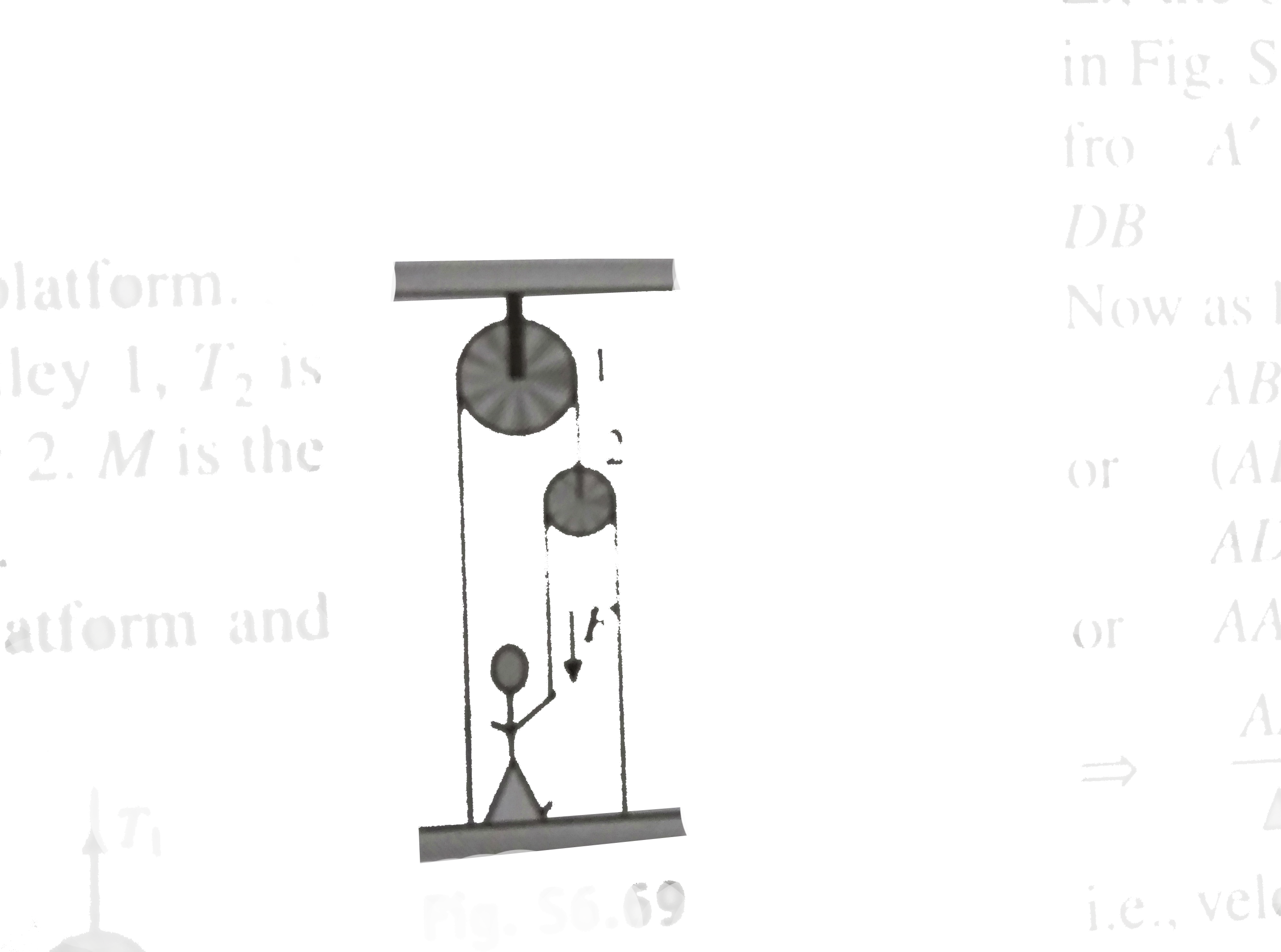
In fig. the man and the platform together weight 950N. The pulley can be treated as frictionless. Determine how hard the man has to pull on the rope to lift himself upward above the ground with constant velocity. If the weight of man is 550 N, what is the normal reaction between them?

Text Solution

Verified by Experts

The correct Answer is:
20 kg wt; 40 kg wt; 80 kg wt.

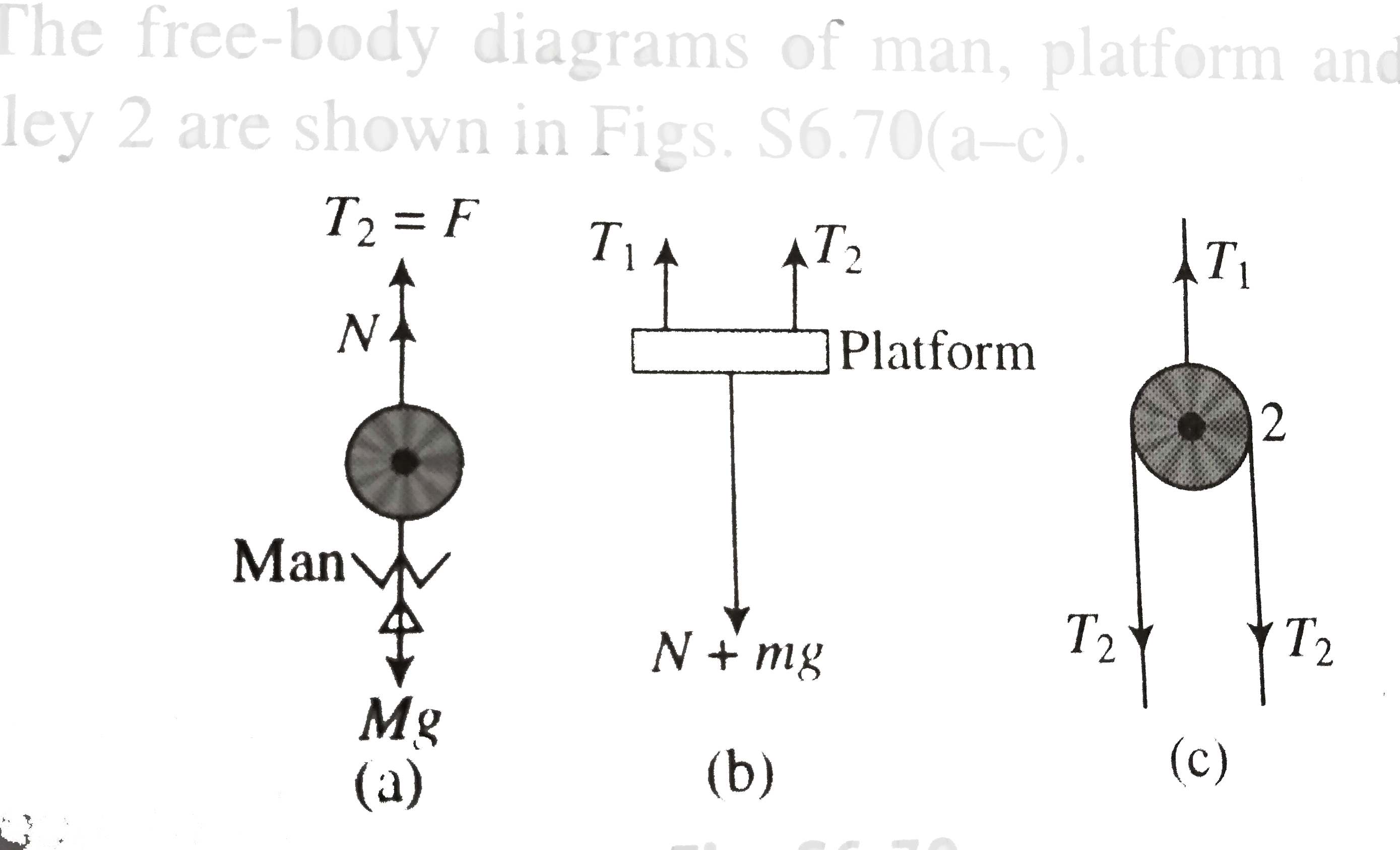
Let N be the reaction between man and platform. `T_(1)` is the tension in string passing over pulley 1, `T_(2)` is the tension in string passing over pulley 2. M is the mass of man, m is the mass of platform.
The free-body diagram of man platform and pulley 2 are shown in fig.


Action exerted by man of platfrom =reaction exerted by platform on man =N
For equilibrium of man: `Mg=T_(2)+N` ..(i)
For equilibrium of platform: `T_(1)+T_(2)=M+Mg` ...(ii)
For equilibrium of pulley 2, `T_(1)=2T_(2)` ...(iii)
Adding Eqs. (iii) we get
`T_(1)+T_(2)+(T_(2)+N)=N+mg+Mg`
`T_(1) +2T_(2) =(M +m)g`
Using Eq. (iii), we get `2 T_(2) + 2T_(2) = (M+m)g`
`implies T_(2)=((M+m))/(4)g`
`:. F=T_(2)=((M+m))/(4)g=((60+20)/(4)) g N = 20 kg wt`.
Now From eq (i)
`N=Mg-T_(2)=Mg-F=Mg-((M+m))/(4)g1`
`=((3M-m))/(4)g` ...(v)
`=((3 xx 60 -20)/(4)) g = 40 kg wt`
Form Eq. (v), `mg=3 Mg-4N`
Clearly mg is maximum when N is minimum.
Minimum `N=0`
so, `(mg)_(max)=3 Mg=3 xx 60 g = 180 kg wt`.
Promotional Banner

Topper's Solved these Questions

  • NEWTON'S LAWS OF MOTION 1

    CENGAGE PHYSICS ENGLISH|Exercise Single Correct|75 Videos
  • NEWTON'S LAWS OF MOTION 1

    CENGAGE PHYSICS ENGLISH|Exercise Multiple Correct|11 Videos
  • NEWTON'S LAWS OF MOTION 1

    CENGAGE PHYSICS ENGLISH|Exercise Exercise 6.4|13 Videos
  • MISCELLANEOUS VOLUME 2

    CENGAGE PHYSICS ENGLISH|Exercise INTEGER_TYPE|10 Videos
  • NEWTON'S LAWS OF MOTION 2

    CENGAGE PHYSICS ENGLISH|Exercise Integer type|1 Videos

Similar Questions

Explore conceptually related problems

A uniform ladder 5.0 m long rests against a frictionless, vertical wall with its lower end 3.0m to from the wall. The ladder weighs 160 N . The coefficient of static friction between the foot of the ladder and the ground is 0.40 . A man weighing 740 N climbs slowly up the ladder. What is the actual frictional force when the man has climbed 1.0 m along the ladder?

Blocks A, B and C are placed as shown in Fig and connected by the rops of negligible mass . Both A and B weigh 25.0 N each , and the coefficient of kinetic friction between each and the surface is 0.35 blocks C descends with constant velocity . a. Draw two separate free- body diagrams showing the forces acting on A and B b. Find the tension in the rope connecting blocks A and B c. What is the weight of blocks C? d. If the rope connecting A and B were cut, what would be the acceleration of C?

A circus wishes to develop a new clown act. Fig. (1) shows a diagram of the proposed setup. A clown will be shot out of a cannot with velocity v_(0) at a trajectory that makes an angle theta=45^(@) with the ground. At this angile, the clown will travell a maximum horizontal distance. The cannot will accelerate the clown by applying a constant force of 10, 000N over a very short time of 0.24s . The height above the ground at which the clown begins his trajectory is 10m . A large hoop is to be suspended from the celling by a massless cable at just the right place so that the clown will be able to dive through it when he reaches a maximum height above the ground. After passing through the hoop he will then continue on his trajectory until arriving at the safety net. Fig (2) shows a graph of the vertical component of the clown's velocity as a function of time between the cannon and the hoop. Since the velocity depends on the mass of the particular clown performing the act, the graph shows data for serveral different masses. If a clown holds on to hoop instead of passing through it, what is the position of the cable so that he doesn't hit his head on the ceiling as he swings upward?

A man stands on a rotating platform with his arms stretched holding a 5 kg weight in each hand. The angular speed of the platform is 1.2 rev s^-1 . The moment of inertia of the man together with the platform may be taken to be constant and equal to 6 kg m^2 . If the man brings his arms close to his chest with the distance n each weight from the axis changing from 100 cm to 20 cm . The new angular speed of the platform is.

A man is standing on a rail road car travelling with a constant speed of v = 10 ms^-1 (Fig . 5.34). He wishes to throw a ball through a stationary hoop 5 m above the height of his hands in such a manner that the ball will move horizontally as it passes through the hoop. He throws the ball with a speed of 12.5 ms^-1 w.r.t. himself. (a) What must be the vertical component of the initial velocity of the ball ? (b) How many seconds after he releases the ball will it pass through the hoop ? ( c) At what horizontal distance in front of the loop must he release the ball ? .

A man of mass m stands on a platform of equal mass m and pulls himself by two ropes passing over pulleys as shown in figure.If he pulls each rop with a force equal to half his weight ,his upwards acceleration would be

By the term velocity of rain, we mean velocity with which raindrops fall relative to the ground. In absence of wind, raindrops fall vertically and in presence of wind raindrops fall obliqucly. Moreover raindrops acquire a constant terminal velocity due air resistance very quickly as they fall toward the carth. A moving man relative to himself observes an altered velocity of raindrops. Which is known as velocity of rain relative to the man. It is given by the following equation. vec(v)_(rm)=vec(v)_(r)-vec(v)_(m) A standstill man relative to himself observes rain falling with velocity, which is equal to velocity of the raindrops relative to the ground. To protect himself a man should his umbrella against velocity of raindrops relative to himself as shown in the following figure. When you are standstill in rain, you have to hold umbrella vertically to protect yourself. (a) When you walk with velocity 90 cm/s, you have to hold your umbrella at 53^(@) above the horizontal. What is velocity of the raindrops relative to the ground and relative to you ? (b) If you walk with speed 160 cm/s, how should you hold your umbrella ?