Home
Class 11
PHYSICS
In the system shown in fig., m(A)=4m, m(...

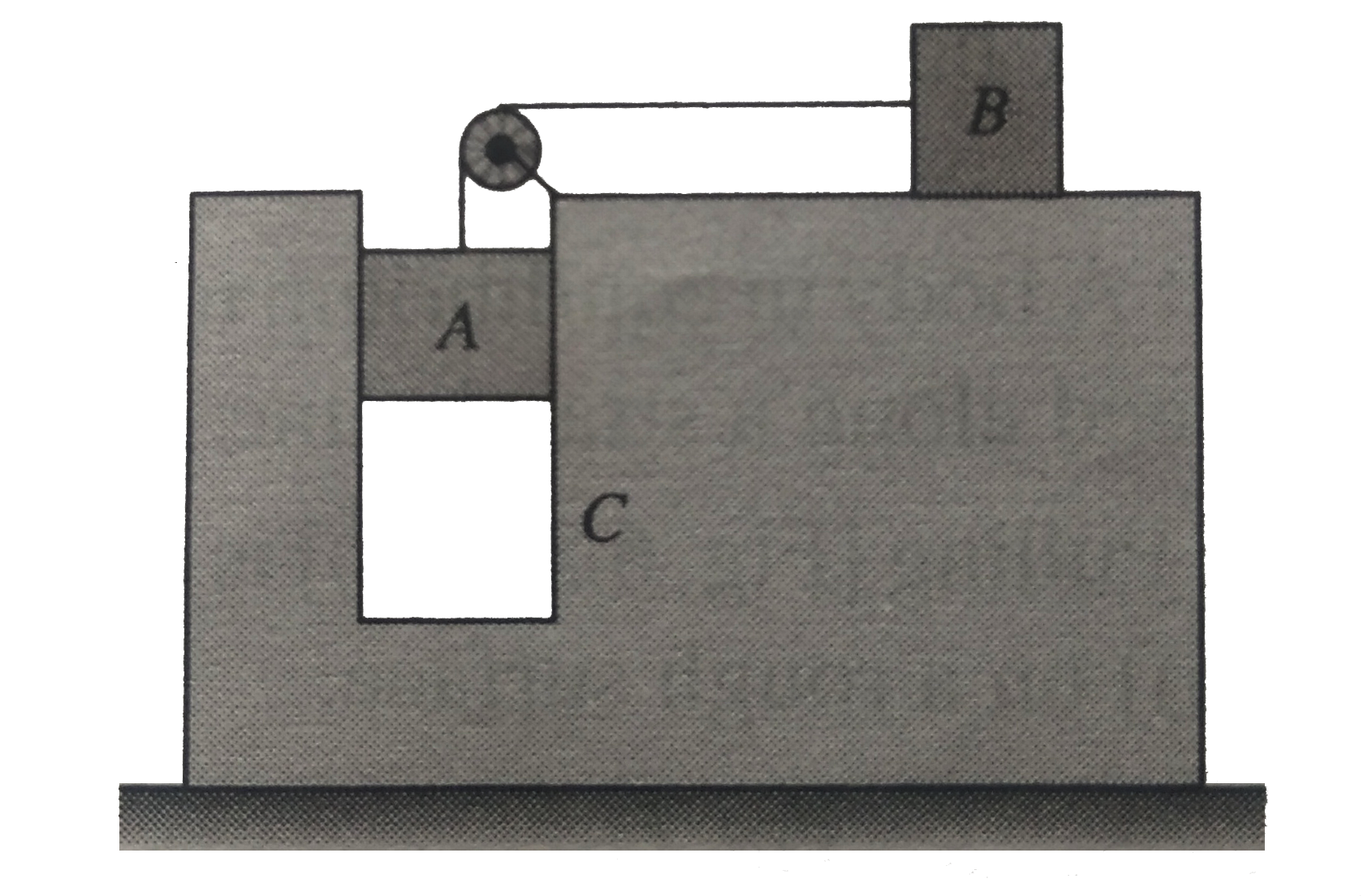
In the system shown in fig., `m_(A)=4m`, `m_(B)=3m`, and `m_(c)=8m`. Friction is absent everywhere. String is inextensible and light. If the system is released from rest, then

Acceleration of Block B is

Text Solution

Verified by Experts

The correct Answer is:
Vertical acceleration of `A=a=6.25ms^(-2)` (downwards) ; Horizontal acceleration of `A=c=1.25 ms^(-2)` (rightward) ; Acceleration of `B=(a-c)=5.00 ms^(-2) (leftward)` ; Acceleration of `C=c=1.25ms^(-2)` (rightward).

Let verically downward component of acceleration of A be a and let acceleration of C be c (rightward).
Then horizontal component of acceleration of A is c (rightward) and acceleration of B, relative to C is a (leftward). Hence, resultant acceleration of B is ,`(a-c)` leftward.
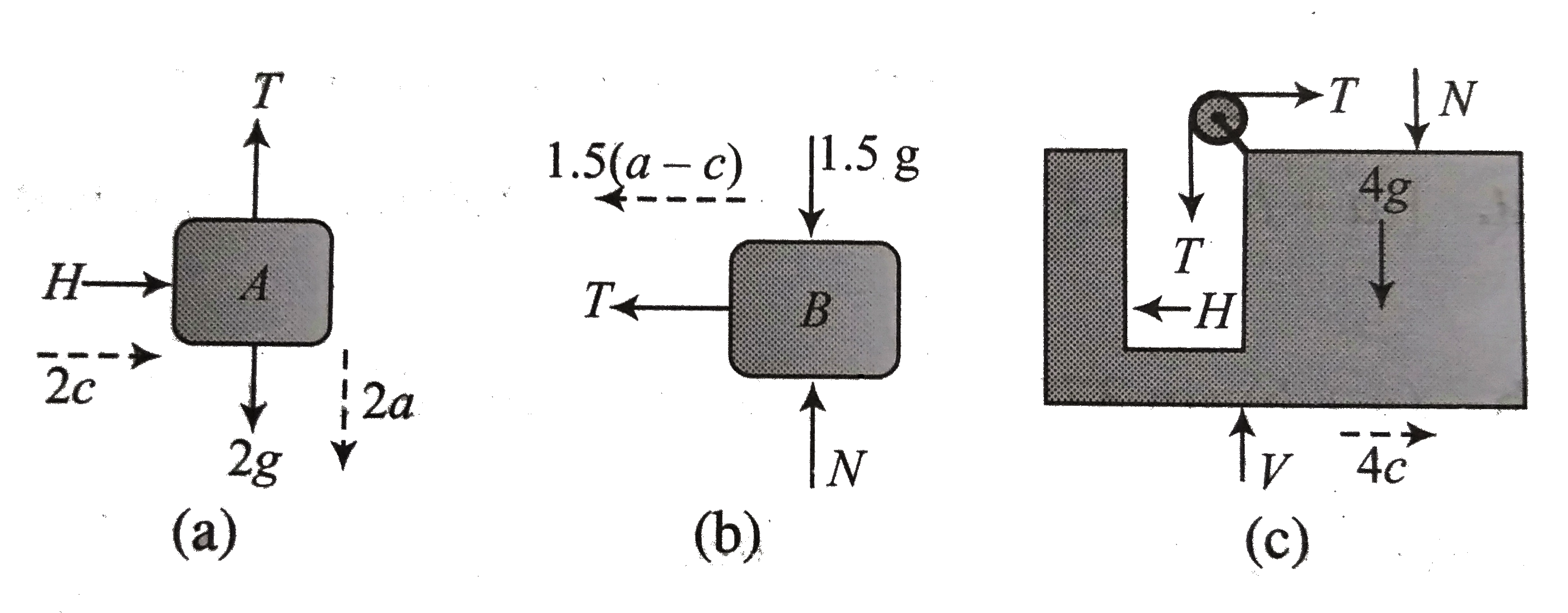
Now considering free body diagrams.

For block A,
`H=2c` ...(i)
`2g-T=2a` ..(ii)
For horizontal forces on block B,
`T=1.5(a-c)`...(iii)
For horizontal force on block C,
`T-H=4C` ..(iv)
From above equations,
`A=6.25 ms^(-2) and c=1.25 ms^(-2)`
Vertical acceleration of `A=a=6.25ms^(-2)` (downwards)
Horizontal acceleration of `A=c=1.25 ms^(-2)` (rightward)
Acceleration of `B=(a-c)=5.00 ms^(-2) ("leftward")`
Acceleration of `C=c=1.25ms^(-2)` (rightward).
Promotional Banner

Topper's Solved these Questions

  • NEWTON'S LAWS OF MOTION 1

    CENGAGE PHYSICS ENGLISH|Exercise Single Correct|75 Videos
  • NEWTON'S LAWS OF MOTION 1

    CENGAGE PHYSICS ENGLISH|Exercise Multiple Correct|11 Videos
  • NEWTON'S LAWS OF MOTION 1

    CENGAGE PHYSICS ENGLISH|Exercise Exercise 6.4|13 Videos
  • MISCELLANEOUS VOLUME 2

    CENGAGE PHYSICS ENGLISH|Exercise INTEGER_TYPE|10 Videos
  • NEWTON'S LAWS OF MOTION 2

    CENGAGE PHYSICS ENGLISH|Exercise Integer type|1 Videos

Similar Questions

Explore conceptually related problems

In the arrangement shown in the figure (m_(A))/(m_(B))=(2)/(3) and the ratio of density of block B and the liquid is 2:1 The system is released from rest. Then

In the system shown in fig. m_(1) gt m_(2) . The system is held at rest by thread BC. Now thread BC is burnt. Answer the following: Just after burning the thread, what is the acceleration of m_(2) ?

In the system shown in figure all surfaces are smooth. Strings is massless and inextensible.Find acceleration of the system and tension T in the string (g=10m//s^(2))

A block of mass m can slide freely in a slot made in a bigger of mass M as shown in fig. There is no friction anywhere in the system. The block m is connected to one end of a string whose other end is fixed at point P. system is released from rest when the string at P makes an angle theta with horizontal. Find the acceleration of m and M after release.

In the diagram shown, the block A and B are of the same mass M and the mass of the block C is (M_(1)) . Friction is present only under the block A. the whole system is suddenly released from the state of rest. The minimum coefficient of friction on block A to keep it in the state of rest is equal to .

Consider the situation shown in figure. Mass of block A is m and that of blcok B is 2m. The force constant of string is k. Friction is absent everywhere. System is released from rest with the spring unstretched. Find (a) The maximum extension of the spring x_(m) (b) The speed of block A when the extension in the springt is x=(x_(m))/(2) (c ) The net acceleration of block B when extension in the spring is x=(x_(m))/(4).

In the arrangement shown in Figure, m_A=2kg and m_B=1kg . String is light and inextensible. Find the acceleration of centre of mass of both the blocks. Neglect friction everywhere.

In the arrangement shown in Figure, m_A=2kg and m_B=1kg . String is light and inextensible. Find the acceleration of centre of mass of both the blocks. Neglect friction everywhere.

Block A of mass m and block B of mass 2m are placed on a fixed triangular wedge by means of a light and inextensible string and a frictionless pulley as shown in fig . The wedge is inclined at 45^(@) to the horizontal on both sides . The coefficient of friction between the block A and the wedge is 2//3 and that between the block B and the wedge is 1//3 .If the system of A and B is released from rest then find . a. the acceleration of A b. tension in the string c.the magnitude and direction of the frictional force acting on A

For the system shown in fog. m_(1) gt m_(2) gtm_(3) gt m_(4) . Initially, the system is at rest in equilibrium condition., if the string joining m_(4) and ground is cut, then just after the string is cut. Statement I: m_(1), m_(2), m_(3) remain stationary. Statement II: The value of acceleration of all the four blocks can be determined. Statement III: Only m_(4) remain stationary. Statement IV: Only m_(4) accelerates.

