Home
Class 11
PHYSICS
Two uniform solid cylinders A and B each...

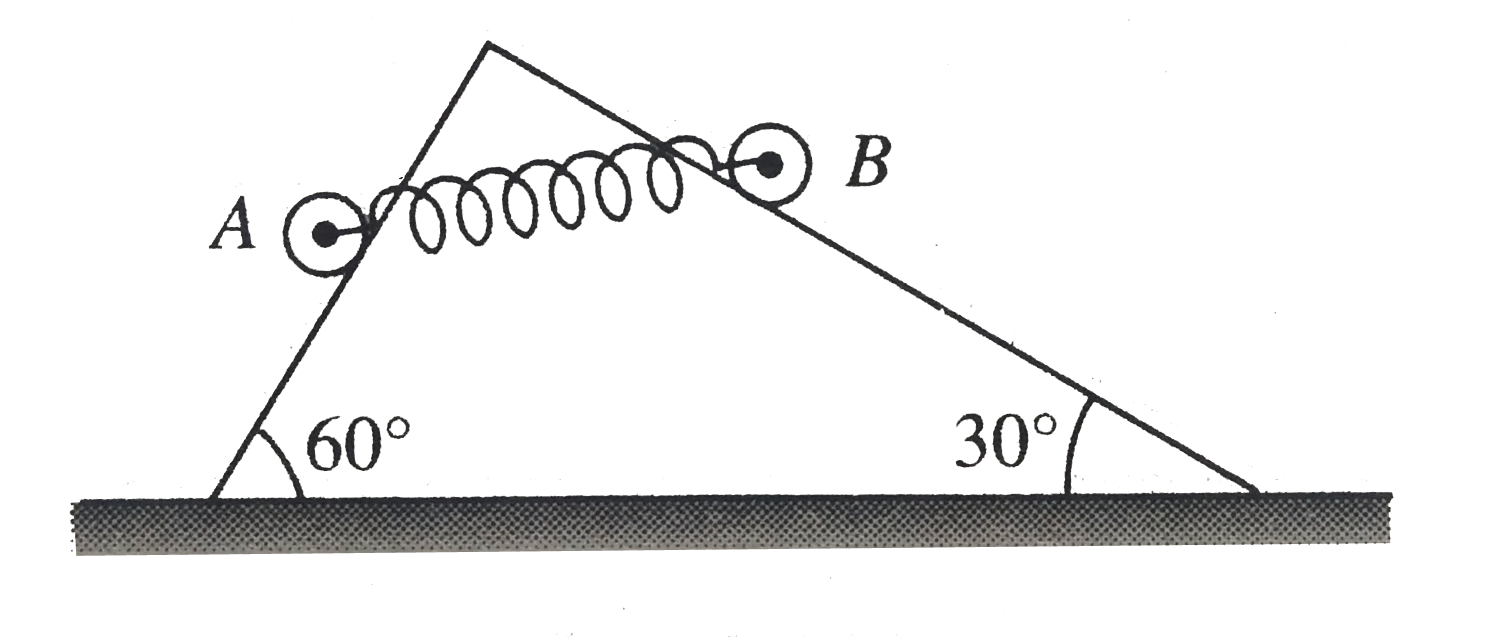
Two uniform solid cylinders A and B each of mass 1 kg are connected by a spring of constant `200Nm^(-1)` at their axles and are placed on a fixed wedge as shown in fig.There is no friction between cylinders and wedge. The angle made by the line AB with the horizontal, in equilibirum is

A

`0^(@)`

B

`15^(@)`

C

`30^(@)`

D

None of these

Text Solution

Verified by Experts

The correct Answer is:
C

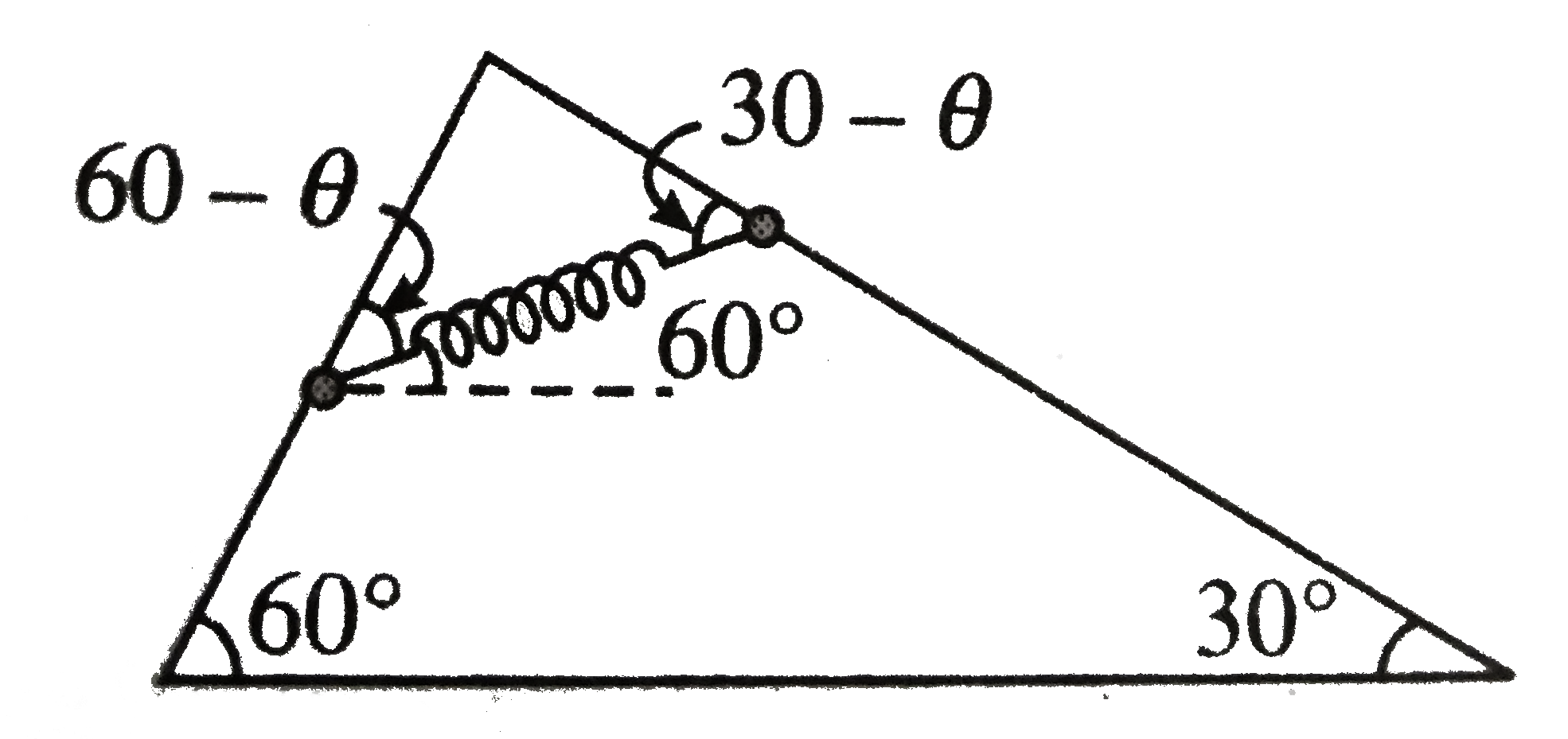
In equlibrium, if `theta` is the required angle
Cylinder A:
`mg sin 60^(@)=kx cos (60^(@)-theta)`
Cylinder B:
`mg sin 30^(@) = kx cos (30^(@)+theta)`
`=kx sin (60^(@)-theta)` on solving `theta=30^(@)`.
Promotional Banner

Topper's Solved these Questions

  • NEWTON'S LAWS OF MOTION 1

    CENGAGE PHYSICS ENGLISH|Exercise Multiple Correct|11 Videos
  • NEWTON'S LAWS OF MOTION 1

    CENGAGE PHYSICS ENGLISH|Exercise Assertion-reasoning|15 Videos
  • NEWTON'S LAWS OF MOTION 1

    CENGAGE PHYSICS ENGLISH|Exercise Subjective|15 Videos
  • MISCELLANEOUS VOLUME 2

    CENGAGE PHYSICS ENGLISH|Exercise INTEGER_TYPE|10 Videos
  • NEWTON'S LAWS OF MOTION 2

    CENGAGE PHYSICS ENGLISH|Exercise Integer type|1 Videos

Similar Questions

Explore conceptually related problems

Two blocks A and B of masses 5 kg and 2 kg respectively connected by a spring of force constant = 100Nm^(-1) are placed on an inclined plane of inclined 30^(@) as shown in figure If the system is released from rest

Two wedges, each of mass m , are placed next to each other on a flat horizontal floor. A cube of mass M is balanced on the wedges as shown in figure. Assume no friction between the cube and the wedges, but a coefficent of static friction mult1 between the wedges and the floor. What is the largest M that can be balanced as shown without motion of the wedges ?

A mass of 1.5 kg is connected to two identical springs each of force constant 300 Nm^(-1) as shown in the figure. If the mass is displaced from its equilibrium position by 10 cm, then maximum speed of the trolley is

A uniform plank of mass m, free to move in the horizontal direction only , is placed at the top of a solid cylinder of mass 2 m and radius R. The plank is attached to a fixed wall by mean of a light spring constant k. There is no slipping between the cylinder and the planck , and between the cylinder and the ground. Find the time period of small oscillation of the system.

A uniform solid. cylinder A of mass can freely rotate about a horizontal axis fixed to a mount of mass m_(2) . A constant horizontal force F is applied to the end K of a light thread tightly wound on the cylinder. The friction between the mount and the supporting horizontal plane is assumed to be absent. Find the acceleration of the point K .

Two blocks A and B of equal mass m are connected through a massless string and arranged as shown in figure. The wedge is fixed on horizontal surface. Friction is absent everwhere. When the system is released from rest.

Two blocks A and B of equal mass m are connected through a massless string and arranged as shown in figure. The wedge is fixed on horizontal surface. Friction is absent everwhere. When the system is released from rest.

A mass of 1.5 kg is connected to two identical springs each of force constant 300 Nm^(-1) as shown in the figure. If the mass is displaced from its equilibrium position by 10cm, then the period of oscillation is

A horizontal uniform rod of mass 'm' has its left end hinged to the fixed incline plane, while its right end rrests on the top of a uniform cylinder of mass 'm' which in turn is at rest on the fixed inclined plane as shown. The coefficient of friction between the cylinder and rod, and between the cylinder and inclined plane, is sufficient to keep the cylinder at rest. The magnitude of normal reaction exerted by the inclinded plane on the cylinder is :

A horizontal uniform rod of mass 'm' has its left end hinged to the fixed incline plane, while its right end rrests on the top of a uniform cylinder of mass 'm' which in turn is at rest on the fixed inclined plane as shown. The coefficient of friction between the cylinder and rod, and between the cylinder and inclined plane, is sufficient to keep the cylinder at rest. The magnitude of normal reaction exerted by the rod on the cylinder is

CENGAGE PHYSICS ENGLISH-NEWTON'S LAWS OF MOTION 1-Single Correct
  1. A block of 5 kg is resting on a frictionaless plane. It is struck by a...

    Text Solution

    |

  2. An ideal liquid of density rho is pushed with velocity v through the c...

    Text Solution

    |

  3. Two uniform solid cylinders A and B each of mass 1 kg are connected by...

    Text Solution

    |

  4. The velocity of point A on the rod is 2ms^(-1) (leftwards) at the inst...

    Text Solution

    |

  5. Two small rings O and O' are put on two vertical stationary rods AB an...

    Text Solution

    |

  6. A U-shaped smooth wire has a semi-circular bending between A and B as ...

    Text Solution

    |

  7. Two identicle particles A and B, each of mass m, are interconnected by...

    Text Solution

    |

  8. The system shown in fig is in equilibrium . Masses m(1) and m(2) are 2...

    Text Solution

    |

  9. In fig. the block of mass M is at rest on the floor . At what accelera...

    Text Solution

    |

  10. A block of mass m(1) lies on the top of fixed wedge as shown in fig. a...

    Text Solution

    |

  11. In the situation shown in fig., all the strings are light and inextens...

    Text Solution

    |

  12. In fig., a person wants to rise a block lying on the ground to a heigh...

    Text Solution

    |

  13. A wooden box is placed on a table. The normal force on the box from th...

    Text Solution

    |

  14. In the arrangement shown in fig., if the acceleration of B is vec(a). ...

    Text Solution

    |

  15. If the acceleration of wedge in the shown arrangement is a ms^(-2) tow...

    Text Solution

    |

  16. In the arrangement shown in fig., at a particular instant, the roller ...

    Text Solution

    |

  17. A particle of mass 2kg moves with an initial velocity of vec(v)=4hat(i...

    Text Solution

    |

  18. Which is the defect represented by the given figure ?

    Text Solution

    |

  19. A small, light pulley is attached with a block C of mass 4 kg as shown...

    Text Solution

    |

  20. A particle is moving in the x-y plane. At certain instant of time, the...

    Text Solution

    |

